
Getting paid to review music online is real, and the barrier to entry is lower than most people assume. Sign up to a platform like Music Feedback Pro as a verified curator, browse active artist campaigns, submit a review proposal, deliver substantive written feedback, and receive payment via escrow once your work is accepted. Earnings range from a few pounds or dollars per review on entry-level platforms up to a genuine side income for curators who build a track record and a niche.
This guide covers every major platform, every realistic earning range, and every step you need to go from music fan to paid music reviewer.
What "Getting Paid to Review Music" Actually Means
Paid music reviewing means writing honest, substantive critiques of songs, albums, or artist releases and earning money directly from platforms or artists for that work. It is not clicking a button to confirm you heard a 30-second clip. It is not earning fractions of a penny from a gamified listening app.
Real music critic jobs require thought, craft, and genuine engagement with the music.
Written Reviews vs. Listening-Only Platforms
There is a meaningful gap between platforms that pay for written critique and apps that pay micro-amounts for passive listening. Written review platforms - Music Feedback Pro, SubmitHub, and Groover - expect you to listen carefully and then produce a review an artist can actually use: editorial feedback, a published blog feature, or a playlist placement with a written rationale. Listening-only apps ask you to rate tracks in seconds and pay pennies per session. The income difference between the two is substantial, and so is the professional value.
If you want to understand that distinction before going further, the get paid to listen to music page on Music Feedback Pro explains both sides clearly.
Why Music Reviewers Are in Demand in 2026
Independent music releases have exploded. According to the IFPI Global Music Report, digital distribution has made it easier than ever for artists to release music, which means competition for listener attention is fierce. Independent artists need credible reviews to cut through the noise - someone who can articulate what their music does well, describe its mood and genre context, and give potential fans a reason to click play. That demand is what creates the paid reviewer economy.
How Much Can You Earn Reviewing Music Online?
Let's be honest about this from the start. Music reviewing is rarely a route to overnight wealth, but it is a legitimate and growing side income that compounds as your reputation builds.
Realistic Earnings Per Review
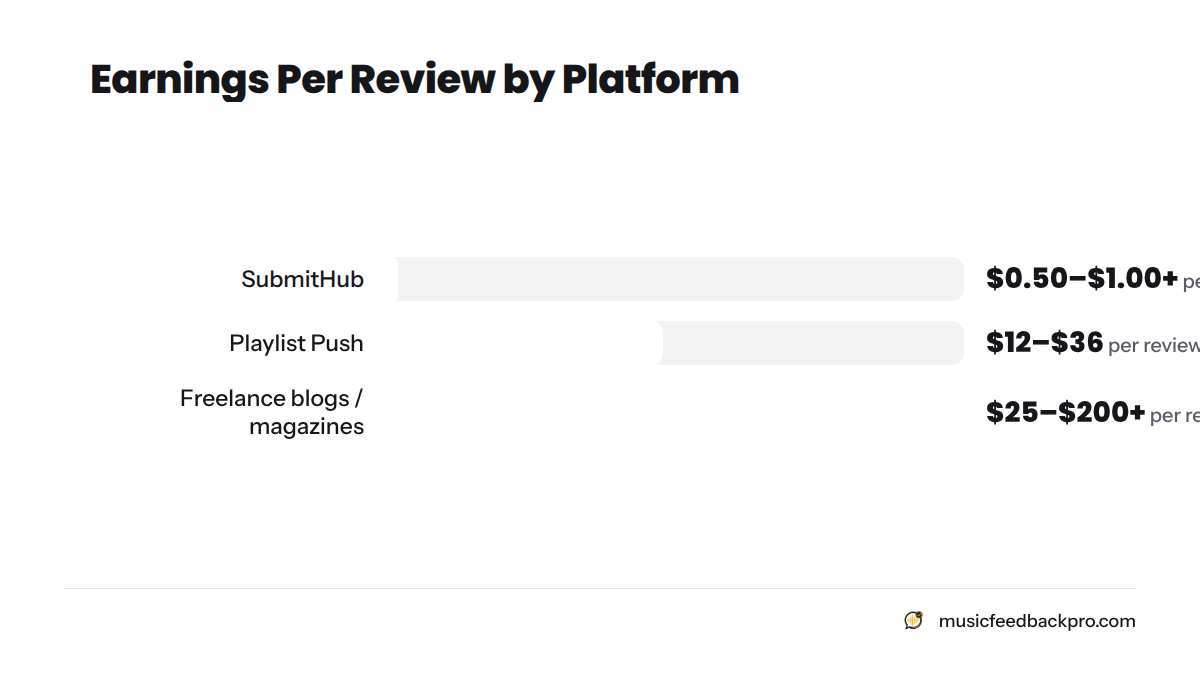
On Music Feedback Pro, artists pay £15 per campaign, and curators receive payment through an escrow model tied to delivered, approved reviews. On SubmitHub, curators earn credits that convert to cash - typically small per-review amounts that grow with volume and acceptance rate. On Groover, curators are paid in credits with cash-out options at rates that vary by curator profile.
| Platform | Pay Model | Earnings Per Review | Payment Method | Best For |
|---|---|---|---|---|
| Music Feedback Pro | Campaign-based escrow | Competitive per-review rate, scales with reputation | Secure escrow release | Curators wanting real income and verified campaigns |
| SubmitHub | Credit system | $0.50-$1.00+ per accepted review | PayPal | Bloggers and playlist curators |
| Groover | Credit system | Variable, based on curator tier | Groover credits / withdrawal | High-volume curators across genres |
| Playlist Push | Campaign fees | $12-$36 per playlist placement review | Direct payment | Playlist curators with existing followings |
| Freelance (blogs/magazines) | Per-article or per-word | $25-$200+ per feature | Bank transfer / PayPal | Experienced music writers |
Part-Time vs. Full-Time Income Potential
A new reviewer completing five to ten reviews per month earns a modest supplementary income. A dedicated curator who manages their profile well, builds a strong acceptance rate, and specialises in a genre can push that into consistent side-income territory within three to six months. Full-time music criticism at publications like Pitchfork involves salaried roles that are competitive and require a strong portfolio. The campaign-based model on platforms like Music Feedback Pro offers a parallel, accessible path that does not require a media credential to begin.
According to the U.S. Bureau of Labor Statistics, the median annual wage for writers and authors in the United States sits around $73,150 - though that figure spans the full spectrum from commercial copywriters to literary authors. Independent music reviewer income through freelance or platform-based models varies widely depending on output, platform, and specialisation.
What Drives Reviewer Earnings
Three factors matter more than anything else:
- Acceptance rate - Platforms reward curators who deliver reviews artists find useful. A high acceptance rate unlocks better campaign visibility and higher-tier opportunities.
- Genre specialisation - Curators who own a niche - Jazz, Folk, Metal, for example - are rarer and more sought-after than generalists.
- Review quality and length - Platforms that pay more per review consistently require longer, more detailed critique. A 50-word pass is not worth the same as a 300-word editorial.
The Best Online Music Review Platforms in 2026
Here is a breakdown of the leading options for anyone looking for music review jobs online right now.
Music Feedback Pro - How the Curator Model Works
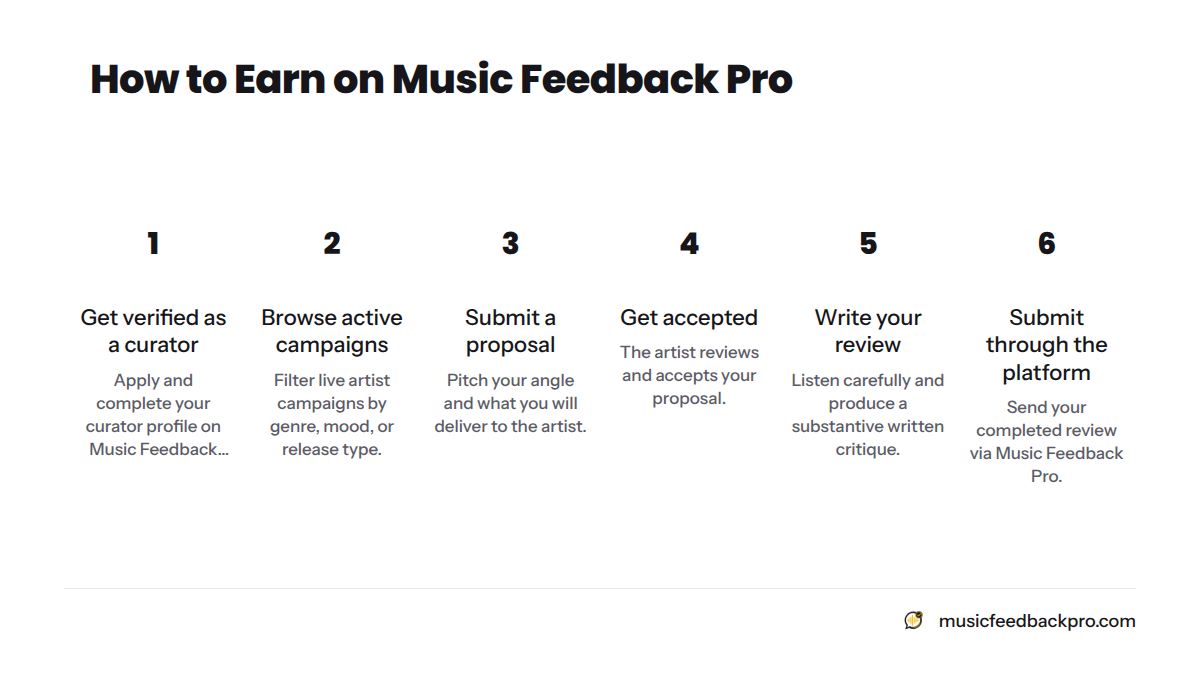
Music Feedback Pro is the strongest option for reviewers who want a structured, fair, and secure framework. Independent artists pay £15 to launch a 30-day campaign. Curators browse live campaigns, submit proposals for the ones that match their taste and genre expertise, and deliver written reviews once accepted. Payment is held in escrow and released upon successful review delivery - protecting both sides and making the income reliable.
How a curator earns money on Music Feedback Pro:
- Apply and get verified as a curator
- Browse active artist campaigns filtered by genre, mood, or release type
- Submit a proposal explaining your angle and what you will deliver
- Receive campaign acceptance from the artist
- Listen carefully and write a substantive review
- Submit your review through the platform
- Escrow payment releases once the review is approved
The platform covers genres from Hip-Hop and R&B through Jazz, Folk, Metal, Electronic, and beyond. Curators are not limited to a single genre, but those who build a reputation in a specific area get more consistent campaign matches. The full breakdown of how it works is published directly on the Music Feedback Pro site.
Ready to start? Apply to review music and join the curator network today.
SubmitHub - What Reviewers Need to Know
SubmitHub is one of the most established music feedback platforms available. Bloggers, playlist curators, and radio stations create profiles, and artists pay credits to submit tracks directly to them. Curators earn credits for every review completed within a 48-hour window, which can be withdrawn as cash via PayPal. The platform rewards curators with a Premium label as their profile builds. The downside: per-review earnings at entry level are relatively low, and the volume required to earn meaningfully can feel relentless.
For a broader comparison of the best music feedback platforms, Music Feedback Pro's blog covers several options with honest analysis.
Groover - Opportunities for Curators
Groover works similarly to SubmitHub but with a European origin and a strong roster of curators - bloggers, playlist managers, radio hosts, and music journalists. Artists pay Groover credits to pitch tracks to curators, who earn credits per review and can convert them to cash withdrawals. Groover's quality bar is relatively high: curators must respond to every submission within seven days with genuine written feedback. It is a credible option, particularly for those with a European or international music focus.
Playlist Push - Is It Right for You?
Playlist Push focuses specifically on Spotify playlist curators. If you manage a playlist with a genuine, engaged following, artists pay campaign fees for playlist consideration, and curators earn per placement - roughly $12 to $36 per submission. Those are among the higher per-review rates in the platform-based model. The catch is that Playlist Push requires curators to already manage an established Spotify playlist with real listeners. It is not a starting point for beginners, but it is a strong income stream once you have built a playlist audience.
Freelance Music Writing - Pitching to Blogs and Magazines
Beyond dedicated platforms, freelance music writing for established blogs and magazines remains a legitimate path. Publications like AllMusic set the standard for encyclopaedic music writing. Pitching to music blogs, independent zines, or genre-specific magazines can yield per-article fees anywhere from $25 for smaller blogs to $200 or more for established publications. This route requires the most developed writing portfolio and the most outreach effort, but it also carries the most professional credibility for those building toward music journalism as a career. The best music feedback sites guide on Music Feedback Pro covers where this kind of work intersects with platform-based reviewing.
What Skills Do You Actually Need?
You do not need a music degree. You do not need twenty years on an instrument. What you need is writing ability, genuine musical engagement, and the discipline to deliver feedback that is genuinely useful.
What Platforms and Artists Expect From Your Writing
Clear, specific, descriptive writing is non-negotiable. Saying a song "sounds good" tells an artist nothing. Saying "the kick drum sits slightly forward in the mix, which works well for the track's aggressive energy, though it risks overpowering the vocal in the chorus" gives them something actionable. Artists and platforms want precise language, honest assessment, and contextual awareness - reviewers who can place a track within a genre, reference comparable artists, and describe the listening experience in a way potential fans would recognise.
The what is a music reviewer guide covers roles, types, and music blog reviewer pay in one clear resource.
Musical Knowledge vs. Writing Quality
Writing quality wins. A skilled writer who listens attentively and describes music accurately will outperform a music theory expert who writes in jargon. That said, the strongest independent music reviewers combine both. Musical knowledge helps you describe arrangement choices, genre conventions, and production decisions intelligently. Writing skill makes those observations accessible and engaging. If you have to prioritise one, prioritise clear writing.
Should You Specialise in a Genre?
Yes - and sooner rather than later. Curators who specialise in a specific genre build a recognisable profile faster. Artists releasing Jazz records want a Jazz-literate reviewer, not a generalist who happened to browse their campaign. Platforms like Music Feedback Pro match campaigns partly on genre fit, so a strong genre profile increases your campaign match rate and your earning potential over time.
Self-Assessment: Are You Ready to Get Paid as a Music Reviewer?
- I can write clearly and specifically about music without resorting to vague compliments
- I listen from multiple angles: production, lyrics, arrangement, mood, genre context
- I can deliver honest feedback even when I personally dislike a track
- I have at least one or two genres I know well enough to write with authority
- I can commit to a review turnaround time and hit deadlines consistently
- I understand the difference between personal taste and objective craft
- I am comfortable writing 150-400 words of structured critique per track
Five or more ticked? You are ready to start.
How to Write a Music Review That Gets Accepted
A rejected review does not earn money. Here is what separates reviews that get approved from ones that do not.
Structure of a Strong Music Review
Every effective music review has three working parts:
- Context - What kind of track is this? What genre does it sit in? Who does it sound like, and where does the artist seem to be positioning themselves?
- Craft assessment - How is the production? Are the vocals compelling? Does the arrangement serve the song? What works, and what could be stronger?
- Listener recommendation - Who is this for? What mood does it suit? Would you add it to a playlist, and if so, which one?
A review covering all three parts in 200-350 words gives an artist something genuinely useful and gives a platform proof that you listened and thought carefully.
What Artists Actually Want
Most independent artists submitting to platforms like Music Feedback Pro are not looking for a takedown. They want honest, constructive feedback they can use to improve their music or their marketing narrative. The worst review is not a negative one - it is a vague one. "Nice track, keep it up" is worthless. A review that acknowledges specific creative decisions, even while noting where something falls short, shows genuine engagement and gets accepted far more often.
Common Mistakes That Get Reviews Rejected
- Writing fewer words than the platform requires
- Making factually wrong claims - misidentifying a genre or an instrument
- Reviewing a different track than the one submitted
- Using stock phrases that could apply to any song
- Being gratuitously harsh without constructive framing
- Copying language from another review source
How to Get Started on Music Feedback Pro as a Curator
Here is the exact process for becoming a music curator on Music Feedback Pro.
Step 1 - Apply to Become a Verified Curator
Visit the Music Feedback Pro reviewer application page and complete your curator profile. You will describe your genre expertise, your reviewing experience (no formal experience is required for beginners), and the type of feedback you plan to offer. Music Feedback Pro verifies curators to maintain the quality of reviews artists receive.
Step 2 - Browse Active Artist Campaigns
Once approved, you gain access to the campaign dashboard. Filter campaigns by genre, release type, and other criteria. Each campaign shows the artist's brief, the track details, and the kind of feedback they are seeking.
Step 3 - Submit an Offer Proposal
When you find a campaign that fits your expertise, submit a proposal - your pitch to the artist outlining what you will deliver, the format of your review, and your relevant background. Think of it as a brief cover note. Specific, well-framed proposals get accepted far more often than generic ones.
Step 4 - Deliver Your Review and Get Paid via Escrow
Once the artist accepts your proposal, listen to the track, write your review, and submit it through the platform. The artist's payment is held in escrow throughout. Once your review is delivered and approved, the escrow releases and you receive your payment. The escrow model protects both sides - it is the right way to run this kind of marketplace.
Apply now: Join Music Feedback Pro as a reviewer and start browsing live campaigns from independent artists today.
Building Your Music Reviewing Career Over Time
The first review is the hardest. After that, the path is about consistency and profile-building.
Building a Review Portfolio From Scratch
Every review you complete becomes part of your portfolio. Even if you start on a platform that pays modestly, the body of work you accumulate proves to future platforms, artists, and editors that you can do this work. Save copies of every approved review. Build a simple personal blog or portfolio page where your best writing is visible. Over time, that becomes your credential.
Growing Your Reviewer Profile and Reputation
Platforms like Music Feedback Pro track your acceptance rate, your response time, and artist feedback on your reviews. A consistently high-quality profile means more campaign invitations, better genre matches, and stronger income potential. Think of your reviewer profile the way a freelancer thinks of their client rating: protect it by only accepting campaigns you can do justice to, and always delivering exactly what you promised.
The how to become a music curator guide on the Music Feedback Pro blog goes deeper on profile-building strategy.
Turning Reviews Into Consistent Side Income
Consistency is the engine of side income. A reviewer who completes eight to twelve reviews per month, maintains a strong acceptance rate, and gradually expands to two or three platforms can build a meaningful supplementary income within six months. The key is treating it like a professional discipline rather than a casual hobby.
When Music Reviewing Becomes a Full-Time Career
Full-time income from reviewing alone is achievable but takes time. The realistic path combines platform-based reviewing with freelance pitching to music blogs and magazines, building an audience through your own publication - blog, newsletter, or social media - and eventually attracting sponsorship, affiliate income, or editorial staff positions. Reviewers who make the leap to full-time typically do so after two to three years of consistent, quality output. The professional music review career guide on Music Feedback Pro covers this progression honestly.
Avoiding Scams - Legitimate Platforms vs. "Get Paid to Listen" Schemes
Warning: Getting paid pennies to "listen" to tracks on apps is not the same as earning real income from substantive reviews. Know the difference before you invest your time.
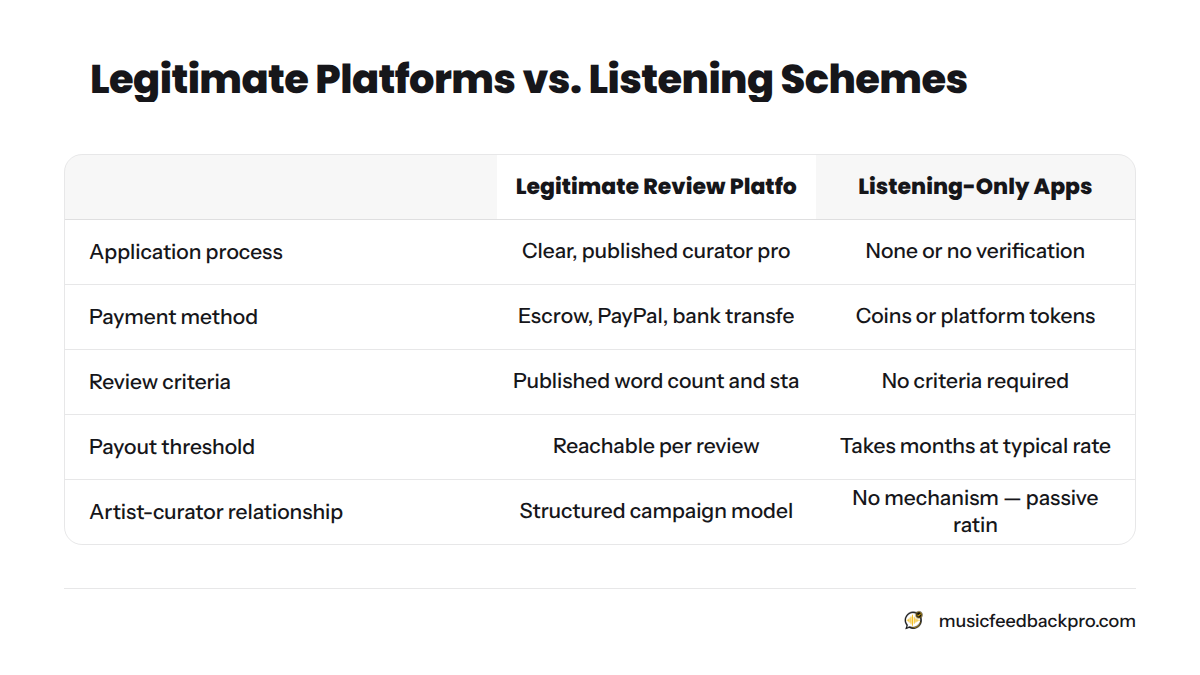
Most apps that advertise "get paid to listen to music" pay micro-amounts that rarely reach minimum payout thresholds. They are designed to keep you engaged, not to compensate you fairly. If an app promises hundreds of dollars a week just for pressing play on songs, it is not offering you a music career.
Red Flags to Watch For
- No published review criteria or word count requirements
- Payment in "coins" or platform-specific tokens with no clear withdrawal pathway
- Promises of high hourly rates for passive listening
- No mechanism for artist-curator relationship - just passive rating
- No verification or onboarding process for reviewers
- Payout thresholds that take months to reach at typical earning rates
How to Verify a Platform Is Legitimate
Legitimate paid review platforms share several traits: a clear, published curator application process; openly disclosed payment models; secure payment methods (escrow, PayPal, bank transfer); a verifiable track record of artist campaigns; and quality standards for reviews you can check before applying. Music Feedback Pro publishes its model publicly. SubmitHub and Groover both have transparent payout structures. Playlist Push discloses its criteria for curator qualification. Any platform that cannot clearly answer "how and when do you pay curators?" is not worth your time.
Frequently Asked Questions About Getting Paid to Review Music Online
Which app pays real money for listening to music?
Most apps that claim to pay you for listening to music pay very little - often fractions of a penny per track - and many have minimum payout thresholds that are difficult to reach. Platforms that pay meaningful rates, such as Music Feedback Pro, SubmitHub, and Groover, require written reviews rather than passive listening. If you want real money, shift your focus from listening apps to review platforms.
Does Playlist Push really pay reviewers?
Yes. Playlist Push pays Spotify playlist curators for reviewing and considering tracks for placement. Curators typically earn between $12 and $36 per submission reviewed, depending on their playlist size and engagement metrics. The platform is legitimate, but it requires you to already manage an active, listener-verified Spotify playlist. It is not accessible to complete beginners without an existing playlist audience.
Can I get paid to review music on Spotify?
Spotify itself does not pay listeners or curators for reviewing music. Spotify's payment model compensates rights holders - primarily labels and distributors - based on stream counts, not on reviews or editorial curation by external parties. If you want to earn money for music curation connected to Spotify, Playlist Push is the closest legitimate path, but you earn from Playlist Push's campaign model, not directly from Spotify.
How much does a music reviewer earn per review?
It varies widely by platform and reviewer experience. On Music Feedback Pro, earnings are tied to the campaign escrow model, with curators receiving payment per accepted review within a structured framework. On SubmitHub, early-stage curators earn roughly $0.50 to $1.00 per accepted review. On Playlist Push, placements pay $12 to $36 per review. Freelance music writers pitching to independent blogs and magazines can earn $25 to $200+ per article. The ceiling rises as your reputation and portfolio grow.
Do I need qualifications to become a paid music reviewer?
No formal qualifications are required on any of the major review platforms. Music Feedback Pro, SubmitHub, Groover, and Playlist Push all assess curators on the quality of their reviews and the credibility of their profile, not on academic credentials. What matters is the ability to write clearly, listen analytically, and deliver feedback that artists and platforms find genuinely useful.
Can beginners get paid to review music?
Yes. Music Feedback Pro accepts curator applications from beginners, provided they can demonstrate a genuine ability to write thoughtful, specific feedback. SubmitHub also accepts bloggers and curators without a long track record, though building your profile to a premium tier takes time. Starting without experience is entirely possible. The best strategy is to apply with a strong sample review that showcases your voice and analytical ability.
Is getting paid to review music a legitimate job?
Music critique has been a recognised profession for decades - from print publications like Rolling Stone to digital outlets like Pitchfork and AllMusic. The platform-based model is a newer, more accessible layer of the same ecosystem, where independent artists pay for access to curators and reviewers who give their music genuine attention. The income may start small, but the work is real, the payment structures are transparent on legitimate platforms, and the professional value compounds over time.