
Independent artists can run music PR campaigns without a label or large budget by submitting a strong brief, bio, and press kit to vetted critics through Music Feedback Pro. Submitting is free. You pay £15 only after editorial approval. No playlists. No guarantees. Real written reviews and press coverage from hand-picked critics matched to your genre.
→ Start your free campaign submission - no charge until approval
What a Music PR Campaign Actually Means for an Independent Artist
A music PR campaign is a structured plan that uses press outreach, written reviews, and blog features to generate credible coverage for a release. For independent artists, that means identifying the right critics, preparing a strong press kit and campaign brief, and pitching to media outlets - all without a label or agency behind you.
PR vs. Marketing - What the Difference Means for Your Budget
Music marketing pushes content outward: ads, social posts, playlist placements, streaming metrics. Music public relations builds credibility through the press: a critic reads your work, forms an opinion, and publishes a review under their name. That distinction has real budget consequences.
Marketing spend stops working the moment you stop paying. A published review stays indexed, shareable, and quotable for the life of your career.
Affordable music PR does not require ad impressions or platform credits. It requires time, preparation, and the right submission process.
What a Campaign Actually Produces
The deliverables of a music PR campaign are concrete and reusable. Think long-form written reviews, blog features, genre-specific critic opinions, and press quotes you can place on your website, in your Electronic Press Kit, on streaming profiles, and in future campaign materials. These are press assets - not vanity metrics that reset each quarter.
Why Independent Artists Struggle to Get Press Without a Label
The access problem is real, and it has nothing to do with talent.
Critics, Contacts, and Cold Outreach
Music critics receive hundreds of unsolicited submissions each week. Without an existing relationship or a credible intermediary, most cold outreach from independent artists gets filtered out before anyone reads it. Labels solve this by maintaining long-term relationships with editors, assigning dedicated publicists, and packaging submissions in formats critics already trust. Solo artists rarely have any of those things.
Cold emailing a list of music blogs is not a campaign. It is noise.
What Labels Provide That Indie Artists Must Replace
Labels supply four things that press coverage depends on: a credible intermediary (the publicist), a formatted press kit, a campaign brief written to editorial standards, and timing. Music Feedback Pro's model replaces all four. The editorial team vets every submission before it reaches a critic, so the critic already knows the campaign meets a minimum standard. That vetting is what turns a cold submission into something closer to a warm introduction.
What Music Feedback Pro's Submission Data Shows About Winning Campaigns
This is not generic advice. The patterns below come from the Music Feedback Pro editorial team's experience approving and rejecting campaigns across thousands of submissions.
The Elements That Earn Editorial Approval
Campaigns that reach critics consistently share the same traits. The brief names a specific audience - not "everyone who likes music," but a genre, a mood, a comparable artist. The bio tells a story without reading like a press release. The music link works immediately on click. The release date is stated clearly, and the campaign window is realistic.
The Patterns That Lead to Rejection
Here is what causes rejection most often:
| Campaign element | Approved pattern | Rejected pattern |
|---|---|---|
| Campaign brief | Specific goals, named target audience, clear release window | One line: "I want more people to hear my music" |
| Artist bio | 100-200 words, narrative arc, honest influences | Copy-pasted social media bio or press-release boilerplate |
| Music link | Active, genre-tagged, full track accessible | Broken link, private SoundCloud, or incomplete EP |
| Press kit | Bio, photo, music link, release date, genre | Missing photo, missing release date, or no prior coverage section |
| Genre fit | Matches the curator pool Music Feedback Pro can serve | Genre mislabelled or too vague to match a critic |
If your submission looks like the right column, it will not reach a critic. No exceptions.
How to Build a Press Kit That Gets Approved
A press kit - sometimes called an EPK - is not a folder of files. It is a structured argument for why a critic should spend time with your music. Build it before you submit.
What Your Press Kit Must Include
- Artist bio - 100 to 200 words, written in third person, with a clear narrative (not a list of achievements)
- High-resolution press photo - at minimum 1,200px wide, no collages or selfies
- Music link - a streaming or download link that is publicly accessible and genre-tagged
- Release date - specific day, month, and year; "coming soon" is not acceptable
- Genre - be precise; "indie" alone is not a genre for the purposes of critic matching
- Previous press coverage - links to any existing reviews, even small blogs; leave blank if none exist (do not fabricate)
- Campaign brief - a short statement of goals, target audience, and what you want critics to respond to
Common Press Kit Mistakes
The most frequent mistake is treating the bio as a promotional paragraph. Critics are not your fans yet. Write it as if you are introducing yourself to a stranger who is paid to be skeptical. The second most common mistake is a broken or private music link - the editorial team cannot approve what it cannot hear.
If you want to understand how music press coverage works as a career tool, read that before you build your kit.
Pre-Release vs. Post-Release: What the Editorial Team Observes
Timing is one of the least-discussed variables in independent music PR, and it changes what critics can do with your campaign.
Why Timing Affects Coverage Quality and Critic Interest
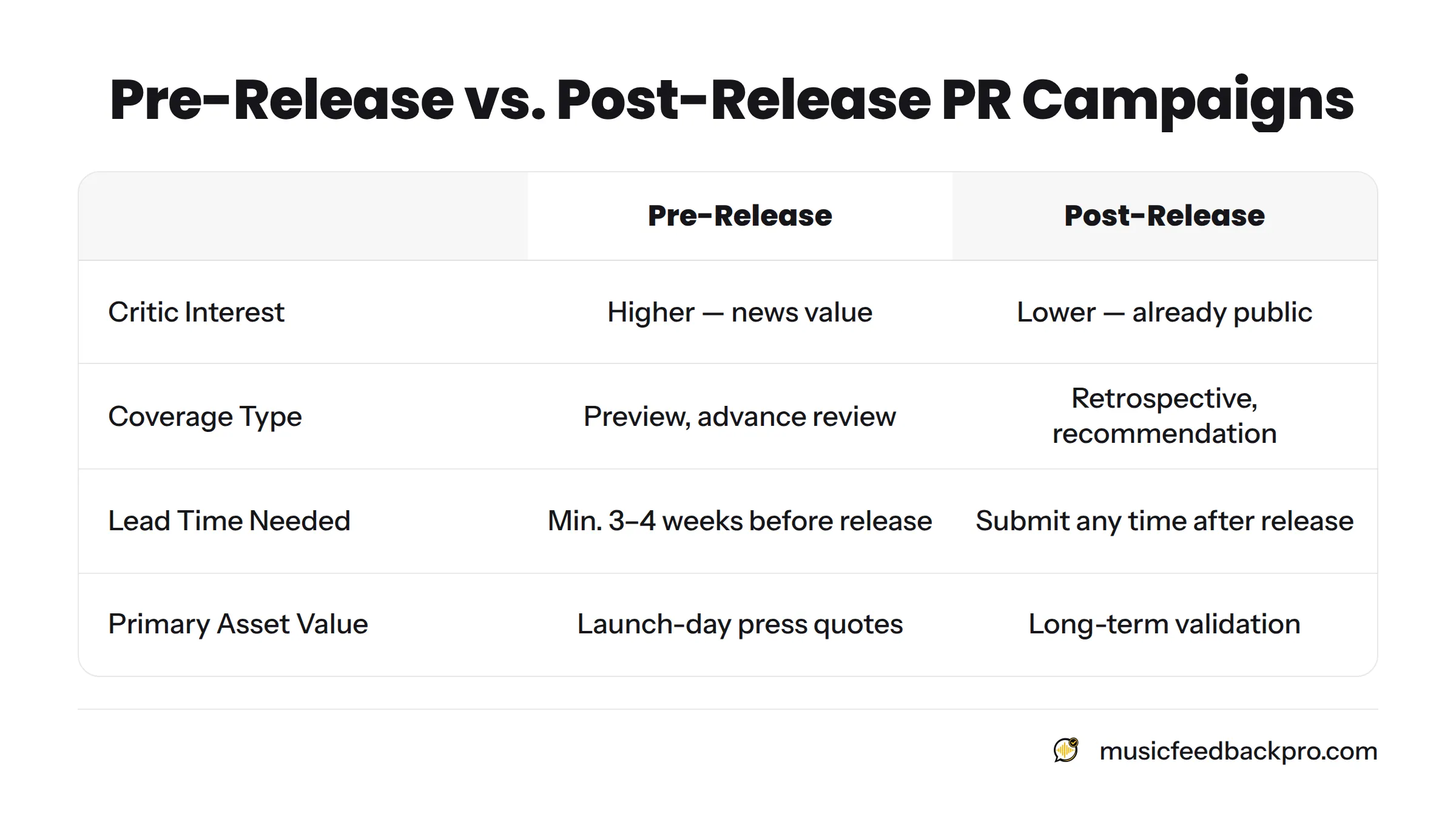
Pre-release campaigns give critics the ability to publish a review ahead of or on release day - the window when coverage generates the most discovery-driven traffic. Critics writing ahead of a release are also more likely to frame their review around anticipation, which produces more shareable copy. Post-release campaigns are still worth running, but the coverage they generate tends to function as evergreen validation rather than launch momentum.
What Changes Between Pre- and Post-Release Campaigns
| Factor | Pre-release campaign | Post-release campaign |
|---|---|---|
| Critic interest | Higher - the release has news value | Lower - the release is already public |
| Coverage type | Preview, advance review, anticipation feature | Retrospective review, recommendation feature |
| Lead time needed | Minimum 3-4 weeks before release date | Submit any time after release |
| Primary asset value | Launch-day press quotes and features | Long-term validation and discoverability |
The optimal submission windows are covered in detail on the Music Feedback Pro blog.
A Three-Phase Release PR Plan That Works on a Low Budget
This is the structure that runs on Music Feedback Pro - sized for a solo artist with no label support and no PR agency.
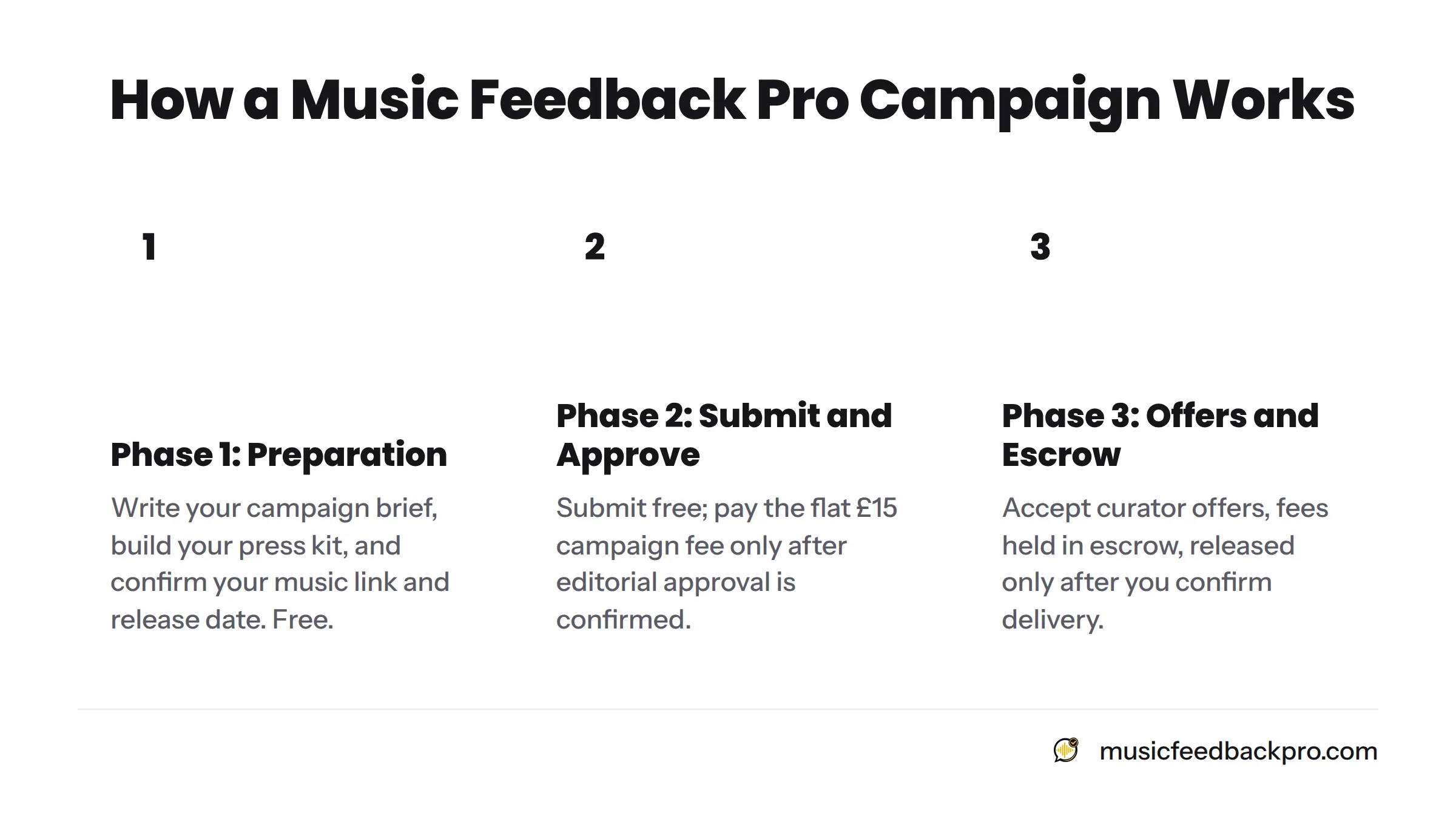
Phase 1 - Preparation (Brief, Bio, Press Kit)
Write your campaign brief. Build your press kit. Make sure your music link works and your release date is confirmed. This phase costs nothing but time, and it determines whether your submission passes editorial review. The team will not approve a campaign that skips preparation.
Phase 2 - Submission and Editorial Approval
Submit your campaign free of charge through the Music Feedback Pro campaign submission page. The editorial team reviews your brief, bio, and press kit against the approval criteria. If the campaign meets the standard, you receive approval and pay the flat £15 campaign fee. If it does not, you receive feedback on what to fix. No money changes hands until approval is confirmed. See how a Music Feedback Pro campaign works step by step for the full process.
Phase 3 - Curator Offers, Escrow, and Delivery Confirmation
Once your campaign is live, vetted critics and curators browse it and make offers to review your music. You review each offer and accept those that fit your goals. Curator fees - where applicable - are held in escrow and released only after you confirm that the review or feature has been delivered as agreed. The £15 flat campaign fee and escrow terms are posted openly on the platform.
Here is why the escrow model matters: no curator can take your money and disappear. You confirm delivery. You release payment. That is an artist-protective structure most music promotion platforms do not offer.
Common Mistakes That Lead to Rejection (and How to Avoid Them)
The editorial team sees rejection patterns so consistently they are almost predictable. Knowing them before you submit saves time for everyone.
Weak or Missing Campaign Brief
A campaign brief is not a description of your song. It is a statement of intent: who the music is for, what you want critics to engage with, and what the release window looks like. Submissions that arrive without a brief - or with one sentence in its place - are rejected at the first read. Write at least 100 words. Name a specific audience. State a goal.
Vague or Promotional Artist Bio
"[Artist name] is a passionate musician who wants to share their love of music with the world" is not a bio. It is a placeholder. Write something a critic can quote. Where are you from? What shaped your sound? What does this release mean in the context of your catalogue? Answer those questions and you have a bio.
Incomplete or Missing Press Assets
No photo means no campaign. No working music link means no campaign. These are non-negotiable. The editorial team cannot forward a submission to critics if basic press assets are missing. Build the full kit before you submit - not after.
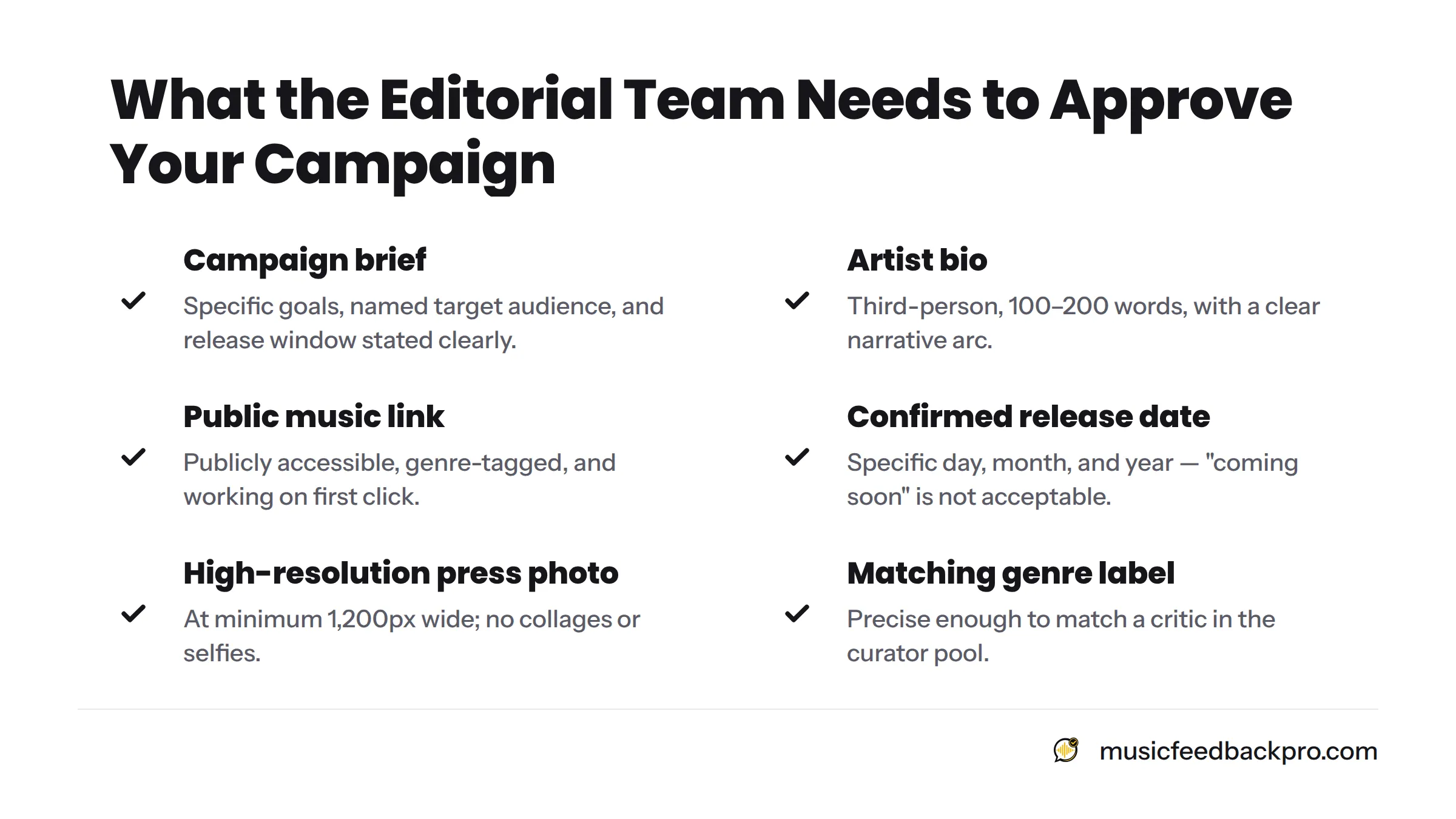
What the editorial team needs to approve your campaign: A campaign brief with specific goals and audience, a third-person artist bio of 100-200 words, a publicly accessible music link, a confirmed release date, a high-resolution press photo, and a genre label that matches the curator pool. That is the complete checklist.
How to Reuse Press Coverage as Long-Term Career Assets
A written review is not a one-time event. Used well, it becomes a durable part of your career infrastructure.
Written Reviews vs. Streaming Numbers - What Lasts
Streaming numbers are a snapshot. They reset with every algorithm change, every playlist removal, every shift in platform policy. A published review by a named critic carries a different kind of weight. It is indexed, shareable, and verifiable. A&R managers, sync licensors, booking agents, and festival programmers all respond to press quotes in a way they never respond to a Spotify play count.
How to Use Press Quotes, Blog Features, and Critic Reviews
Pull the strongest sentence from each review and place it on your website's press page. Add the outlet name and the critic's name. Build a "press" section in your EPK that links directly to the published feature. When you submit your next campaign, include links to previous coverage - campaigns with existing press history earn approval at a higher rate in Music Feedback Pro's submission data. The full guide to earning press coverage you can reuse as assets covers how to build this into your career strategy.
Launch a Music PR Campaign With Music Feedback Pro
The model is straightforward. Submit free. Pay £15 only after editorial approval. Curator fees are negotiated separately and held in escrow until delivery is confirmed. No playlists. No streaming metrics. Real written reviews from hand-picked critics matched to your genre.
If you are still building your approach, these pages will help:
- Music PR Without a Label: What Works in 2026 - the full guide to running PR without industry connections
- Music PR Campaign on a £15 Budget - how to plan a campaign when money is tight
- Get Your Music Reviewed - submit free, pay £15 once approved - the starting point for every campaign
→ Start your free campaign submission - no charge until approval
Frequently Asked Questions
How much does a music PR campaign cost on Music Feedback Pro?
Submitting is free. A one-time flat fee of £15 per campaign is charged only after editorial approval. Curator offer fees - where a critic charges for coverage - are negotiated separately and held in escrow until you confirm delivery. You never pay for a result that has not been delivered.
Can I run music PR without a publicist?
Yes. A focused campaign with a strong brief, bio, and press kit can earn written reviews and blog features from vetted critics. Publicists add existing relationships and time management - not a guarantee of coverage. The Music Feedback Pro editorial model gives independent artists access to the same pool of critics a publicist would pitch, without the monthly retainer.
How is this different from playlist promotion?
Music Feedback Pro does not place music in playlists. The platform connects artists with music critics and bloggers who write long-form reviews and features. Playlist plays are a streaming metric. A published written review is a press asset - something you can quote, link, and present to industry contacts for the rest of your career. For a direct comparison, see press coverage vs playlist plays: why artists need both.
When should I start a campaign before my release?
Earlier is better. Critics need lead time to listen, write, and schedule publication. A minimum of three to four weeks before release is a reasonable baseline for most independent releases, though longer lead times produce better results for campaigns targeting larger outlets. The pre-release campaign timing guide covers optimal windows in detail - find it on the Music Feedback Pro blog.