
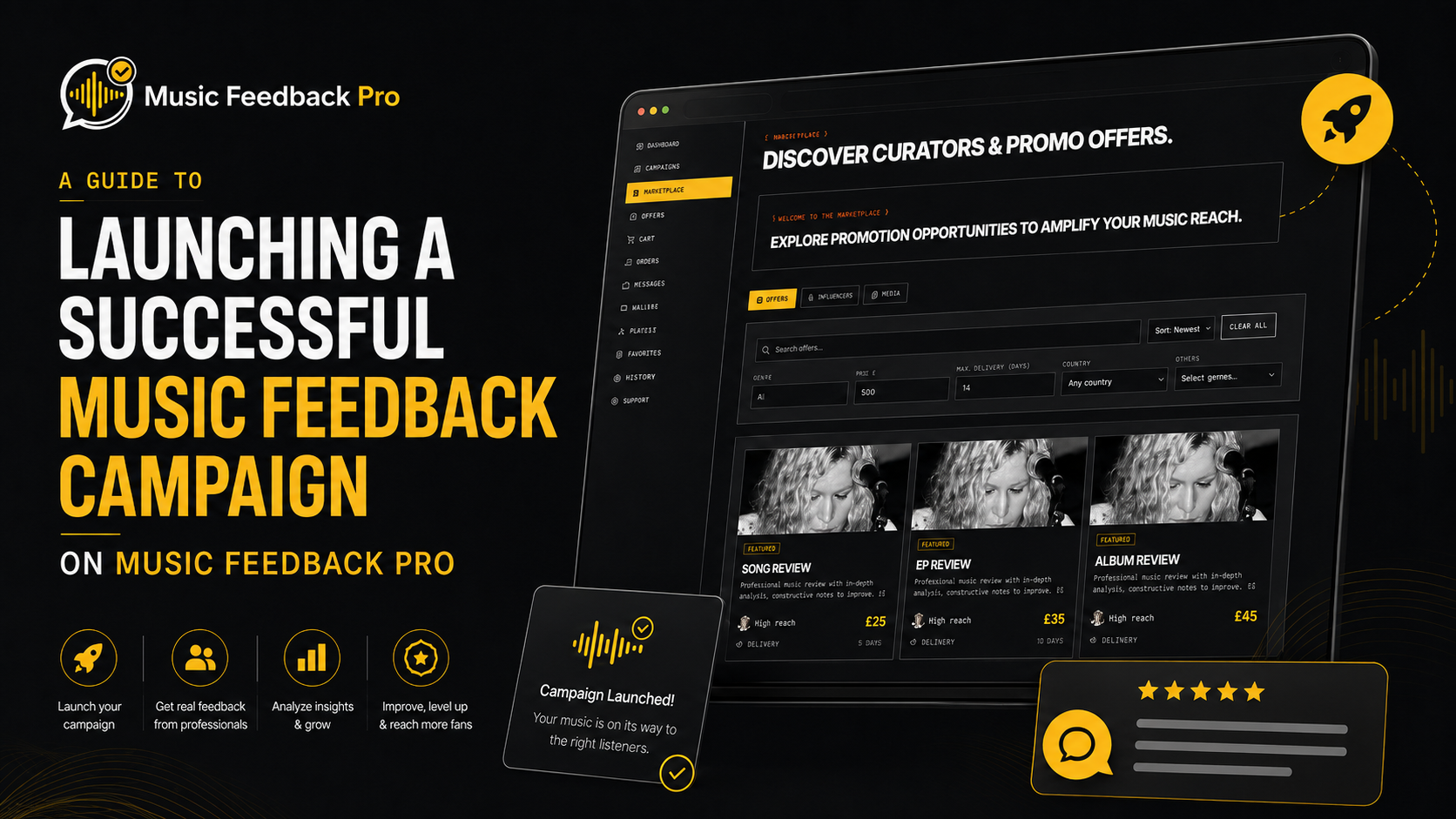
Launching a successful music feedback campaign is not just about uploading a song and waiting for reviewers to respond. The artists who get the best results usually prepare their campaign properly, explain their story clearly, choose the right release goal, provide strong assets, and stay active once offers start coming in.
Music Feedback Pro is built for independent artists, emerging musicians, labels, managers, and music PR teams who want real music feedback, written reviews, blog coverage, private critique, media responses, and credible review-led opportunities. It is not a playlisting platform. It does not sell streams or fake hype. The focus is simple: helping artists get their music in front of real reviewers, blogs, writers, and media outlets who can listen properly and respond with meaningful opportunities.
This guide walks you through how to launch a successful music feedback campaign on Music Feedback Pro, from preparing your release assets to creating your campaign, getting approved, receiving offers, using the marketplace, choosing the right reviewers, and turning feedback into real career value.
What Is a Music Feedback Campaign?
A music feedback campaign is a focused submission campaign designed to help an artist get useful responses from reviewers, blogs, media outlets, and music writers. Instead of sending random emails, chasing DMs, or submitting blindly to people who may never reply, a campaign gives your music a structured place where curators can review your release details, listen to your song, and decide whether they want to offer feedback, a review, media coverage, or a social share.
On Music Feedback Pro, a campaign can be created for a single, EP, album, or music video. Once your campaign is approved, it runs for 30 days and becomes available to approved reviewers, blogs, and media outlets. These curators can then discover your music and send relevant offers based on your sound, story, genre, release quality, and campaign goals.
The best campaigns are not built around hope. They are built around preparation. You need strong music, working links, a clear artist story, good visuals, useful release information, and a realistic goal for what you want to achieve.
Why Use Music Feedback Pro for Your Campaign?
Music Feedback Pro is designed for artists who want more than empty promises of promotion. Many music platforms focus heavily on playlisting, streams, or broad exposure. Music Feedback Pro takes a different route by focusing on music reviews, critiques, written feedback, blog coverage, media interest, and review-led campaign opportunities.
This makes the platform useful for artists who want to understand how their music is being received by real listeners with editorial experience. A strong review or piece of feedback can help you improve your next release, sharpen your press materials, understand your audience, build your EPK, create better social proof, and promote your music with more confidence.
Music Feedback Pro is especially useful if you want to:
Get honest feedback on your music
Receive private critique from reviewers or media outlets
Get written reviews for your single, EP, album, or music video
Build stronger press quotes for your artist profile
Connect with music blogs and independent media outlets
Understand how reviewers respond to your sound
Promote an upcoming release before it goes live
Get more value from already released music
Manage review and media opportunities from one place
Step 1: Decide the Goal of Your Campaign Before You Start
Before creating a campaign, be clear about what you want the campaign to achieve. Many artists make the mistake of submitting music without a clear goal. That makes it harder for reviewers to understand what kind of opportunity makes sense.
Your campaign goal should guide how you write your submission, what assets you include, which offers you accept, and how you use the results after the campaign ends.
Common campaign goals include:
Getting honest private feedback before release
Getting a public review for a new single
Building press quotes for an EPK
Finding blogs that understand your genre
Testing how reviewers respond to your sound
Generating media coverage around a release date
Promoting an EP, album, or music video
Understanding what to improve before the next release
If your goal is feedback, make that clear. If your goal is public review coverage, say that. If your goal is to understand whether your song connects emotionally, explain that. Reviewers respond better when the campaign gives them direction.
Step 2: Choose the Right Release to Submit
Music Feedback Pro supports singles, EPs, albums, and music videos. The right format depends on your current release plan.
If you are preparing a new single, a campaign can help you collect feedback, reviews, and media interest before or during release week. If you are releasing an EP or album, a campaign can help reviewers understand the wider project and write a more complete critique. If you are submitting a music video, your campaign should explain the visual concept as well as the song.
Best campaign format by goal
Release type | Best campaign goal | What to prepare |
|---|---|---|
Single | Fast feedback, review quotes, release coverage | Song link, artwork, short bio, release date, campaign angle |
EP | Project feedback, wider review, artist positioning | Full EP link, tracklist, concept, standout tracks, press assets |
Album | Long-form critique, editorial review, career story | Album link, artist story, album concept, key themes, press photos |
Music video | Video review, visual storytelling, media coverage | Video link, song details, video concept, credits, visuals |
My advice: if you are new to Music Feedback Pro, start with your strongest single. A single is easier for reviewers to process quickly and easier for you to promote after receiving feedback or coverage.- Yusuf Muritala, Founder - Music Feedback Pro
Step 3: Submit at the Right Time
Timing matters. Music Feedback Pro allows artists to submit unreleased music up to 30 days before the release date. This is useful because reviewers and media outlets need time to listen, consider your campaign, send offers, and prepare reviews or coverage.
If your song is unreleased, do not wait until release day to start. Give your campaign time to work. A good pre-release campaign can help you collect feedback, prepare review quotes, understand how the music is landing, and build momentum before the song goes public.
Suggested campaign timing
Timing | Best use | Campaign approach |
|---|---|---|
30 days before release | Best for pre-release feedback and review planning | Submit full assets, private listening link, release date, and campaign goal |
14 to 21 days before release | Good for review interest and release preparation | Focus on a clear story, genre fit, and strong press materials |
Release week | Good for immediate review and media opportunities | Use public streaming links, artwork, social links, and release context |
After release | Good for extended promotion and feedback | Explain why the release still deserves attention now |
If your music is already released, you can still create a campaign. Just make sure you explain why the release is relevant now. For example, you may be promoting a new video, pushing a live performance, building an EPK, preparing a tour, or collecting reviews for a wider campaign.
Step 4: Prepare Your Campaign Assets Before Uploading
A strong campaign starts before you log in. Reviewers and media outlets need enough context to decide whether your music is a good fit. If your campaign is missing key information, it becomes harder for them to take action.
Before creating your Music Feedback Pro campaign, prepare all the basic materials a reviewer might need.
Campaign asset checklist
Artist name
Release title
Release date
Genre
Streaming link or private listening link
Artwork or cover image
Artist bio
Song or project description
Press photos
Social media links
Website link, if available
Previous press links, if available
Lyrics, most curators find this useful
Music video link, if submitting a video
Campaign goal
Any important credits, collaborators, producers, or featured artists
The stronger your campaign assets are, the easier it is for reviewers to understand your music and offer the right kind of feedback or coverage.
Step 5: Use a Strong Music Link
Your music link is one of the most important parts of your campaign. Reviewers should be able to press play quickly without friction. A broken, private, confusing, or low-quality link can reduce your chances of getting responses.
If the music is unreleased, use a private listening link that works properly. If the music is already released, use a public streaming link. Make sure the link does not require complicated login steps or special access.
Good music link options include:
Private SoundCloud link
Private YouTube link
Spotify link for released music
Apple Music link for released music
Bandcamp link
Official website landing page
Music video link
Do not add a pre-save link to any of your campaigns
Music link mistakes to avoid
Submitting a link that does not work
Using a private link without checking access
Sending a file that takes too long to open
Only linking to a social media teaser instead of the full song
Using low-quality audio when a proper version is available
Forgetting to update the link after the release goes live
Before submitting your campaign, open the link in a private browser window and test it like a reviewer would. If you cannot access it quickly, fix it before submitting.
Step 6: Write a Clear Artist Bio
Your artist bio should help reviewers understand who you are, what you make, and why your music matters. It does not need to be long, but it should be clear and useful.
A weak bio says something generic like “I am a passionate artist making music from the heart.” A stronger bio gives context, genre, location, influences, achievements, and direction.
A strong artist bio should include:
Who you are
Where you are based, if relevant
Your genre or sound
Your influences or creative direction
Any notable achievements
What makes your music different
What stage you are at in your career
Example artist bio structure
Artist name is a [genre] artist based in [location], creating music that blends [sound/influence] with [second influence]. Their work explores [themes], combining [vocal style/production style/songwriting style] with [unique angle]. Following [previous release/achievement], they are now releasing [release title], a track that captures [main emotion or message].
Keep the bio honest. Do not overhype yourself with claims that are hard to prove. Reviewers prefer clear context over exaggerated language.
Step 7: Explain the Release Properly
Your release description is different from your artist bio. The bio explains who you are. The release description explains what this specific song, EP, album, or music video is about.
This is where you give reviewers the story behind the music. You can explain the inspiration, the production process, the emotional theme, the genre direction, and what you want listeners to feel.
Your release description can answer:
What is the song or project about?
Why did you create it?
What emotions or themes does it explore?
What genre does it fit into?
What makes it different from your previous work?
Who produced, mixed, mastered, or featured on it?
Is there a wider story behind the release?
A clear release description helps reviewers write better feedback. It also helps media outlets understand the angle of the story, not just the sound of the track.
Step 8: Choose the Right Genre and Campaign Angle
Genre fit matters. Reviewers, blogs, and media outlets usually have specific tastes, audiences, and editorial focuses. If your campaign describes your music too vaguely, the wrong curators may ignore it, and the right ones may not understand where it fits.
Do not just say “alternative” if your music is indie pop, dream pop, post-punk, or alternative R&B. Do not just say “electronic” if your track is house, ambient, techno, UK garage, or experimental electronic. The more accurate your genre tags and description are, the easier it is for relevant reviewers to identify your campaign.
Weak genre descriptions
Pop
Rock
Electronic
Urban
Alternative
Stronger genre descriptions
Indie pop with dream pop textures
Alternative R&B with Afrobeats influence
Melodic house with cinematic electronic production
Folk-pop singer-songwriter track with acoustic storytelling
Experimental hip-hop with jazz-influenced production
The goal is not to overcomplicate your description. The goal is to help reviewers understand your sound quickly.
Step 9: Create Your Campaign on Music Feedback Pro
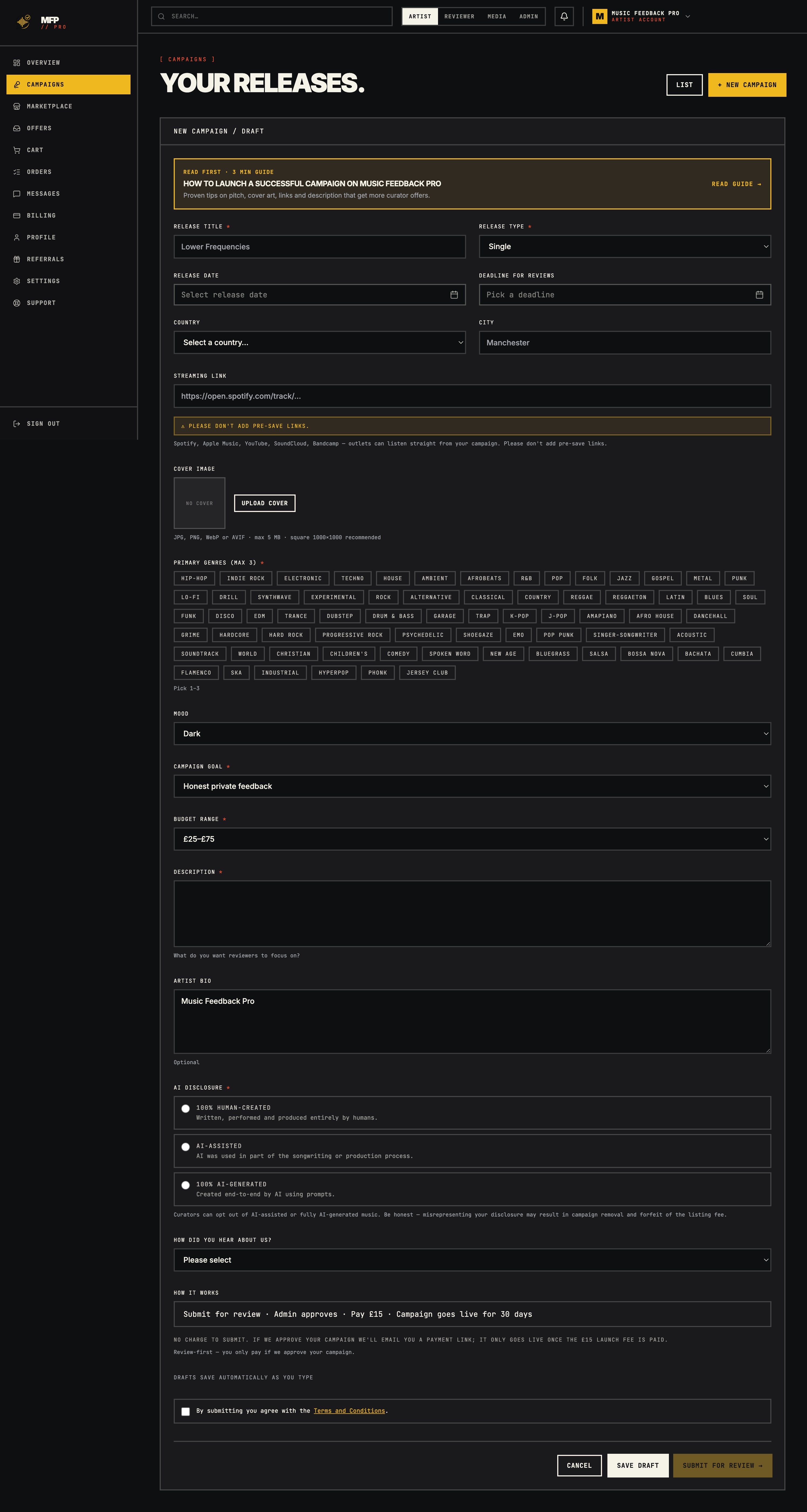
Once your assets are ready, you can create your campaign on Music Feedback Pro. The campaign builder is where you add your release details, music links, artwork, bio, genre, social links, and campaign goals.
Take your time here. This is the information reviewers will use to decide whether they want to engage with your music. A rushed campaign can make a strong song look less serious.
When creating your campaign, make sure you include:
A working listening link
A clear release title
The correct artist name
The correct release date
Accurate genre information
High-quality artwork
A useful artist bio
A clear release description
Social links and website links
Your campaign goal
Any extra context reviewers should know
After submitting your campaign, Music Feedback Pro reviews it before it goes live. This approval process helps ensure reviewers and media outlets have the information they need to consider your release properly.
Step 10: Understand the Campaign Approval Process
Music Feedback Pro reviews campaigns before they go live. This is important because low-quality or incomplete campaigns make it harder for reviewers to do their job. The approval process helps protect both artists and curators.
Your campaign may be checked for working links, clear release details, useful context, appropriate assets, and enough information for reviewers to consider your music properly.
Why campaign approval matters
It helps reviewers receive better submissions
It helps artists avoid incomplete campaigns
It improves the quality of the marketplace
It reduces confusion for media outlets
It gives your campaign a stronger chance of being understood
If your campaign needs improvement before going live, treat that as a helpful step. A better campaign presentation can improve your chances of receiving relevant offers.
Step 11: Activate Your 30-Day Campaign
Once approved, your campaign goes live for 30 days. This is the active campaign window where reviewers, blogs, and media outlets can discover your music and send offers.
Music Feedback Pro is free to submit — the £15 launch fee is only taken once our team approves your campaign, which then runs for one month. During that period, your campaign becomes available to relevant curators who can listen, review the submission details, and decide whether to respond.
Remember that responses are based on fit. Reviewers may consider genre, quality, story, audience relevance, editorial interest, and campaign presentation. A strong campaign does not force people to respond, but it gives them a better reason to pay attention.
Step 12: Know What Types of Offers You Can Receive
During your Music Feedback Pro campaign, you may receive different types of offers from reviewers, blogs, writers, or media outlets. Not every offer will be the same, and not every offer will suit your goal.
Common offer types may include:
Private music feedback
Written music critique
Public song review
EP or album review
Music video review
Blog music review feature
Interview opportunity
Editorial mention
Social media share
Media coverage opportunity
Some reviewers may focus on a detailed critique. Some blogs may focus on published reviews. Some media outlets may offer social shares or editorial mentions. Your job as the artist is to choose the opportunities that support your current goal.
Step 13: Review Offers Carefully Before Accepting
Do not accept every offer automatically. A successful campaign is not about collecting the highest number of offers. It is about choosing the offers that can help your music, brand, release campaign, and long-term growth.
Before accepting an offer, review what the curator is offering, what type of feedback or coverage you will receive, the cost if there is one, the curator’s profile, the sample of their work or social media, and whether the opportunity matches your goals.
Questions to ask before accepting an offer
Does this offer match my campaign goal?
Is this private feedback, public review, media coverage, or social sharing?
Does the reviewer or outlet understand my genre?
Can I use this review or coverage in my EPK?
Does the offer help my release strategy?
Is the cost reasonable for the value?
Will this opportunity help me learn, promote, or build credibility?
For example, if your goal is to improve your next release, private critique may be more valuable than a social share. If your goal is public credibility, a published review or blog feature may be more useful.
Remember, you can chat with the curator to clarify everything before you accept and pay.
Step 14: Use the Marketplace to Request Relevant Offers
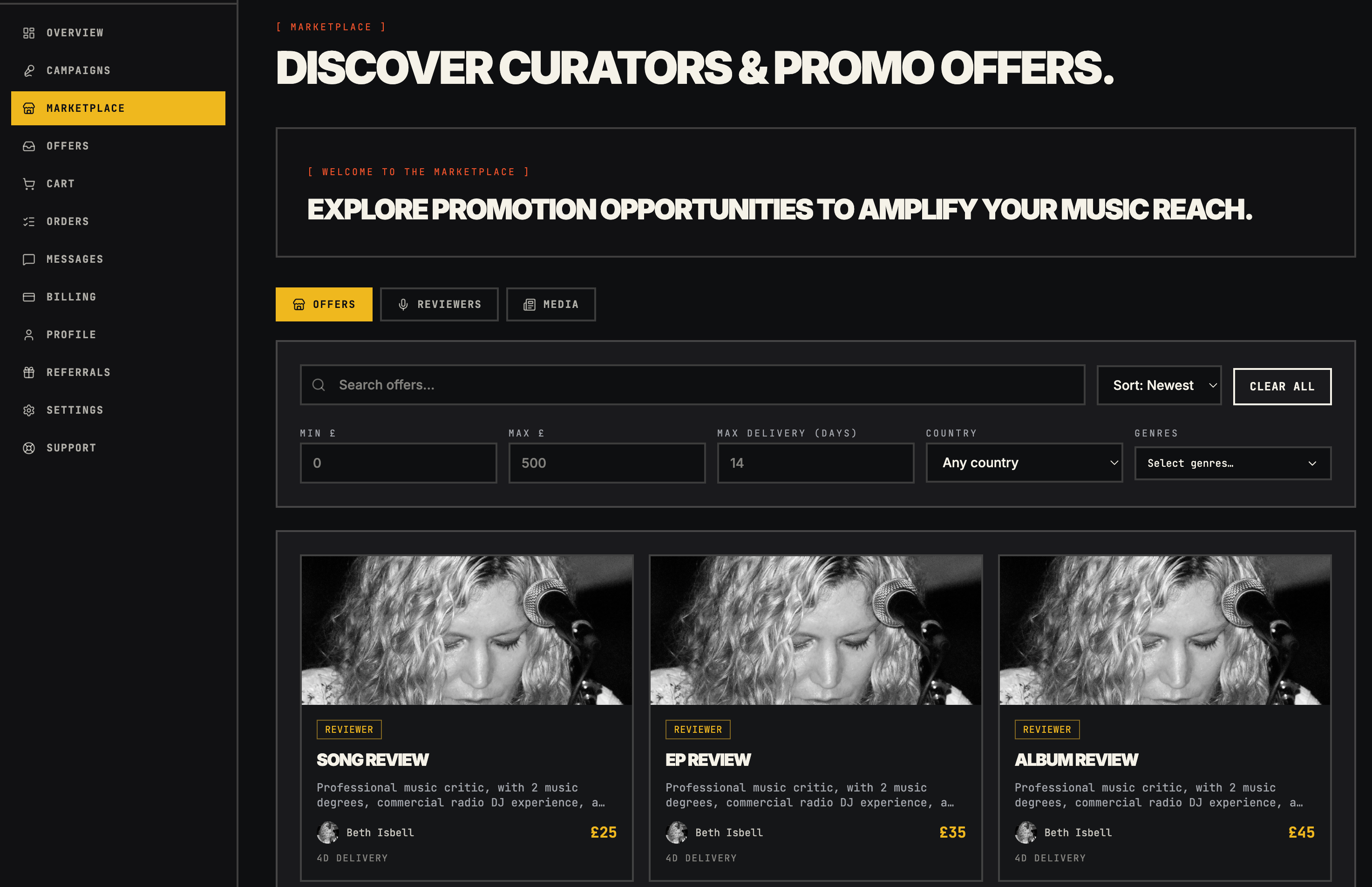
One of the most useful parts of Music Feedback Pro is the curator marketplace. Instead of only waiting for reviewers and outlets to discover your campaign, artists can use the marketplace to explore available reviewers, media outlets, and offers that may fit their release.
The marketplace gives artists more control. You can browse relevant curators, compare offer types, check profiles, and request opportunities that match your genre, budget, and campaign goal.
How artists can use the marketplace effectively
Browse available reviewers, blogs, and media outlets
Filter based on offer type, reviewer type, media type, or genre fit
Review each curator’s profile before requesting an offer
Look for outlets that match your sound and audience
Click on "Request this offers" on the one that supports your campaign goal
Avoid requesting offers from curators who are clearly not a fit
Compare the value before accepting any paid opportunity
The marketplace should not be treated like a numbers game. Do not request offers from every available curator just because they are there. Target the reviewers and outlets most likely to understand your music.
Step 15: How to Choose the Right Marketplace Offers
The best marketplace offer is not always the cheapest or the biggest-looking one. The best offer is the one that matches your goal, your genre, and the kind of result you need from the campaign.
If your goal is to improve your craft, look for reviewers who offer thoughtful critique. If your goal is public credibility, look for outlets that can publish reviews or features. If your goal is social reach, look for media pages with a relevant audience. If your goal is a stronger press kit, prioritize review quotes and written coverage.
Choose offers based on:
Genre fit
Offer type
Review depth
Outlet relevance
Audience alignment
Potential use in your EPK
Cost versus value
Your current release goal
Offer selection examples
Your goal | Best type of offer | Why it works |
|---|---|---|
Improve your music | Private critique | Gives you direct feedback without needing public coverage |
Build credibility | Published review | Creates a public asset you can share |
Promote release week | Blog feature or social share | Helps create timely visibility around the release |
Strengthen your EPK | Written review or review quote | Gives you language for press and booking outreach |
Test your sound | Feedback from multiple reviewers | Helps identify repeated strengths and weaknesses |
Step 16: Stay Active During the Campaign
A common mistake artists make is launching a campaign and disappearing. A better approach is to stay active, check offers, review responses, update your campaign if needed, and respond professionally.
If a curator sends an offer, review it in good time. If you accept an offer, provide anything needed quickly. If your release date changes, update your campaign information. If you receive a review or social share, acknowledge it and use it in your promotion.
During your 30-day campaign, you should:
Check your campaign dashboard regularly
Review new offers carefully
Respond to accepted opportunities quickly
Keep your music links working
Update public links after release day
Track which offers support your goal
Save useful feedback and review quotes
Share published coverage when appropriate
Campaign success is not passive. The more professionally you manage the process, the more value you can get from it.
Step 17: Respond Professionally to Reviewers and Media Outlets
Reviewers and media outlets are more likely to take artists seriously when communication is clear, polite, and professional. Even if feedback is not 100 percent positive, handle it with maturity.
Music feedback is not always praise. Sometimes a reviewer may point out issues with production, songwriting, vocal delivery, structure, or branding. That does not mean the campaign failed. Honest feedback can be more valuable than empty compliments.
Good artist communication tips
Thank reviewers for their time
Do not argue with honest critique
Ask clear questions if clarification is needed
Provide extra assets quickly when requested
Keep replies short and professional
Share published coverage respectfully
Build relationships for future releases
Think long term. A reviewer who covers your song today may be interested in your next release if the relationship starts well.
Step 18: Turn Feedback Into Action
The value of a music feedback campaign is not only in receiving responses. The real value comes from what you do with the feedback afterward.
After you receive feedback, read it carefully and look for patterns. If one reviewer says your hook is weak, that is one opinion. If several reviewers mention the same issue, that is a signal. Use that information to improve your next song, rewrite your artist bio, adjust your messaging, improve your visuals, or refine your release strategy.
How to analyse feedback
Look for repeated comments across different reviewers
Separate personal taste from useful criticism
Note comments about songwriting, production, vocals, lyrics, and originality
Identify which parts of the song reviewers responded to most strongly
Save strong quotes for promotion
Use constructive criticism to improve future releases
Do not change your entire artistic direction because of one review. But do pay attention when multiple people identify the same strength or weakness.
Step 19: Use Reviews and Coverage in Your Promotion
If you receive public reviews, blog coverage, social shares, or media mentions, do not let them sit unused. These assets can support your wider release campaign.
A good review can become a social media post, an EPK quote, a website testimonial, a newsletter feature, a press pitch line, or proof of credibility when contacting bookers, labels, blogs, playlist curators, and media outlets.
Ways to reuse campaign results
Add review quotes to your EPK
Share blog reviews on Instagram, TikTok, Facebook, and X
Add review links to your website
Use strong quotes in press pitches
Include coverage in your artist newsletter
Reference reviews in future release campaigns
Create social graphics from short review quotes
Add coverage links to your link-in-bio page
One campaign can create assets that keep working long after the 30-day window ends.
Step 20: Track Your Campaign Results
To understand whether your campaign was successful, track more than just the number of offers. The right metrics depend on your goal.
Useful campaign metrics to track
Number of offers received
Number of accepted offers
Number of reviews completed
Number of public coverage pieces
Number of social shares
Quality of feedback received
Most common positive comments
Most common constructive comments
Review quotes collected
New media relationships created
Not every campaign should be judged by public coverage alone. If your goal was to learn how reviewers respond to your new sound, then a useful critique may be the main win. If your goal was to build press assets, then published reviews and strong quotes may be the main result.
Step 21: What Makes a Campaign More Attractive to Reviewers?
Reviewers and media outlets are more likely to respond when a campaign looks complete, relevant, and easy to understand. They want to know what they are listening to, who the artist is, why the release matters, and what kind of opportunity makes sense.
Reviewers are more likely to engage when:
The music link works immediately
The genre is clearly described
The artist bio is concise and useful
The release story is interesting
The artwork looks professional
The campaign goal is clear
The song fits the reviewer’s taste or outlet focus
The artist has provided useful context
The campaign does not feel rushed or incomplete
Think of your campaign as a mini press kit. It does not need to be complicated, but it needs to make the reviewer’s job easier.
Common Mistakes You should Avoid As An Artists On Music Feedback Pro
Many artists reduce their chances of getting strong offers because they treat campaign submission as a quick admin task. The better approach is to treat it like a serious release asset.
Avoid these mistakes:
Submitting broken or restricted music links
Using a vague artist bio
Not explaining the release story
Choosing the wrong genre
Uploading low-quality artwork
Submitting too close to the release date
Expecting every reviewer to like the song
Accepting offers without checking fit
Ignoring private feedback
Failing to reuse reviews and coverage in promotion
The biggest mistake is expecting the platform to do all the work. Music Feedback Pro gives you access to a better campaign system, but your preparation still matters.
Tips for Getting Better Results From Music Feedback Pro
If you want your campaign to perform better, focus on clarity, timing, relevance, and follow-through.
1. Start with your strongest release
Do not submit a song just because it is new. Submit a song that represents you well. Reviewers are more likely to respond when the music feels ready, and the campaign has a clear purpose.
2. Submit before release day if possible
If your song is unreleased, use the 30-day pre-release window. This gives reviewers and media outlets more time to consider your music before it becomes old news.
3. Make your campaign easy to understand
Reviewers should not have to guess your genre, story, release date, or goal. The clearer your campaign is, the easier it is for curators to respond.
4. Be honest about your stage
You do not need to pretend to be bigger than you are. If you are an emerging artist, say so confidently. Reviewers often appreciate authenticity more than exaggerated claims.
5. Use the marketplace strategically
Do not request every offer available. Look for reviewers, blogs, and media outlets that match your genre, sound, budget, and campaign objective.
6. Accept offers based on value, not ego
A smaller blog that understands your genre may be more useful than a bigger outlet that does not care about your sound. Choose fit over vanity.
7. Save every useful quote
Strong review quotes can be used in your EPK, press pitches, website, ads, social posts, and future campaign materials.
8. Treat feedback as data
One opinion is not the final truth. But repeated comments from different reviewers can reveal what is working and what needs improvement.
9. Build relationships
If a reviewer gives useful feedback or covers your release well, keep the relationship warm. They may be interested in your future music.
10. Use the campaign to improve your next release
The best artists do not only use feedback for promotion. They use it to make better music, better campaigns, and better release decisions.
Example Campaign Strategy for an Independent Artist
Here is a simple example of how an independent artist could use Music Feedback Pro for a new single release.
Timeline | Action | Goal |
|---|---|---|
30 days before release | Create a campaign with a private listening link, artwork, bio, and release story | Give reviewers early access and enough context |
21 days before release | Review marketplace offers and request relevant reviewer or blog opportunities | Increase chances of targeted feedback and coverage |
14 days before release | Accept the strongest private critique or review offers | Collect useful feedback and prepare promotional assets |
Release week | Update campaign with public streaming links and share published coverage | Support release visibility and credibility |
After release | Save quotes, review feedback patterns, and update EPK | Turn campaign results into long-term value |
This kind of campaign gives the artist more than a one-time review. It creates feedback, content, relationships, and promotional material that can support the release beyond launch week.
What to Do If You Receive No Offers
Sometimes a campaign may not receive offers. That does not automatically mean the music is bad. It may mean the campaign presentation needs work, the genre fit was unclear, the assets were weak, the release angle was not strong enough, or the timing was not ideal.
Music Feedback Pro only charges the £15 launch fee after our team approves your campaign — so if your submission is not approved, you are never charged. Once live, your 30-day window gives curators a fair chance to respond. Still, the best move is to use the experience as a learning opportunity.
If you receive no offers, review these areas:
Was the music link working?
Was the genre clearly described?
Was the artist bio strong enough?
Did the release story give reviewers a reason to care?
Was the artwork professional?
Was the campaign submitted early enough?
Did the music fit the platform’s reviewer audience?
Could the campaign angle be stronger next time?
Sometimes a small improvement in your presentation can make a big difference in the next campaign.
Music Feedback Pro Campaign Checklist
Before launching your campaign, use this checklist to make sure your submission is ready.
Before submitting
Choose your strongest release
Decide your campaign goal
Prepare a working music link
Write a clear artist bio
Write a useful release description
Add accurate genre information
Prepare high-quality artwork
Add social links and website links
Include release date and credits
Test all links before submitting
After approval
Monitor your campaign dashboard
Review incoming offers carefully
Use the marketplace to request relevant offers
Accept offers that match your goal
Respond professionally to curators
Update links after release day
Save feedback and review quotes
Share published coverage
Track campaign results
Use insights to improve your next release
Final Thoughts: A Successful Campaign Starts With Preparation
A successful Music Feedback Pro campaign is not about buying praise. It is about creating a strong, clear, and useful submission that gives reviewers and media outlets everything they need to understand your music.
If you prepare your assets properly, explain your release clearly, choose relevant marketplace offers, respond professionally, and use the feedback after the campaign ends, Music Feedback Pro can become more than a submission platform. It can become part of your release strategy, your artist development process, and your long-term music marketing system.
The artists who get the most value are the ones who treat feedback as a tool. Use it to improve your music. Use reviews to build credibility. Use media coverage to strengthen your release campaign. Use marketplace offers strategically. Most importantly, use every response to understand how your music connects with real listeners.
When you are ready to get your music heard by reviewers, blogs, and media outlets who actually listen, you can start your campaign on Music Feedback Pro.