
An EP - Extended Play - is a recorded music release containing 3 to 6 tracks with a total runtime under 30 minutes. It sits between a single and a full-length album, and for independent artists, it may be the most strategically useful format available.
EP at a glance: Extended Play | 3-6 tracks | Under 30 minutes | More than a single, less than an album.
What Does EP Stand For?
EP stands for Extended Play. The term traces back to the early 1950s, when record labels needed a name for a physical format that sat between the 7-inch single and the 12-inch LP (Long Play) - the standard vinyl full-length record. Early EPs were pressed on 7-inch vinyl at 45 RPM or 33⅓ RPM, holding more music than a single but falling short of album length. The name carried forward as the format moved from vinyl to cassette, CD, digital download, and streaming. The term never changed because the concept never did.
How Long Is an EP? Track Count and Runtime
This is the question every new artist eventually asks, and the answer depends on which industry body or platform you consult.
Track Count
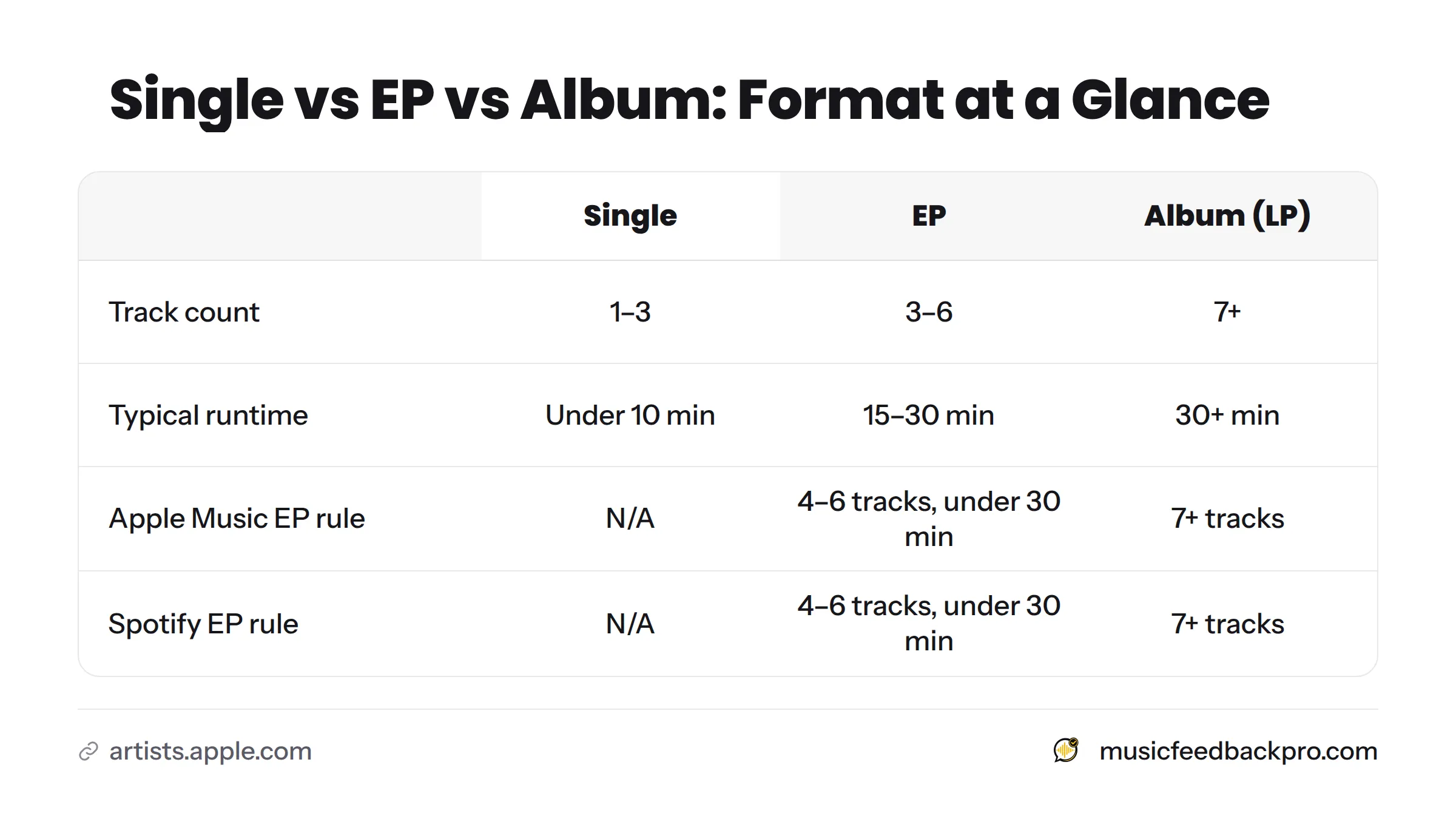
The Recording Industry Association of America (RIAA) defines an EP as a release covering 3 to 5 tracks for certification purposes. Across the broader industry, 3 to 6 tracks is the widely accepted range, with some distributors allowing up to 8 tracks before reclassifying a release as an album. At 7 or more tracks, most major platforms and industry bodies treat the release as an album.
Runtime
Standard EP runtime sits under 30 minutes. Streaming platforms apply their own thresholds, and those classifications affect how your release appears to listeners and curators.
According to Apple Music's artist and label documentation, Apple Music classifies a release as an EP when it contains 1 to 3 tracks (provided at least one track exceeds 10 minutes) or 4 to 6 tracks with a total runtime under 30 minutes. Spotify applies similar logic: releases in the 4 to 6 track range running under 30 minutes are displayed as EPs rather than albums in its catalog.
Getting this right is not just academic. Track count and runtime determine how your release is labeled across every major DSP, which affects discoverability and how curators find you.
| Format | Tracks | Typical Runtime |
|---|---|---|
| Single | 1-3 | Under 10 min |
| EP | 3-6 | 15-30 min |
| Album (LP) | 7+ | 30+ min |
What Independent Artists Actually Use EPs For
The EP meaning in music goes beyond a track count - it reflects a deliberate creative and commercial choice. Here are the real reasons artists reach for this format:
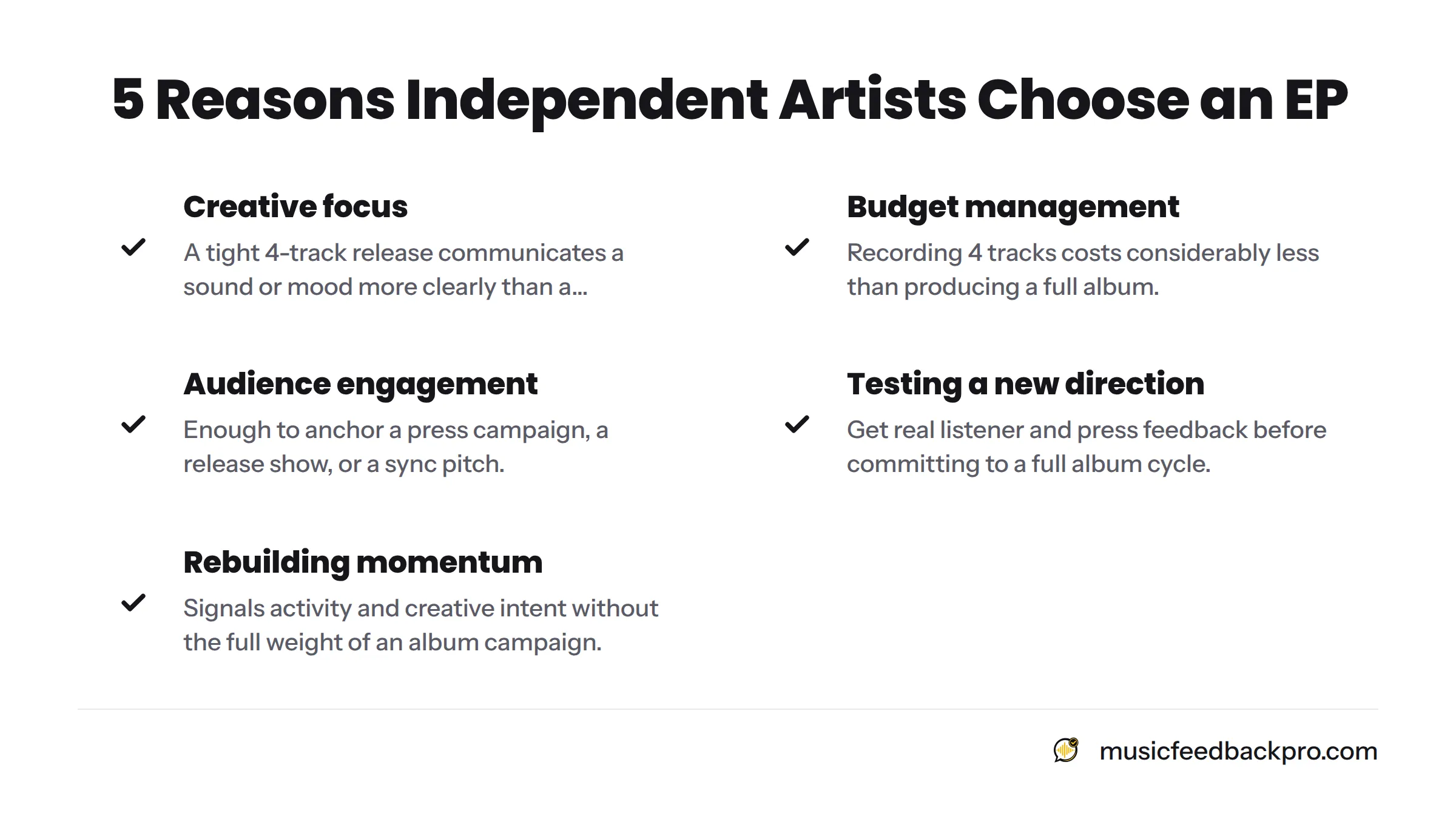
Creative focus. A tight 4-track release communicates a sound or mood more clearly than a sprawling debut. Constraints sharpen the artistic statement.
Budget management. Recording, mixing, and mastering 4 tracks costs considerably less than producing a full album - a genuine factor for independent artists without label funding. Our guide on music PR campaigns for independent artists covers how to plan releases around realistic budgets.
Audience engagement. An EP gives existing fans more to absorb than a single while keeping the release manageable. It's enough to anchor a press campaign, a release show, or a sync pitch.
Testing a new direction. A 4-track EP carries enough material to get real listener and press feedback before committing the time and money required for a full album cycle. If the reception is strong, the full LP has a proven foundation. If it isn't, the cost of that discovery is far lower.
Rebuilding momentum. Many artists use an EP to re-establish presence after a release gap. It signals activity and creative intent without the full weight of an album campaign.
Why an EP Generates More Press Than a Single
Here is where I think independent artists consistently undersell the format.
Music blogs, editorial outlets, and press reviewers engage with an EP differently than a single. A single gives a reviewer one track to assess. An EP gives them a narrative - an arc across multiple tracks, cohesive artwork, a release theme, a story worth writing about. From reviewing EP campaigns at Music Feedback Pro, releases with 4 or more tracks and a clear thematic direction consistently attract more curator interest and editorial offers than standalone singles.
A reviewer can say something meaningful about a 4-track EP. A 90-second single leaves far less room to work with.
This matters practically. Music blogs that accept submissions - the kind you can reach through music blog submission sites - are more likely to publish a full feature or review for an EP than a single because there is simply more for the writer to engage with. The EP becomes a press asset. Our guide on music blog features and press assets goes deeper on structure and pitching if you want to build that kind of asset deliberately.
EP vs Single vs Album: The Editorial Differences
The table above covers the numbers. Here is the context behind them.
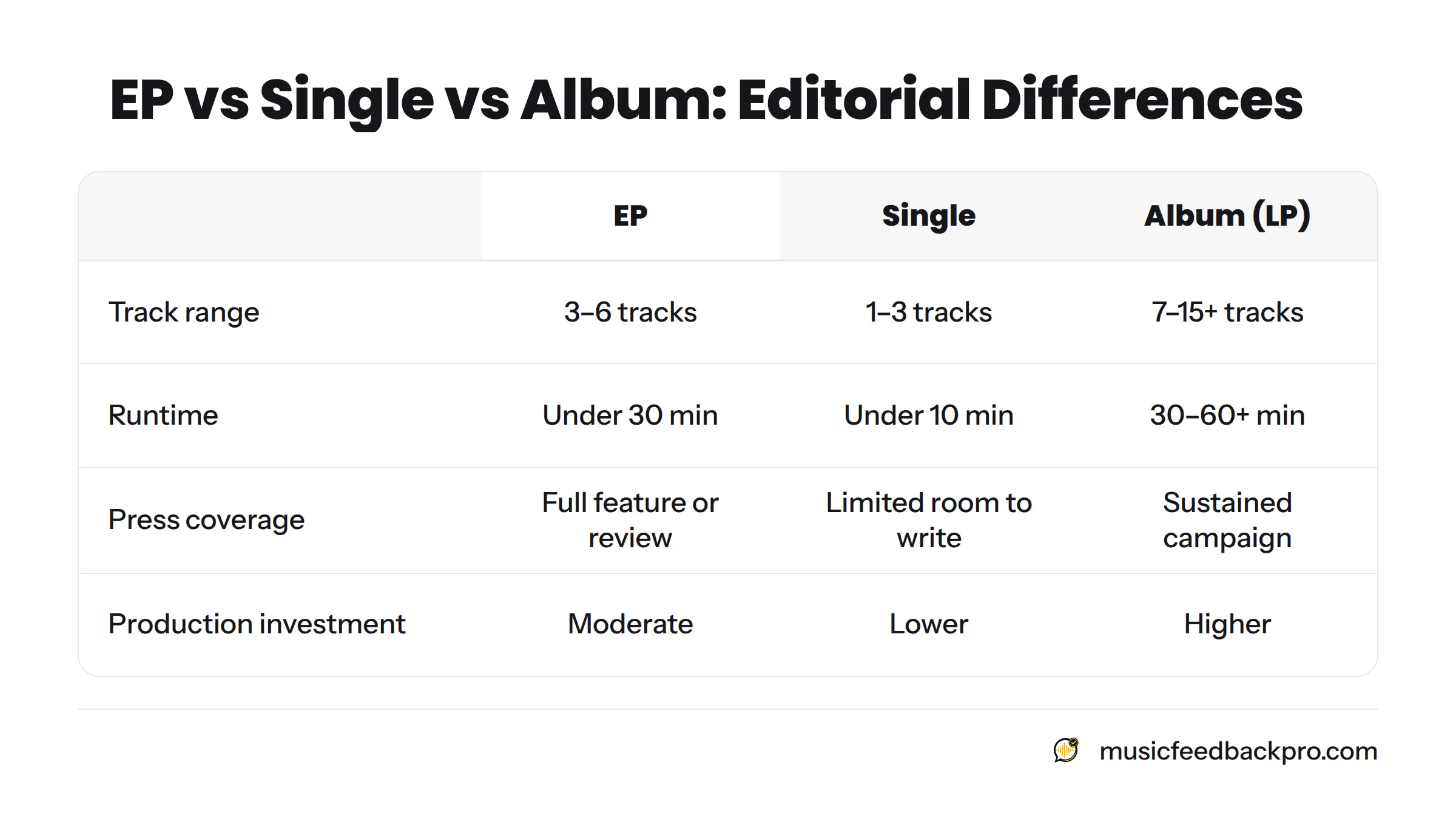
EP vs single: A single is a focused promotional release, usually 1 track (occasionally 2 or 3), built to drive streams and playlist placement. An EP carries more creative weight and generates more press coverage, but it also requires more production investment.
EP vs album (LP): An album is a full artistic statement - typically 7 to 15 or more tracks, 30 to 60 or more minutes. It demands a larger budget, a longer production timeline, and a more sustained promotional campaign. An EP is a faster, leaner alternative when you're not ready to commit to that scale.
EP vs mini-album: "Mini-album" is an informal term sometimes used for releases in the 5 to 8 track range - longer than a typical EP but shorter than a full LP. The distinction is blurry and rarely used in Western markets. EP remains the standard industry term for sub-album releases.
For a full breakdown of trade-offs between formats, see our guide on EP versus album.
When an EP Is the Right Format for Your Release
Not every project calls for an EP. These situations make it the natural choice:
- You have 3 to 6 finished tracks that share a cohesive theme, sound, or narrative
- You want press coverage beyond what a single can generate, but a full album isn't ready
- You're rebuilding momentum after a release gap or a period off the radar
- Budget constraints make a full LP impractical right now
- You want to test a new sound before committing to a full album cycle
What about 7 songs - is that an EP or an album? By most industry and streaming platform conventions, 7 songs crosses into album territory. Both Apple Music and Spotify typically classify a 7-track release as an album regardless of runtime.
If a single suits your situation better, our guide on promoting a single covers that path. For launch tactics specific to EPs, see our guide on how to promote an EP.
Frequently Asked Questions
What does EP stand for in music? EP stands for Extended Play. The term dates to the 1950s vinyl era and refers to a release that contains more music than a single but less than a full album.
How many songs are on an EP? Typically 3 to 6 tracks. The RIAA and most streaming platforms use this range to classify a release as an EP rather than a single or an album.
How long is an EP? Usually under 30 minutes. Apple Music classifies releases as EPs at 1 to 3 tracks (if one track exceeds 10 minutes) or 4 to 6 tracks totaling under 30 minutes.
Is 7 songs an EP or an album? Seven songs is generally classified as an album by industry convention and by major streaming platforms including Apple Music and Spotify.
What is the difference between an EP and an album? An EP contains 3 to 6 tracks and runs under 30 minutes. An album contains 7 or more tracks and runs 30 minutes or longer. Our guide on EP versus album covers the full comparison.
Ready to turn your EP into real press coverage? Start a music PR campaign from £15 and connect with vetted reviewers and blogs today, or read our guide on music PR without a label to see what works for independent artists in 2026.