
A good music review is honest, structured, and useful - to the artist who receives it and the reader who discovers it. The 8-step process below draws directly from editorial observations Music Feedback Pro's team makes when vetting curator samples: listen multiple times, research context, define a critical angle, write a positioned opening, analyse specific musical elements, balance critique constructively, deliver a clear verdict, then edit before publishing.
What Separates a Real Music Review From a Reaction Post
Before touching the keyboard, it helps to understand what distinguishes a genuine music review from a reaction post or a playlist caption. A reaction tells you how music made someone feel. A review explains why it made them feel that way - and whether the craft behind the release earned that response.
Three qualities define a review worth reading. It is honest when every opinion anchors to a specific observation. It is structured when it follows a logical sequence that readers and artists can navigate. It is useful when it gives the artist something to act on and gives the reader enough information to decide whether the release is for them.
Understanding what a music reviewer does is the starting point. A reviewer is not a fan, a hater, or a hype machine. They are an editor of sound - someone who translates what they hear into precise, evidence-backed language.
Editorial principle from Music Feedback Pro's vetting process: "A review without evidence is an opinion. A review with evidence is criticism."
That distinction matters at every stage of the process below.
Step 1: Listen to the Release Multiple Times Before Writing a Word
A single listen produces impressions, not a review. The first time through any track, your brain is busy orienting - mapping out the structure, registering the mood, catching the hook. You cannot analyse what you have not yet absorbed.
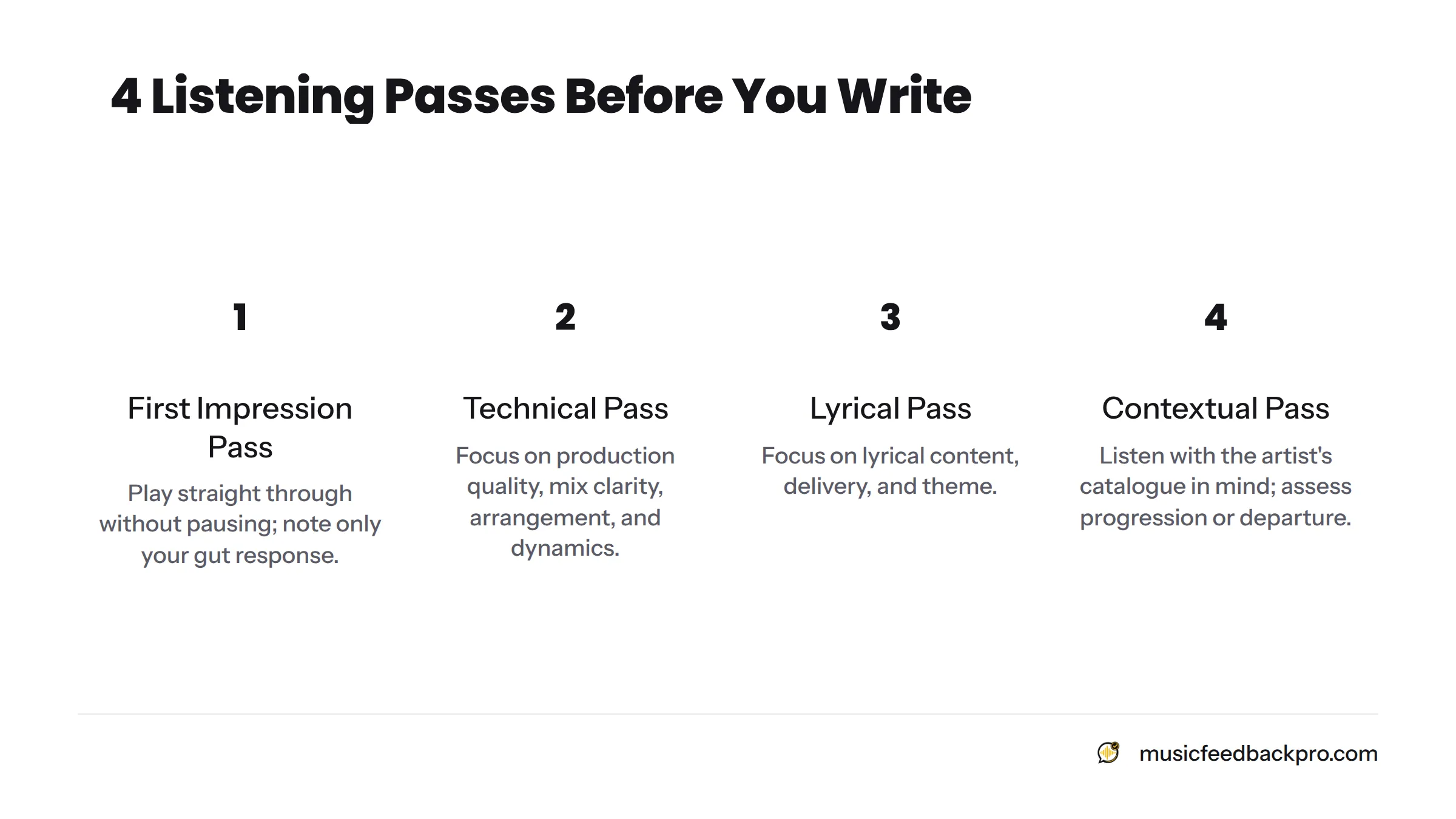
Music Feedback Pro's editorial team recommends four distinct listening passes before taking any notes that will shape your draft:
- First impression pass - Play the track or album straight through without pausing. Note only your gut response: what grabbed you, what surprised you, what fell flat.
- Technical pass - Focus on production quality, mix clarity, arrangement choices, and dynamics. Is the low end clean? Does the vocal sit in the right register? Does the arrangement serve the song or compete with it?
- Lyrical pass - Focus on lyrical content, delivery, and theme. What is the song actually about? Does the writing land metaphors that work, or do the lyrics feel generic?
- Contextual pass - Listen with the artist's catalogue in mind. Is this a progression? A departure? Does it confirm or challenge what you know about their sound?
Good headphones or accurate monitor speakers are standard critical methodology - streaming through a laptop speaker masks production decisions that matter to the review. Keep a note-taking document open from the second pass onward and write down timestamps, specific moments, and phrases that catch your ear. These notes are the raw material for everything that follows.
Step 2: Research the Artist's Context and Intent
Context is not a shortcut around honest listening. It is the frame that stops you from misreading the work. A debut single from a 19-year-old bedroom producer deserves different reference points than a fifth studio album from a veteran act. Ignoring that difference produces reviews that punish artists for not being something they never claimed to be.
Before you draft a word, pull together the following:
| Research Area | What to Look For |
|---|---|
| Artist background | Career stage, genre home, prior releases, key influences stated in interviews |
| Release details | Single, EP, or album? Release date, label or self-released |
| Producer credits | Who produced it? What else have they worked on? |
| Genre conventions | What are the expectations of this genre, and does the release meet or subvert them? |
| Press notes / artist statement | Has the artist stated an intent for this release? What did they say it is about? |
Use this information to sharpen your listening notes, not to replace them. If the press notes say the album is a meditation on grief but you hear something that feels superficial, that gap is worth writing about. The research informs your critical eye - it does not tell you what to conclude.
Step 3: Define Your Critical Angle Before You Draft
This is the step that most guides skip, and it is the one that separates a meander from a music review.
A critical angle is the single interpretive lens through which your entire review is organised. It is the central argument your review makes. Every paragraph that follows either supports it or complicates it in a way that ultimately reinforces it.
Examples of a clear critical angle:
- "A bold genre shift that partially lands - the ambition is clear, but the production choices undercut it."
- "A confident debut that trades polish for honesty, and earns that trade."
- "An album that sounds exactly like the artist's last three - not a failure, but a refusal to risk anything."
A critical angle is not a summary. It is a position. Derive it from your listening notes and your research: what is the most honest and specific thing you can say about this release? That is your angle.
Observation from Music Feedback Pro's editorial team during curator vetting: "Weak reviews have no central argument. Strong reviews make one point and prove it."
Choose your angle before you open a new document. Everything you write should push that argument forward.
Step 4: Write an Opening That Positions the Release Immediately
The opening paragraph of a music review has one job: establish the release, signal the critical angle, and set the editorial tone - all within the first two to three sentences. Readers and artists should know exactly where the review is headed before they reach the second paragraph.
Common opening mistakes that Music Feedback Pro's editorial team flags during curator sample reviews:
- Starting with biography - "Artist X was born in Birmingham and has been making music since 2019..." tells the reader nothing about the release they came to learn about.
- Opening with vague praise - "This track is absolutely stunning" is not a critical opening. It is a caption.
- Burying the angle - Saving your central argument for the third paragraph means most readers never find it.
A strong opening names the release and the artist, delivers the critical angle in one sentence, and gives the reader a reason to keep reading. Compare that to a weak opening that circles the subject with biographical context before landing anywhere.
How Long Should a Music Review Opening Be?
For a standard long-form review, the opening should run 50 to 100 words. That is enough space to position the release and establish tone without losing the reader before the analysis begins. For shorter song reviews, or write a song review formats built around a single, the opening can be tighter - closer to 40 words - because the analysis section has less ground to cover.
Step 5: Analyse the Music Using Specific, Technical Language
This is the body of the review - where the critical angle is proved or honestly complicated. The elements to cover in any thorough album review structure or song review include:
- Production quality - How the track was recorded and mixed; whether the sonic choices serve the song
- Song structure - Verse, pre-chorus, chorus, bridge, outro; how the architecture shapes the emotional arc
- Vocal performance - Delivery, register, control, emotional range, and whether the performance matches the lyrical content
- Lyrical content - Theme, imagery, specificity, and whether the writing elevates or undermines the music
- Instrumental arrangement - The relationship between instruments; what is present and what is deliberately absent
- Genre conventions - Whether the release works within, against, or across its genre - and whether that choice pays off
Specificity is what separates professional music critique from casual listening notes. "The snare sits well in the mix" tells the reader something. "It sounds good" tells them nothing. Naming the second verse's key lyric line, or describing the way the arrangement strips back before the final chorus, gives your critical angle its evidence.
Key Music Review Vocabulary
Working reviewers draw from a shared vocabulary that makes their observations precise. Here are the core terms every reviewer should know:
- Production - The overall process of recording, mixing, and shaping a track's sound
- Mix - The balance of individual elements (vocals, instruments, effects) within the final audio
- Arrangement - The decision about which instruments play what, when, and how
- Timbre - The tonal character or "colour" of a sound - what makes a guitar sound warm or brittle
- Dynamics - The range between the quietest and loudest moments in a track
- Hook - The memorable musical or lyrical phrase that defines the song's identity
- Bridge - A contrasting section that breaks the verse-chorus pattern and shifts the emotional register
- Cadence - The rhythmic flow or feel of a phrase, whether in lyrics or melody
- Register - The pitch range in which a voice or instrument operates (high, mid, low)
- Texture - The density or layering of sound - sparse textures feel open; dense textures feel full or pressured
For deeper grounding in music theory terminology, musictheory.net is a reliable free reference.
How to Back Up Opinions With Evidence
Every opinion in a music review needs a specific anchor. The method is straightforward: name the moment, describe what you hear, then state what it achieves or misses.
- Reference timestamps for singles: "At 1:42, the production drops to a single piano line - the contrast resets the emotional weight of the final chorus."
- Name specific track titles in an album review: "The sequencing choice to open with 'Title Track' and close with its acoustic reprise creates a satisfying arc the middle of the album never quite delivers."
- Call out production decisions: "The reverb on the lead vocal throughout the second half pushes intimacy but creates a muddiness in the mix that competes with the lyrical detail."
Linking to resources on professional music critique can help artists understand the standard their own reviews are held to.
Step 6: Balance Critique With Constructive Observation
Honest criticism does not mean brutal criticism. The difference between a constructive observation and a dismissive one is whether it gives the artist - and the reader - something to understand, even if the news is not good.
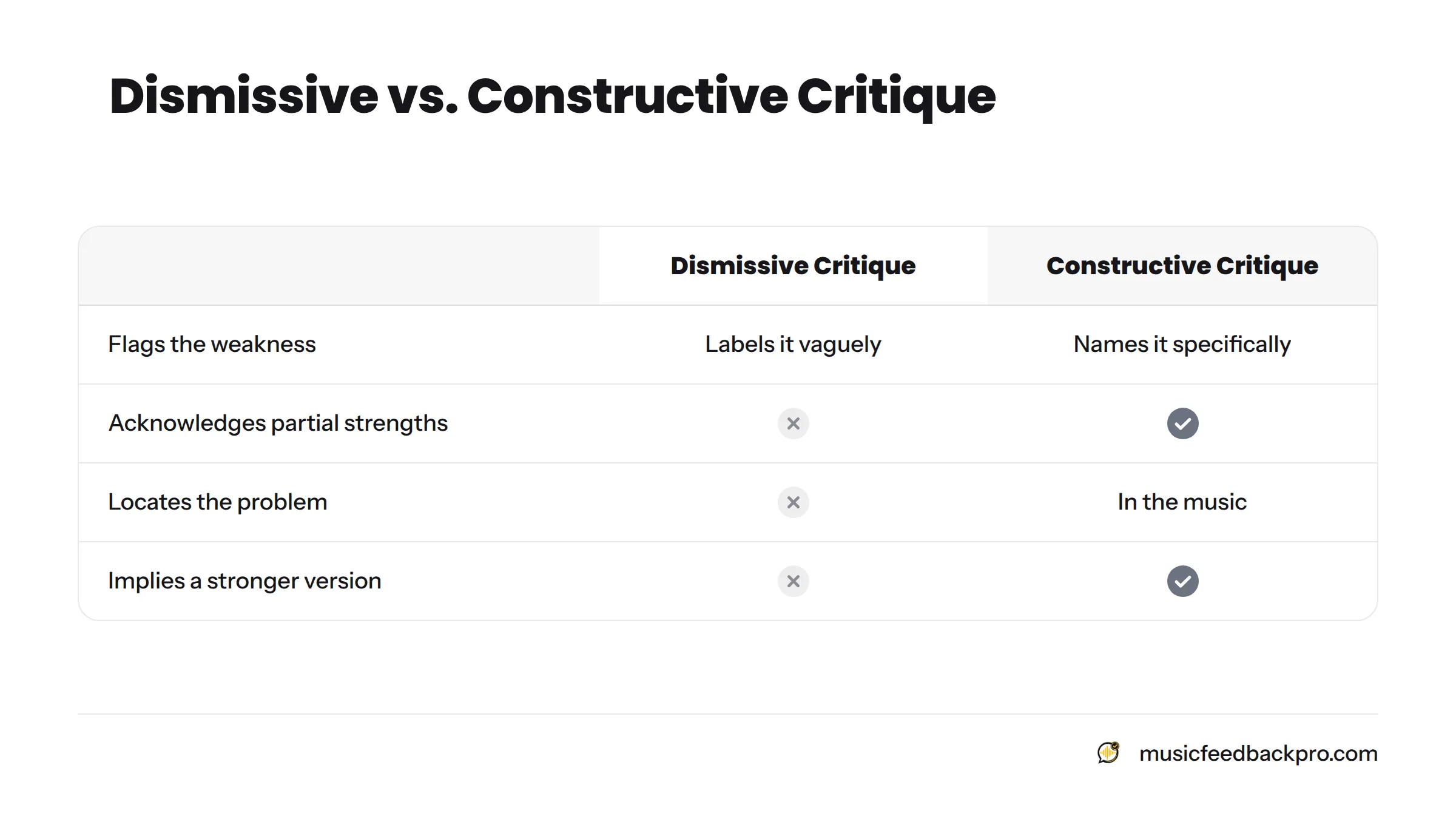
Here is the distinction in practice:
- Dismissive: "The lyrics are weak and clichéd."
- Constructive: "The lyrical imagery leans on familiar metaphors - moonlight, roads, leaving - that the emotional delivery almost rescues, but the writing needed a sharper edit before the recording stage."
The second version is more honest, more useful, and more credible. It flags the weakness, identifies the root (lack of originality in the imagery), acknowledges what partially works (the delivery), and locates where the problem could have been addressed.
Phrases that signal constructive intent: "the potential here is audible," "the approach works against its own strengths," "a stronger mix decision would have," "the idea is sound even when the execution..."
Phrases that read as dismissive: "simply bad," "completely fails," "no redeeming quality," "a waste of time."
From Music Feedback Pro's editorial team vetting observations: "A useful critical note names the problem, locates it in the music, and implies what a stronger version would look like. An unhelpful note just delivers a verdict with no map."
Understanding what music feedback means for artists explains why this constructive framing is not softness - it is rigour.
Step 7: Write a Conclusion That Delivers a Clear Verdict
A verdict section must do three things: summarise the critical angle, state your overall assessment, and tell the reader who this release is for. If a reader skips the entire body and reads only your conclusion, they should still walk away informed.
Vague conclusions betray the rest of the review. "Overall, this is an interesting project with some strong moments" says nothing. A clear verdict sounds like: "This is a debut that earns its ambition more often than not - raw where polished would have been safer, and specific where it would have been easier to be generic. Listeners who came to [Genre X] for honesty will find it here."
Should You Use a Rating Score in a Music Review?
The scores versus words debate is genuine and long-running. Numeric ratings compress a multi-dimensional response into a single decontextualised figure - a 7/10 on one site means something different to a 7/10 on another.
Music Feedback Pro's editorial position, consistent with what the team sees in strong curator samples, is that a prose verdict is more useful than a number. A score invites comparison without context. A prose verdict tells the reader why the release earns its place, and for whom. If your platform requires a score, pair it with a verdict paragraph - never let the number stand alone.
For reference, see music review examples to model for how vetted reviewers deliver verdicts across different release types.
Step 8: Edit for Tone, Evidence, and Readability Before You Publish
Most first-draft reviews fail not because the thinking is wrong but because the writing has not been tested. The editing step is where good reviews become trustworthy ones.
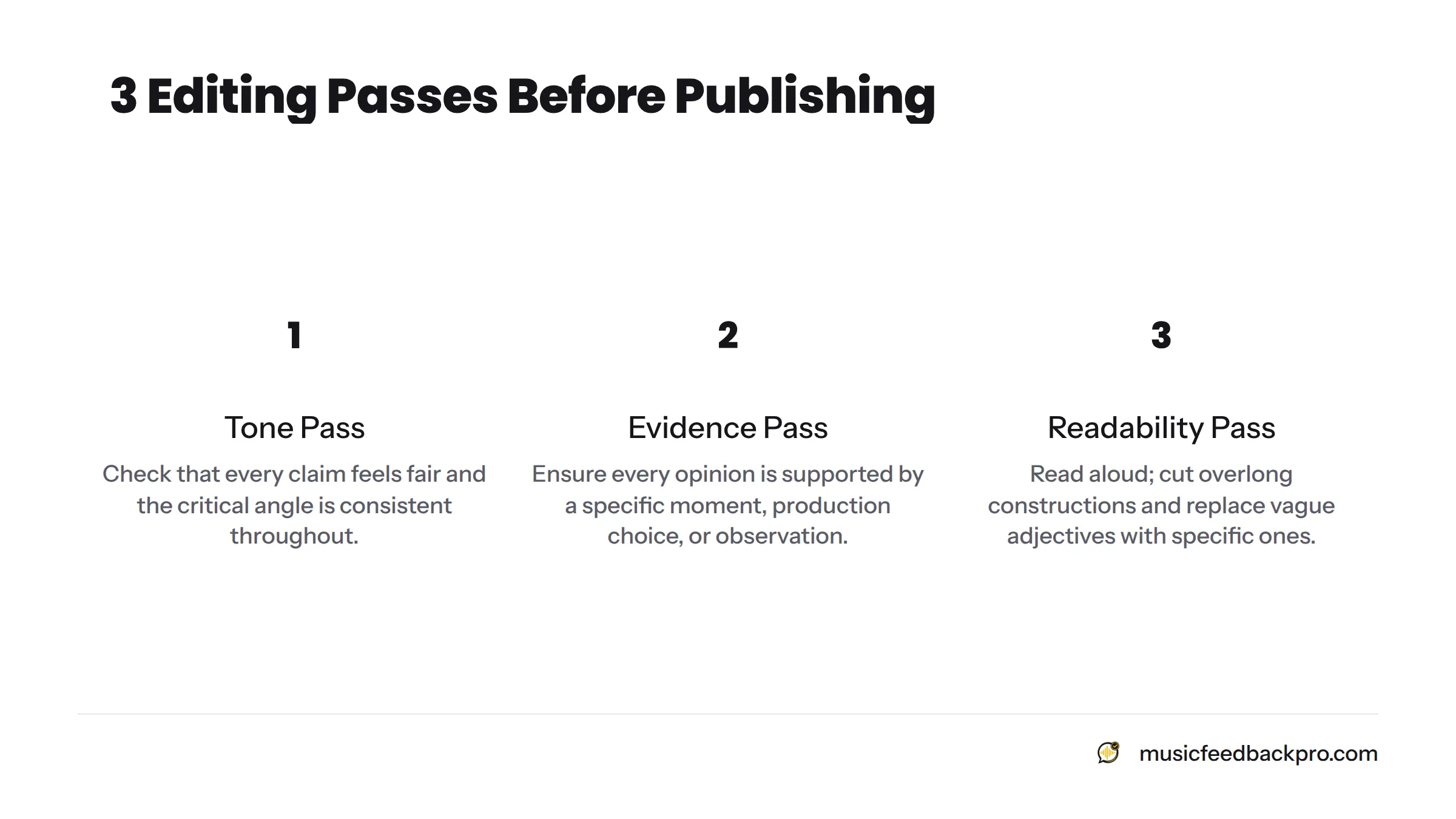
Run three sequential passes before publishing:
- Tone pass - Does every claim feel fair and grounded? Is the critical angle consistent throughout, or does the review drift between positions? Cut anything that reads as personal grievance rather than critical observation.
- Evidence pass - Is every opinion supported by a specific moment, production choice, or structural observation? If a paragraph contains an unsupported adjective, either add the evidence or cut the claim.
- Readability pass - Does the review read clearly for a general music audience? Read it aloud. Sentences that are hard to say are hard to read. Cut overlong constructions and replace vague adjectives with specific ones.
Pre-publish editing checklist:
- Opening names the release and delivers the critical angle within the first two sentences
- Every opinion is backed by a specific observation, timestamp, or named element
- No unsupported superlatives (incredible, stunning, perfect) appear without evidence
- The critical angle is consistent from opening to verdict
- Constructive framing is used for any weaknesses identified
- Verdict section states who the release is for
- Vocabulary is precise - at least five technical terms are used accurately
- Reading aloud reveals no awkward phrasing or stalled sentences
Ready to Put This Into Practice?
If you have worked through these eight steps and found that the process suits how you think and listen, reviewing music as a vetted critic is the logical next move. Music Feedback Pro connects independent artists with experienced reviewers who follow exactly this kind of structured, evidence-based process.
Aspiring reviewers can become a verified music curator on Music Feedback Pro - the application process is how the editorial team assesses whether a reviewer's samples meet the standard this guide describes.
Artists looking for a structured, honest assessment of their own work can explore professional music critique from vetted critics on the platform.
Frequently Asked Questions
How do you do album reviews? Follow the same 8-step process - listen multiple times across different passes, research the artist's context and the album's stated intent, define a critical angle, write a positioned opening, and analyse the release using precise technical language. For albums specifically, also consider how individual tracks relate to each other: does the sequencing serve a narrative or emotional arc? Does the album sustain its argument across its full runtime, or does it peak early? Balance critique with constructive observation, deliver a verdict that addresses the album as a whole, then edit. The album review structure adds one layer the song review does not require: accounting for the cumulative effect of the full body of work, not just standout tracks.
How do I write a review example? Start with your critical angle - for example, "an assured debut that trades production polish for raw authenticity" - then support it with specific observations drawn from each element: vocals, lyrics, arrangement, and production choices. Build the body by walking through those elements with evidence, balance any weaknesses constructively, and close with a verdict that tells the reader who the release is for. See music review examples to model for annotated examples that demonstrate how vetted reviewers apply this structure in practice.
How do I write about music? Writing about music means translating sound into specific, evidence-backed language. Describe what you hear using precise terms - production, dynamics, timbre, register - and contextualise those observations against the artist's intent and genre conventions. The goal is not to describe your emotional state but to make a clear argument about what the music does and whether it does it well. A string of impressions is not a review. An argument supported by specific observations from the music is.
How do you write for Pitchfork? Pitchfork commissions established critics with a demonstrable reviewing track record and a distinctive critical voice. The same fundamentals this guide covers apply: a strong critical angle, technical specificity in the body, contextual depth from solid research, and clean prose that earns its conclusions. Building a portfolio of structured, evidence-based reviews on a vetted platform is a standard path toward the kind of track record Pitchfork and similar publications look for. The guide above is how that portfolio gets built.
What is a music review template or structure? A music review template follows three broad sections: an opening that establishes the release and states the critical angle (50-100 words), a body that analyses each musical element with specific evidence (production, song structure, vocal performance, lyrical content, arrangement), and a verdict that summarises the critical angle and states who the release is for. Within that structure, the 8 steps in this guide map the full process from first listen to final edit. This album review structure applies to singles and EPs with appropriate scope adjustments.