
Music Feedback Pro connects independent artists with vetted music critics for honest, long-form song feedback. Submit your track free. Pay the flat £15 campaign fee only after editorial approval. Your campaign runs for 30 days, and you decide which curator offers to accept - no pressure, no hidden costs, no risk.
[Submit Your Track Free - No Charge Until Your Campaign Is Approved]
A Song Critique Service Built Around Human Judgment, Not Algorithms
Music Feedback Pro is a song feedback platform built specifically for independent artists who need more than a thumbs-up. Every piece of feedback exchanged on the platform comes from a vetted music critic or curator - a real person with a documented editorial track record, not an automated scoring engine.
If you want a fuller picture of the platform's purpose, you can read more about what music feedback is and how it works. The short version: this is structured, human critique delivered in formats you can actually use.
The vetted-curator model is what separates Music Feedback Pro from everything else in the market. Before any curator can send you an offer, they have already been screened for content quality, consistency, and genre relevance. That means the feedback you receive reflects genuine listening and genuine expertise - not a formula.
Open to All Genres and Career Stages
Music Feedback Pro accepts campaigns across a wide range of genres:
- Hip-Hop and R&B
- Folk, Americana, and Singer-Songwriter
- Jazz and Soul
- Metal, Rock, and Punk
- Electronic, Dance, and Ambient
- Classical crossover and experimental work
- Pop and Indie Pop
Whether you released your debut single last week or you are preparing a third album, the platform is open to you. There is no membership gate, no genre restriction, and no career-stage requirement.
Why Generic Opinions Stall Your Progress
You have probably run into at least one of these three feedback failures.
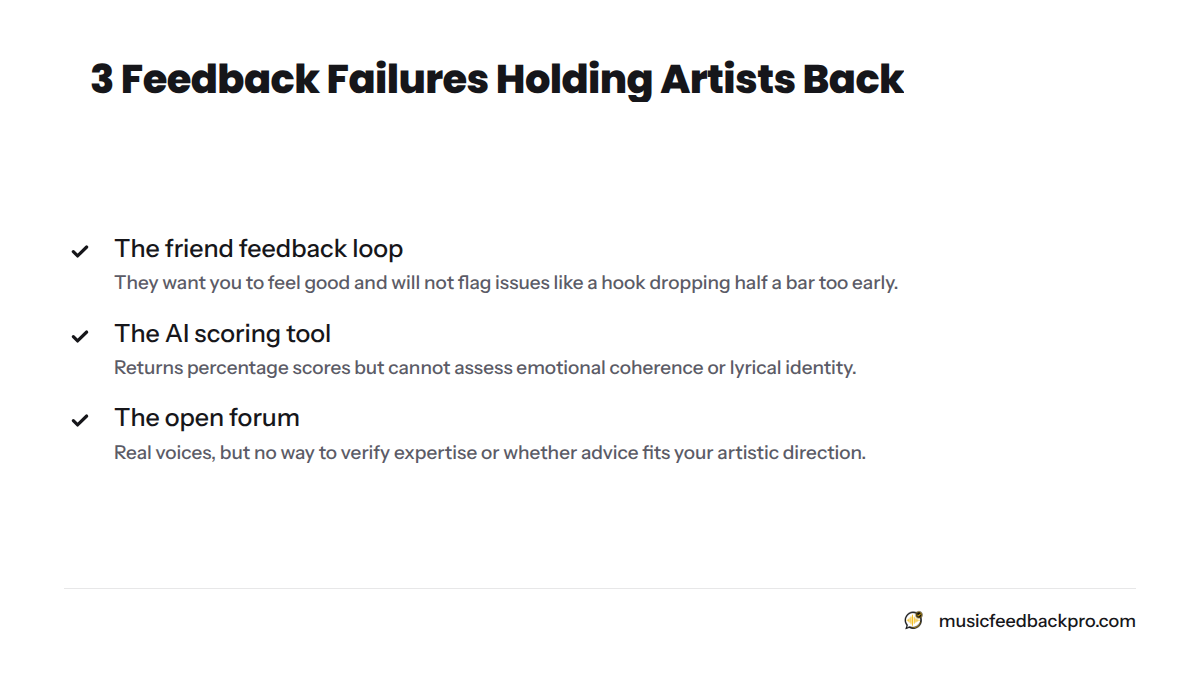
The friend feedback loop. Someone who cares about you listens and says "sounds great." They mean it. But they are not going to tell you that your chorus hook drops half a bar too early, or that the low-mid buildup is masking your lead vocal. They want you to feel good - and that is exactly the problem.
The AI scoring tool. These tools measure signal patterns and return percentage scores across production dimensions. Some are genuinely useful for technical benchmarking. What they cannot do is tell you whether your bridge is emotionally incoherent, whether your lyrical imagery contradicts your sonic identity, or whether the song is ready for the audience you are chasing. Context is a human skill. If you want to go deeper on why that matters, how to get feedback on your music breaks it down clearly.
The open forum. Reddit threads and Discord servers surface real voices. The problem is that you cannot verify who is speaking, what their expertise is, or whether their advice is consistent with where you are trying to go artistically.
The problem is not that you are not getting feedback. It is that none of it is telling you what to actually change.
What You Actually Receive: Feedback Formats, Explained
Let's be specific about what a professional song review on Music Feedback Pro looks like.
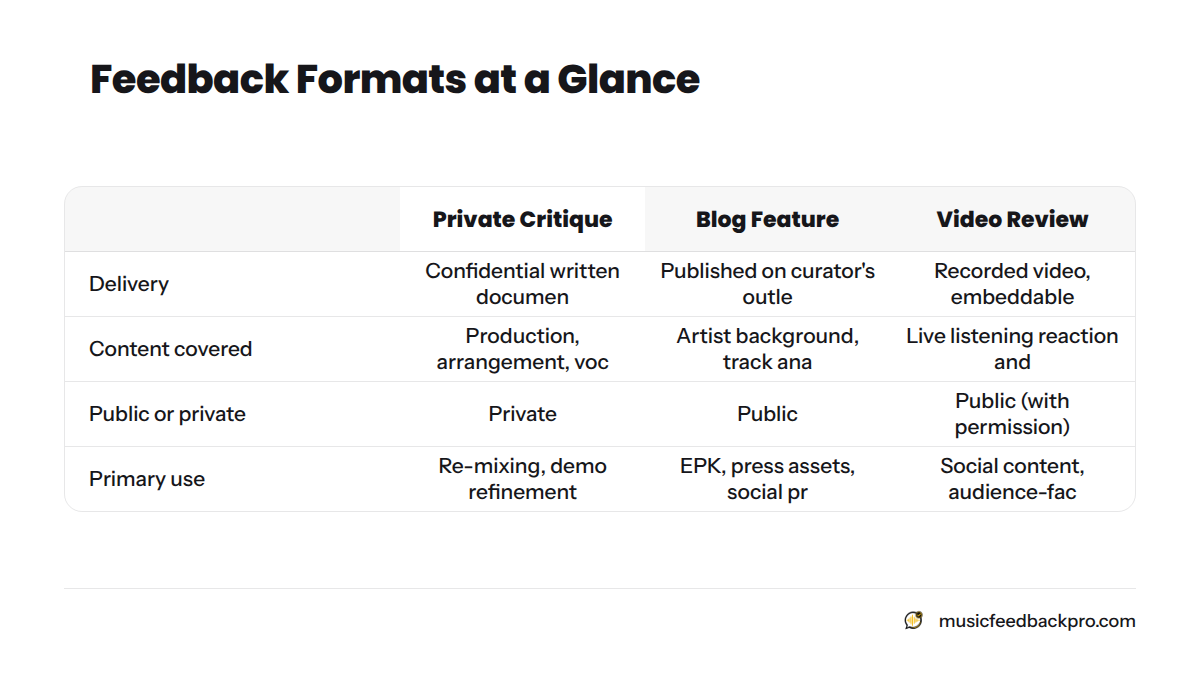
| Format | What It Covers | How Artists Use It |
|---|---|---|
| Private Critique | Production, arrangement, vocals, lyrics, commercial potential | Self-directed improvement, re-mixing, demo refinement |
| Blog Feature | Artist background, track analysis, public recommendation | Press asset, EPK material, social proof |
| Video Review | Live listening reaction, verbal critique, scored or structured commentary | Embeddable media, social content, audience-facing proof |
Private Critique
A private critique is a written, long-form analysis delivered directly and confidentially to you. The curator works through your track systematically - production choices, arrangement structure, vocal performance, lyrical clarity, and where applicable, commercial positioning. You receive a document you can return to repeatedly as you refine your work. Artists use private critiques to inform re-recording decisions, guide mixing sessions with their engineer, and benchmark progress between releases.
Blog Feature
A blog feature is a published written review that appears on the curator's editorial outlet or music blog. It covers your background as an artist, a detailed analysis of the track, and a public recommendation to the curator's readership. That distinction matters: unlike a private critique, a blog feature is a public record. Artists routinely use blog features as press assets in their electronic press kit (EPK), on their website, and in social media content. A strong blog feature from a credible outlet signals to bookers, labels, and festival programmers that your music has passed independent editorial scrutiny.
For a closer look at what professional critique looks like, that resource covers the craft of critique in useful depth.
Video Review
A video review is a recorded critique by a YouTube-based or video-format curator. It captures a live listening reaction alongside structured verbal commentary, sometimes scored against specific criteria. The value is dual: you get honest, spoken feedback from someone listening in real time, and you receive a piece of embeddable video content you can share with your audience as transparent, third-party proof that your music has been reviewed by a genuine critic.
How Real Artists Have Used Their Feedback
These are anonymised examples drawn from real campaigns on the platform.
An indie folk artist preparing a festival application received a blog feature from a curator specialising in acoustic and Americana music. She used the published review as the central press asset in her EPK, submitting it alongside her application to three UK festivals. She credited the feature with making her submission feel professionally documented rather than self-promotional.
An electronic producer releasing his second EP requested a private critique targeting his mix decisions specifically. The curator's written feedback identified that sub-bass frequencies were competing with the kick pattern across three of the four tracks. He took that note back to his mixing engineer before the release date, adjusted the low-end relationship on each track, and described the change as the clearest mix improvement he had made in two years.
A singer-songwriter building her first press profile used a video review as the anchor of her social rollout for a new single. The curator's recorded reaction - shared with permission - reached her audience as a transparent, third-party listening experience. She gained more meaningful engagement from that single video share than from any previous promotional post.
You can browse reviews of Music Feedback Pro to read more from artists about their experience with the platform.
The Vetting Step: How Curators and Submissions Are Screened
Getting honest track feedback depends entirely on who is doing the listening. Here is how Music Feedback Pro ensures quality on both sides of every campaign.
How Curators Are Vetted
Every curator goes through an editorial review before they can participate in campaigns. The vetting process checks their published content history for consistency and quality, assesses whether their output reflects genuine listening rather than formulaic reviewing, confirms that their claimed genre expertise is reflected in their actual published work, and reviews their track record for reliability and professionalism.
Curators who lack a demonstrable editorial history, produce low-effort or generic content, or whose stated genre specialisms do not match their actual output are not approved. The result is a curator marketplace where every offer you receive comes from someone with a verifiable reason to be there.
How Submissions Are Screened
Your campaign submission goes through an editorial review before it is approved. The team checks that your track link is functional and correctly attributed, that your campaign includes complete press information - bio, genre, release date, press goals - and that the submission meets the platform's standards for completeness and professional presentation.
If your submission is incomplete, you receive specific guidance on what needs to be addressed before resubmitting. If a submission does not meet the editorial threshold, it is declined - and because the platform operates on a pay-after-approval model, you are not charged. Across the platform's campaign history, the approval process has maintained consistent standards across thousands of submissions, with rejection rates that reflect genuine editorial selectivity rather than rubber-stamping.
Vetting protects both sides. Artists get feedback from qualified critics. Curators get complete, professional submissions worth their time.
How to Submit Your Track and What Happens Next
Here is the exact process from first click to feedback delivery:
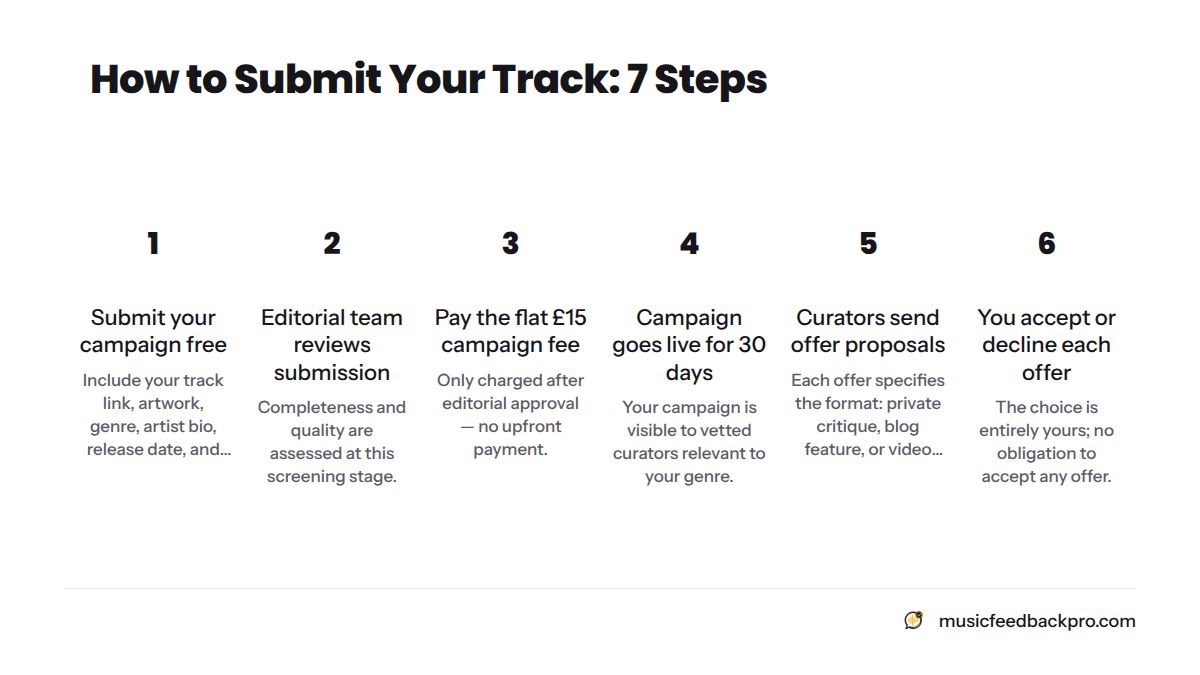
- Submit your campaign free - include your track link, artwork, genre, artist bio, release date, and press goals.
- Music Feedback Pro's editorial team reviews your submission - this is the screening stage where completeness and quality are assessed.
- Approved? Pay the flat £15 campaign fee to activate your campaign. You can review the flat £15 campaign fee in full before committing.
- Your campaign goes live for 30 days on the curator marketplace, visible to vetted curators relevant to your genre.
- Vetted curators send you offer proposals - each offer specifies whether it is a private critique, blog feature, or video review.
- You review each offer and accept or decline - the choice is entirely yours; there is no obligation to accept any offer you receive.
- Accepted offers are funded via escrow - funds are held securely until your feedback is delivered and confirmed, protecting both you and the curator.
For a complete walkthrough of how a campaign runs from submission to delivery, the platform's dedicated guide covers every stage in detail. If you want to set your campaign up for the best possible results from the start, a guide to launching a successful music feedback campaign is the right place to begin.
[Submit Your Track Free - No Payment Until Approved]
Who This Song Critique Service Is Built For
Music Feedback Pro is the right fit if you recognise yourself in any of these:
- Independent musicians releasing original work who need structured, expert critique before or after a release.
- Emerging artists building their first press profile - the blog feature format gives you credible, third-party documentation of your music at a stage when you have no label PR behind you.
- Music producers seeking written critique of a track's arrangement, mix, or sonic direction from someone qualified to assess it.
- Music PR teams managing artist campaigns who need credible, independently published feedback assets to support press outreach.
- Artists at any career stage who have stopped growing because the feedback they receive is not specific enough to act on.
If that last one sounds familiar, the song reviewer platform for independent artists guide explains exactly how a structured critique process fits into an artist's broader development. And if you want to understand how Music Feedback Pro sits within the wider range of available options, the 5 best music feedback sites for independent artists in 2026 gives you an honest comparison.
Ready to hear what your music actually sounds like to someone who knows what they are listening for?
Submit your campaign free today. Pay £15 only after editorial approval. No hidden fees. Full artist control from offer to delivery.
[Start Your Free Submission]
Frequently Asked Questions
What types of feedback does Music Feedback Pro offer? Music Feedback Pro offers three deliverable formats: a private critique (a written, long-form analysis delivered confidentially), a blog feature (a published written review on the curator's editorial outlet), and a video review (a recorded listening and critique from a video-format curator). Each format serves a different purpose, and you can indicate your preferences when submitting your campaign.
How long does it take to receive feedback after my campaign is approved? Your campaign runs for 30 days once activated. Curator offers typically arrive within the first two weeks of your campaign window, and feedback delivery follows once you accept an offer and the curator completes their review. Timelines vary by curator, and each offer proposal will indicate the curator's expected delivery window.
What happens if my campaign is not approved? If your submission does not pass the editorial review, you receive specific guidance on what needs to be addressed. Because the platform operates on a pay-after-approval model, you are not charged anything for a declined submission. You can revise and resubmit at no cost.
Can I choose which curators give me feedback? Yes. Curators send you offer proposals; you review each one individually and choose whether to accept or decline. You are never locked into a curator automatically. Full control of which offers you accept stays with you throughout the campaign.
What genres does the platform cover? Music Feedback Pro accepts campaigns across a wide range of genres including Hip-Hop, R&B, Folk, Jazz, Metal, Rock, Electronic, Pop, Singer-Songwriter, Ambient, Classical crossover, and more. The platform does not restrict participation to any single genre or regional tradition.
Is there a risk if I don't receive any curator offers? If your approved campaign runs its 30-day window without generating curator offers, you have paid the £15 campaign activation fee but received no feedback charges beyond that. The escrow model means funds for accepted offers are only released on confirmed delivery - so you are never charged for feedback that was not delivered.
How is this different from getting AI-generated feedback? AI tools analyse audio signal data and return scores against technical parameters. They do not listen contextually, they cannot assess whether your creative choices serve your artistic identity, and they have no understanding of your audience or your goals. Music Feedback Pro's vetted curators bring human judgment, genre expertise, and editorial experience to their critique - the kind of feedback on your song that tells you not just what is happening in your track, but what it means and what to do about it.
Can I use my feedback deliverable as a press asset? Yes, and many artists do. A blog feature is a published editorial record that you can include in your EPK, link from your website, and share on social media. A video review is embeddable content. A private critique is confidential by design, but the insight it gives you feeds directly into the quality of the work you release publicly. Get your music reviewed and start building a press record that speaks for itself.