
Most people picture one thing when they hear "music review" - a write-up in a magazine or on a music blog. In practice, the term covers at least seven distinct professional formats, each with its own audience, length, tone, and purpose. Knowing which format you're reading - or receiving - changes how you interpret it, and more importantly, what you do with it next.
A good professional music review is a structured, specific evaluation of a track, EP, or album written by a vetted critic. It describes the sound, places the artist within their genre, and assesses craft elements like production, composition, and vocals. Reviews may be private (for the artist only) or public (for readers and press). The seven formats below cover the full range used by working critics and independent artists in 2026.
The seven formats are:
- Private Critique
- Public Blog Feature
- Video Review
- Genre-Context Review
- EP or Album Overview
- Pull-Quote Review
- Constructive Critique
Each one serves a different audience, carries a different tone, and opens different doors for the artist who receives it. Let's walk through a real sample music review example of each.
For aspiring critics curious about the craft, New York Times chief music critic Jon Pareles shares his review writing process in a short video well worth four minutes of your time.
Example 1 - The Private Critique: Honest Feedback Meant for the Artist's Eyes Only
What this format looks like
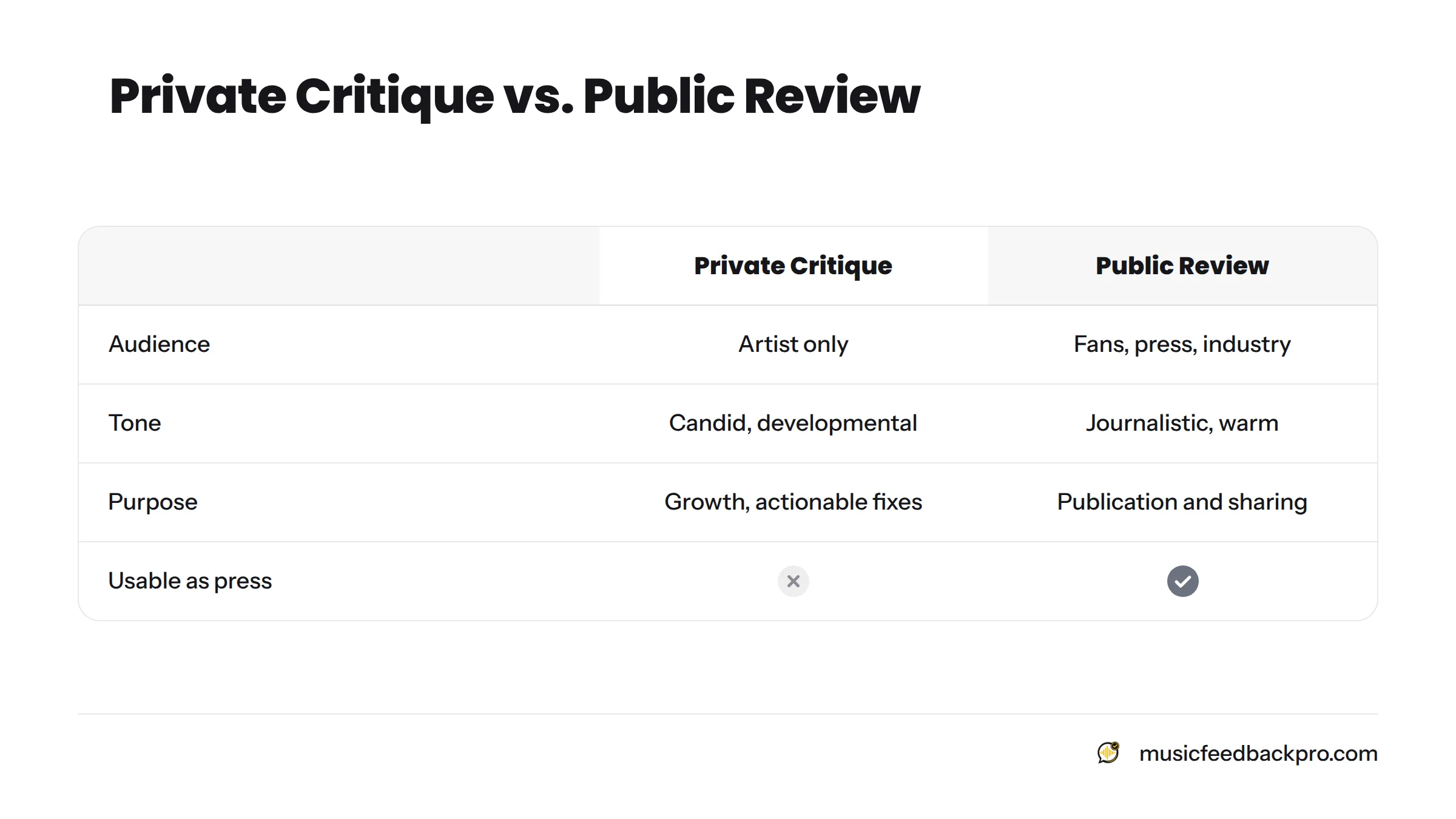
A private critique is a written review delivered directly to the artist and never intended for publication. It is candid, developmental, and structured around the specific craft elements of the submission. On the Music Feedback Pro platform, private critiques arrive as detailed written reports covering production quality, vocal performance, compositional choices, lyrical strength, and commercial positioning.
Here is a representative music review example drawn from a Music Feedback Pro campaign, shared with the artist's permission:
"The opening eight bars establish atmosphere effectively - the reverb-heavy guitar sets a melancholic tone that suits your vocal timbre. Where the track loses momentum is at the pre-chorus: the build is telegraphed too early, which deflates the impact of the chorus drop. Your vocal sits slightly hot in the mix relative to the mid-range instrumentation, which creates a crowded centre image. Recommend revisiting the EQ on the lead vocal between 2kHz-4kHz and giving the guitar a narrower stereo field. The song's emotional core is genuine - the production just needs space to let it breathe."
What this example does well
Several things make this excerpt work as a good music review structure. First, it is specific: it references a precise frequency range and a named structural moment ("the pre-chorus"), rather than offering vague praise or criticism. Second, it is actionable - the artist can open their DAW and address the exact problem described. Third, it balances honest criticism with genuine encouragement, which is the hallmark of a well-calibrated private critique. The tone is professional rather than harsh, and the artist finishes reading knowing exactly what to fix.
How artists used it
The artist who received this critique used it before finalising their mix. They sent the notes to their mixing engineer, who addressed the EQ crowding in the revision. The subsequent version went on to receive a public blog feature - which brings us to format two. Private critiques are not press assets in themselves, but they often shape the next release that earns the public review.
For a deeper look at how track feedback from real curators differs from informal peer opinions, the platform's dedicated track feedback page is the clearest starting point.
Example 2 - The Public Blog Feature: A Narrative Review Built for Readers
What this format looks like
A public blog feature is a narrative review written for an audience of music fans, bloggers, and industry readers. Unlike a private critique, it is designed to be published, indexed, and shared. The critic adopts a journalistic voice, introduces the artist to readers who may not know them, and evaluates the work within the context of the artist's catalogue and genre.
Here is a blog review sample from a Music Feedback Pro blog feature campaign, shared with the artist's permission:
"South London-based producer Callum Reeve has spent three years building a catalogue that sits comfortably between late-night electronica and melancholic pop songwriting. His latest single, 'Harbour Lights,' is the clearest distillation of that sensibility yet. The production is restrained where lesser tracks would reach for bombast - a sparse drum pattern, a piano loop that cycles with hypnotic patience, and Reeve's own vocal, processed just enough to feel intimate without losing presence. It is the kind of song that earns a second listen before the first one ends."
What this example does well
This excerpt does three things immediately: it introduces the artist to an unfamiliar reader, positions the work within a recognisable genre space (late-night electronica, melancholic pop), and makes a specific evaluative claim ("the clearest distillation of that sensibility yet"). The phrase "earns a second listen before the first one ends" is exactly the kind of sentence that survives extraction as a pull quote. The tone is warm but critical, written for readers who care about music, not just for the artist.
How artists used it
Callum linked the published blog feature from his artist bio and embedded the URL in his electronic press kit under "Press." He shared the post on his social channels during the single's release week, which drove both blog traffic and Spotify saves. The blog feature became the anchor document for his next round of playlist pitching.
Here is a direct comparison of the two formats covered so far:
| Format | Audience | Tone | Typical Length | Publishable? | Press Asset Value |
|---|---|---|---|---|---|
| Private Critique | Artist only | Candid, developmental | 200-500 words | No | Indirect (informs next release) |
| Public Blog Feature | Music fans, industry | Narrative, editorial | 300-600 words | Yes | High (EPK, bio, social, pitching) |
For artists building long-term coverage, music blog features as durable press assets is worth reading alongside this page.
Example 3 - The Video Review: Spoken Commentary With Timestamped Reactions
What this format looks like
A video review is a spoken critique recorded and published on a platform like YouTube. The critic listens to the track on camera and delivers timestamped reactions - pausing to comment on specific moments as they arrive: the intro, the first chorus, a production detail at 1:42, the outro fade. This format gives the viewer a real-time window into a critic's listening experience that written reviews cannot replicate.
A typical video music review example from a Music Feedback Pro-affiliated critic runs five to eight minutes for a single track. The critic opens by stating the genre and artist context, plays the track (or key sections), and inserts spoken commentary at specific timestamps. The session often ends with an overall verdict and a star or percentage rating.
What this example does well
The timestamp structure is the video format's most distinctive strength. When a critic says "at 2:15, the bassline drops out and everything opens up - this is the song's best moment," the viewer can verify that claim immediately. This creates a transparency that builds trust between critic and audience. For the artist, it pinpoints exactly which moments resonated and which fell flat. Spoken delivery also communicates enthusiasm or hesitation in ways that text cannot - tone of voice carries information that punctuation simply cannot encode.
How artists used it
Artists who receive video reviews commonly embed the YouTube link on their official website under a "Press" or "Reviews" section. A video review carries social proof that static text cannot: viewers see a real person reacting to the music in real time. Several artists on the Music Feedback Pro platform have shared video review links as the primary piece of social proof in pitch emails to sync supervisors and playlist curators.
For a structured look at how spoken and written formats compare, the guide to video versus written review formats covers the differences in detail.
Example 4 - The Genre-Context Review: Placing a Track Within Its Scene
What this format looks like
A genre-context review situates a track within its genre lineage and evaluates it against scene peers rather than treating it as an isolated piece of work. This is a named journalistic approach used by critics who specialise in a particular scene - jazz, UK garage, contemporary classical, hyperpop, or any genre with a defined tradition and active community.
Here is a song review example from a Music Feedback Pro genre-context campaign, shared with the artist's permission:
"Within the current UK jazz revival - a scene whose credibility rests on names like Nubya Garcia, Shabaka Hutchings, and Moses Boyd - Amara Diallo's 'Meridian' arrives as an assured statement of purpose. The track's harmonic language owes a clear debt to Hutchings' post-bop vocabulary, but Diallo's production sensibility - the filtered synth pads, the sub-bass underpinning the rhythm section - marks a younger generation's claim on the form. This is not imitation; it is conversation."
What this example does well
The critic demonstrates genuine scene knowledge by naming active scene figures and situating the artist's work relative to them. That is what gives the review authority beyond generic praise. The phrase "not imitation; it is conversation" makes a specific critical argument that a reader of this genre will either agree or disagree with - and that kind of critical engagement is the hallmark of strong genre-context writing.
How artists used it
Genre-context reviews are the most targeted press asset in this list. Amara used the published version when pitching to niche blogs and music journalists covering the UK jazz scene specifically. A review that names your genre peers gives a niche editor immediate evidence that your music belongs in their editorial orbit. It also makes playlist pitching to genre-specific curators considerably easier.
For a broader look at why reviews matter for career momentum, what a professional music review does for your career covers the strategic picture in full.
Example 5 - The EP or Album Overview: Reviewing a Body of Work Track by Track
What this format looks like
An EP or album overview is a multi-track review that evaluates a body of work as a whole. The critic moves through the release track by track, commenting on individual songs before stepping back to assess the arc of the project - its thematic coherence, its production consistency, its emotional journey from opening track to closer.
A typical Music Feedback Pro EP overview follows this structure: a short introductory paragraph establishing the artist and release context, a track-by-track section where each song receives two to four sentences of specific commentary, and a closing paragraph that evaluates the EP as a unified piece of work rather than a collection of singles.
Here is a representative album review example excerpt, shared with artist permission:
"Track 1, 'Glass Morning,' sets the register for the whole project - sparse, introspective, and built on a vocal performance that trusts silence as much as sound. Track 3, 'Seventeen Steps,' is the EP's commercial peak: the chorus melody is the most immediate thing here, and it earns its brevity. The closing track, 'Salt Flat,' lands differently after what preceded it - the stripped production feels like a deliberate exhale after the mid-project intensity. As an EP, this holds together in a way that suggests Yara Issa knows exactly what she is building."
What this example does well
The excerpt does not treat every track equally - it identifies a standout, notes a closer that works because of what came before it, and makes a final argument about the artist's intentionality. That editorial judgment is what separates an EP overview from a track listing with adjectives. The comment on Track 3 being "the EP's commercial peak" gives the artist a clear signal about which song to lead with in pitching.
How artists used it
Yara included the published EP overview in her press kit for the release cycle. When pitching to labels and sync supervisors, she referenced the full review URL and extracted the "knows exactly what she is building" line as a pull quote on her EPK cover page. EP overviews carry particular weight in full-release press coverage because they demonstrate that a critic engaged with the entire project, not just a single track.
Example 6 - The Pull-Quote Review: Short, Press-Ready, and Shareable
What this format looks like
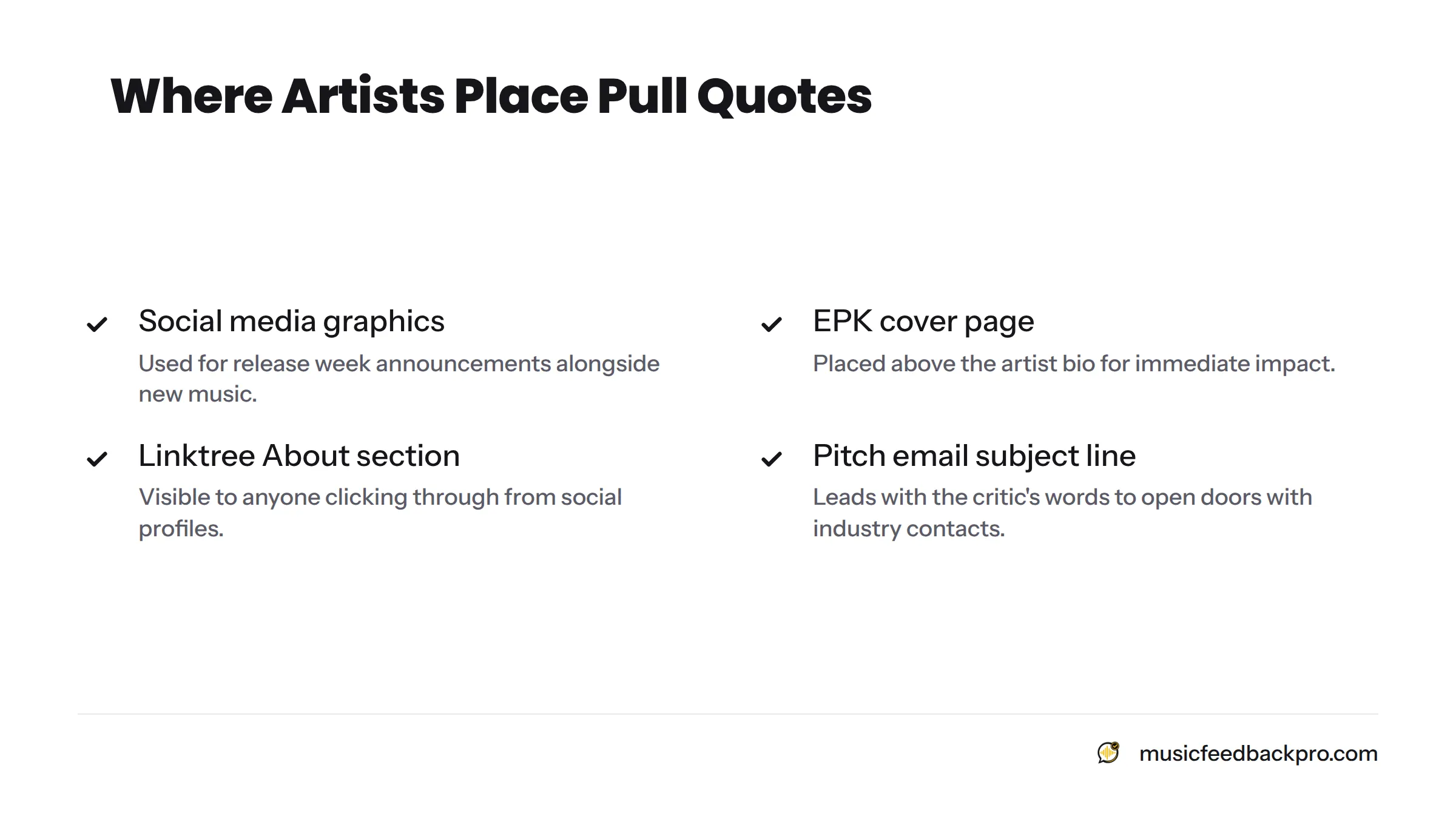
A pull-quote review is a one-to-three sentence evaluation designed from the outset for visual and social use. It is the most compressed professional format - the critic's entire judgment distilled into language that can live on a press kit cover page, a social graphic, or a Linktree bio without losing its meaning.
Here are three real pull-quote music review examples from Music Feedback Pro campaigns, shared with artist permission:
"A voice that makes you stop scrolling."
"Production this considered rarely arrives this early in a career."
"'Orbit' is the kind of debut single that makes you want to hear the album that follows it."
What this example does well
Each of these pull quotes works for the same reason: it makes a single, confident claim in compressed, image-ready language. The first uses a second-person hook that the reader projects onto themselves. The second uses contrast - considered production against an early career - to imply the artist is ahead of schedule, a potent signal for industry readers. The third uses anticipation as a compliment: it is not just praise for the song but an investment in what comes next. Every word earns its place.
How artists used it
Pull quotes are the most practically reused format in this list. Artists placed these three examples on social media graphics for release week, the cover page of their EPK (above the artist bio), the "About" section of their Linktree, and the subject line of pitch emails. The Music Feedback Pro platform delivers pull quotes alongside longer reviews specifically because artists need both: the full review for credibility, and the distilled quote for immediate use.
Once you have a pull quote, adding review quotes to your press kit explains exactly where and how to place them for maximum impact.
Example 7 - The Constructive Critique: Strengths, Weaknesses, and Next Steps
What this format looks like
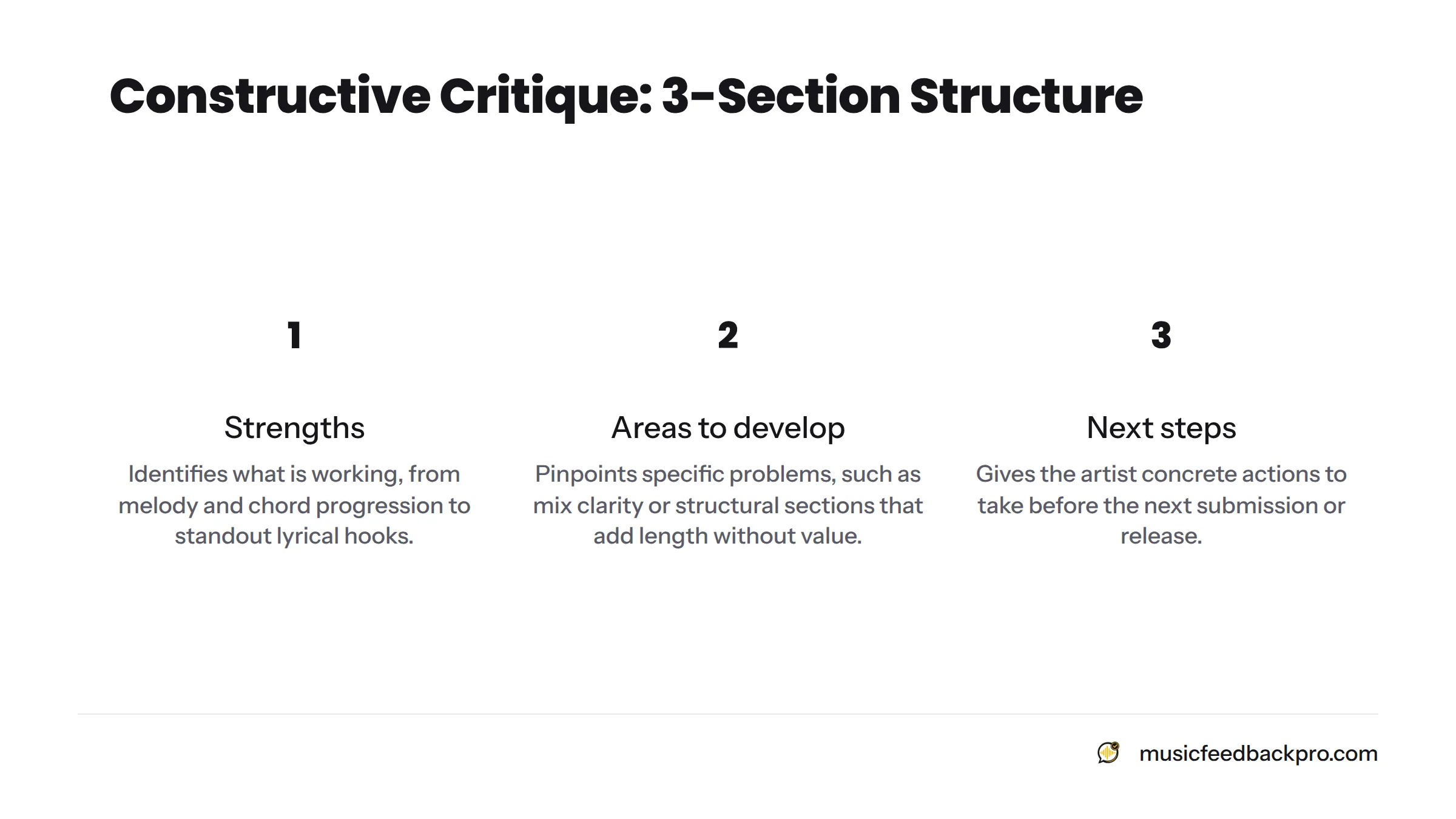
A constructive critique is a structured review built around three explicit sections: what is working, what is not working, and what the artist should do next. It is developmental rather than purely evaluative - written for the artist's growth rather than a reader's entertainment. This format is most commonly used for pre-release demos and early-stage recordings where the artist still has production decisions to make.
Here is a representative constructive critique excerpt from a Music Feedback Pro campaign, shared with artist permission:
Strengths: The song's core melody is strong and sits naturally in the vocal's most comfortable register. The chord progression in the verse creates genuine emotional tension that the chorus resolves well. The lyrical hook ('every room I leave behind') is the most memorable line in the track and should be more prominent.
Areas to develop: The mix lacks low-mid clarity - the kick and bass occupy the same frequency space, which muddies the bottom end on consumer earbuds. The bridge section adds length without adding emotional information; consider cutting it entirely or repositioning it before the final chorus.
Next steps: Send the stems back to your engineer with notes on the kick/bass frequency clash. Test the track without the bridge in a listening session and compare listener response. Once the mix is addressed, this track is ready for blog submission.
What this example does well
The explicit three-section structure means the artist knows exactly where to look for praise, where to look for problems, and what action to take. The "next steps" section is the critical differentiator between a constructive critique and a negative review: a negative review evaluates and exits; a constructive critique evaluates and propels forward. The note about consumer earbuds is a concrete, real-world detail that shows the critic considered the track's actual listening environment - not just a studio monitor perspective.
How artists used it
The artist who received this critique shared the document with their producer before the final mix session. The bridge was removed, the mix was addressed, and the track was submitted to a blog three weeks later. Constructive critiques are not typically shared publicly, but several artists on the platform have shared the "next steps" section with collaborators as a shared production brief.
How Artists Turn Reviews into Press Assets
Across all seven formats, the artists who got the most value from their reviews treated them as career documents rather than one-time reads. Here is how platform artists have turned reviews into durable press coverage:
- Save the full review URL and link it from your artist bio - a live, published review builds immediate credibility for anyone who clicks through.
- Extract a pull quote for social graphics - one sentence from a blog feature or genre-context review can become a visual that accompanies every new release announcement.
- Include the review in your EPK under "Press" - a vetted critic's words carry more weight with labels and sync supervisors than self-written biography copy.
- Share the blog feature link when pitching - a published review demonstrates that at least one credible voice has already evaluated and endorsed the work.
- Use private critique feedback to refine your next submission - the private critique closes the loop between receiving feedback and acting on it, making every subsequent release stronger.
What makes a review quotable is the same thing that makes it memorable: specificity, confidence, and compression. A critic who writes "this is a good song" gives you nothing to share. A critic who writes "production this considered rarely arrives this early in a career" gives you a sentence that does promotional work every time it appears.
For artists who want to understand the full strategic picture, why indie artists need music reviews in 2026 and music PR without a label are the two most useful companion reads on this site. For those curious about writing reviews themselves, the how to write a music review guide covers the craft from the critic's perspective.
Ready for a review like these? Submit your track free - Music Feedback Pro connects you with vetted critics who deliver real, written feedback across the formats above. Get your own music reviewed and start building your press assets today.
Frequently Asked Questions About Music Review Formats
What are the main types of music review formats?
The main professional formats are: private critique, public blog feature, video review, genre-context review, EP or album overview, pull-quote review, and constructive critique. Each serves a different audience and purpose, and most active artists will encounter several of these formats across their career.
What does a good music review look like?
A good music review structure is specific, organised, and purposeful. It describes the sound clearly, places the artist within their genre, evaluates craft elements such as production, vocals, composition, and lyrics, and leaves the reader - or the artist - with a clear sense of the work's strengths and areas for development. Vague praise ("great vibes") is not a professional review. Named details ("the pre-chorus build deflates the chorus impact") are.
Can a music review be used as a press asset?
Yes. Public blog features, genre-context reviews, EP overviews, and pull-quote reviews are all regularly used by independent artists as press assets - embedded in EPKs, shared on social, and linked from artist bios. The music blog features guide on this site covers how to get the most from that press coverage over time.
What is the difference between a private critique and a public review?
A private critique is written for the artist only - candid, developmental, and not intended for publication. A public review is written for a readership and is designed to be published, shared, and used as press. The tone, structure, and purpose differ considerably between the two. For a full breakdown, the guide to private versus public feedback covers both sides in detail.
How long is a typical music review?
Length varies by format. Pull quotes may be one to three sentences. Private critiques and blog features typically run 200 to 600 words. Constructive critiques follow a similar length but with a rigid three-part structure. EP overviews and long-form genre-context reviews can reach 800 words or more, depending on the size of the release and the depth of the critical engagement.
What is the purpose of timestamped reactions in a video review?
Timestamps allow the critic to anchor their commentary to specific moments in the track. When a critic says "at 1:42, the arrangement opens up and the melody finally has room," the viewer can verify that observation in real time. This transparency builds trust and gives the artist precise information about which production choices worked and which did not - something a general verdict cannot provide.
What makes a constructive critique different from a negative review?
A negative review evaluates and exits. A constructive critique evaluates and propels forward. The defining feature is the "next steps" section: instead of closing with a judgment, it closes with actionable direction. The tone remains honest about weaknesses, but the frame is developmental - the assumption is that the artist will act on the feedback, not simply receive it.