
Submit your track free and Music Feedback Pro's editorial team reviews your campaign. Once approved, vetted critics and bloggers send you written review offers. You choose which to accept, and your review is delivered - ready to quote in your press kit, bio, or media materials. No charge until your campaign clears editorial approval.
Submit Your Track Free - No Charge Until Approved
A Professional Music Review Is a Press Asset, Not Just an Opinion
A professional music review is a long-form written critique by a named critic covering an artist's composition, production, lyrics, and context - delivered as a citable press asset.
That definition matters. "Getting reviewed" means something very different depending on where you go. A playlist placement puts your track in front of listeners. A social shoutout generates a moment of attention. A written review by a vetted music critic creates a permanent, quotable document - something you carry into every future pitch, EPK, or media conversation.
At Music Feedback Pro, the deliverable is always the written music review. Not a stream count, not a follower spike. A real, structured critique authored by a named critic who has been approved to write on the platform. That review belongs to you. It is a press asset you built by going through a process - and it stays useful long after the campaign closes.
This is the core distinction: written reviews serve different artist goals than streaming-growth services. If your aim is credible documentation of your work's quality, a written review is the tool. Playlist pitching is a separate discipline entirely.
Who Actually Reviews Your Music: The Vetting Behind Every Critic
Not every person with an opinion qualifies to review music on MFP. Every critic, music blogger, and media outlet on the platform goes through an editorial review before they are ever offered a campaign.
Vetting at MFP means three things in practice. First, the editorial team examines a reviewer's existing body of work - published reviews, editorial standards, writing quality, and the credibility of their outlet. Second, genre credibility is assessed: a critic claiming to cover Jazz is evaluated against their actual Jazz coverage, not just their self-description. Third, editorial standards are set and agreed upon before a reviewer joins the platform. This is a hand-picked roster, not an open-submission directory where anyone can register and start receiving campaigns.
The result is that when a critic sends you a review offer, you already know they cleared a bar. The question you are answering when you accept an offer is not "is this person qualified?" - that question was already answered before you ever saw their name.
MFP's reviewer network spans Hip-Hop, Folk, Electronic, Metal, Jazz, R&B, indie rock, singer-songwriter, and genres beyond mainstream categories. You can browse the vetted curators marketplace to see who covers your genre before you even submit.
The difference between a music critic, a music blogger, and a music curator on MFP is straightforward: critics and bloggers write long-form editorial content published on their outlet; curators may also offer playlist placement or feature coverage. All three categories go through the same vetting process. "Hand-picked" means no one on the platform self-selected - every reviewer was invited after editorial assessment.
For a fuller picture of what music reviews built for independent artists look like in practice, that page lays out the artist-side view in detail.
How to Submit Your Music for Review: Step by Step
Step 1 - Prepare Your Submission
Before you submit, gather everything that makes your campaign complete. Incomplete submissions are the single most common reason editorial approval is declined - and it is almost never about the music itself.
What to include in your submission:
- Streaming or preview link (high-quality, finished audio)
- Artwork (high-resolution, press-ready)
- Artist biography (press-ready preferred, 150-300 words)
- Genre and mood tags (accurate and specific)
- Release date and format
- Your press goals (what you want the review to achieve)
The press goals field is where many artists undersell themselves. Critics read your stated goals and use them to frame their approach. "I want to pitch this to sync licensing" tells a reviewer something very different from "I'm building a following in the indie folk space." Be specific - it earns more relevant offers.
Step 2 - Free Submission and Editorial Review
Submit at no cost. Once your submission is received, MFP's editorial team reviews the campaign for completeness and quality fit. This is the approval gate - the step that protects both you and the critics on the platform.
Approval signals to critics that this campaign is worth their professional time. Rejection is not a judgment on your music's artistic merit; it is an improvement signal. The most common rejection reasons, drawn from thousands of campaigns reviewed on the platform: missing or vague artist biography, low-resolution artwork, mismatched genre tags that make it unclear who the target audience is, and audio previews that do not represent a finished recording.
If your campaign is rejected, you can correct the submission and resubmit. Many artists who address the flagged elements are approved on their second attempt.
Learn more about how a Music Feedback Pro campaign runs before you submit so there are no surprises at this stage.
Step 3 - Campaign Activation
After editorial approval, a one-off fee activates your campaign. Your campaign then goes live for 30 days, during which vetted critics browse active campaigns and send you written review offers. For full details on the flat £15 campaign fee and escrow terms, see the pricing page.
Step 4 - Accept Offers and Receive Your Review
You control every offer you receive. No critic can commit to reviewing your music without your acceptance. Once you accept an offer, payment for that review is held in escrow until the written review is delivered and you confirm receipt. Your funds are protected until you have the review in hand.
The written review is then yours to use.
Submit Your Track Free - No Charge Until Approved
Approval, Rejection, and Why the Editorial Gate Exists
The editorial approval gate exists for one reason: quality protection. Critics on MFP's platform are professionals who choose which campaigns to engage with. If campaigns routinely lacked basic information, critics would stop browsing. The approval gate keeps the marketplace functioning at a standard that makes it worth every critic's time.
Across thousands of campaigns processed through MFP, the data tells a clear story. Campaigns that sail through approval share one common trait: they treat the submission as a press document, not a quick form fill. Campaigns that get rejected almost always fall into recognisable patterns:
- Incomplete bio - no artist context means no basis for a reviewer to frame their critique
- Missing or low-res artwork - signals an unfinished release, which critics interpret as a risk
- Mismatched genre tags - a Folk artist tagging their work as "All Genres" confuses every reviewer who filters by genre
- Unfinished audio - demo recordings or rough mixes tell critics the work is not ready for public critique
Approval is an improvement signal going forward, and rejection is a correctable one going backward. Neither is permanent. What matters is the quality of the submission package you bring to the process.
What the Written Review Covers - and Why That Structure Matters
A finished MFP review typically covers five areas: artist context (who you are and where this release fits in your body of work), production analysis (how the track sounds technically and aesthetically), lyrical or compositional commentary (what the writing achieves), comparative references (where the music sits in relation to known artists or movements), and a closing assessment.
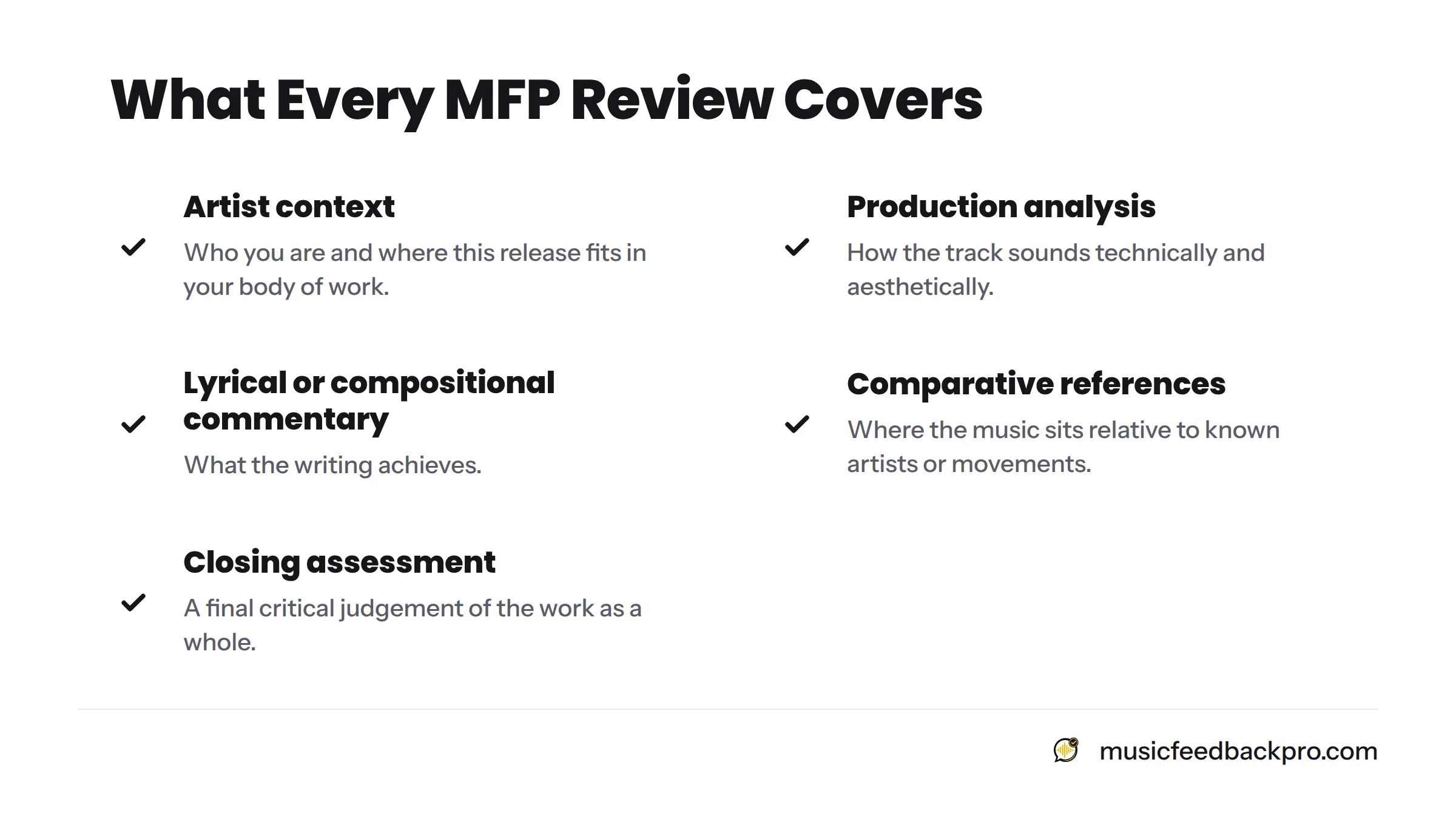
That structure is not arbitrary. It mirrors what music journalists, sync supervisors, and label A&R staff read when evaluating an artist. The review is designed to be useful in professional contexts.
Once delivered, the review is yours. Artists use MFP reviews in their Electronic Press Kit, artist biography pages, social proof sections on websites, media pitching emails, and label submission packages. Pulling a single powerful sentence from a review and placing it prominently in a press kit - what the industry calls a press quote - is one of the most common downstream uses.
You can see exactly what the output looks like by browsing real music review examples from MFP's platform. That page shows seven real review formats, which makes it easy to understand what you are building toward when you submit.
One MFP artist incorporated their review excerpt - "a singular voice that defies easy categorisation" - directly into their EPK and used it successfully in a sync licensing pitch. The review gave them a third-party credibility signal they could not generate themselves.
Check each curator's terms on public use when you accept an offer, as individual publication policies vary. Written reviews are designed to be quoted - that is their purpose as press assets.
If you want to understand the broader career value of this kind of coverage, the article on what a professional music review does for your career covers that territory in depth.
What Separates High-Interest Submissions From Those That Stall
After reviewing thousands of campaigns, patterns emerge. The submissions that attract the most curator offers are not always the most commercially polished - but they are always the most professionally presented.
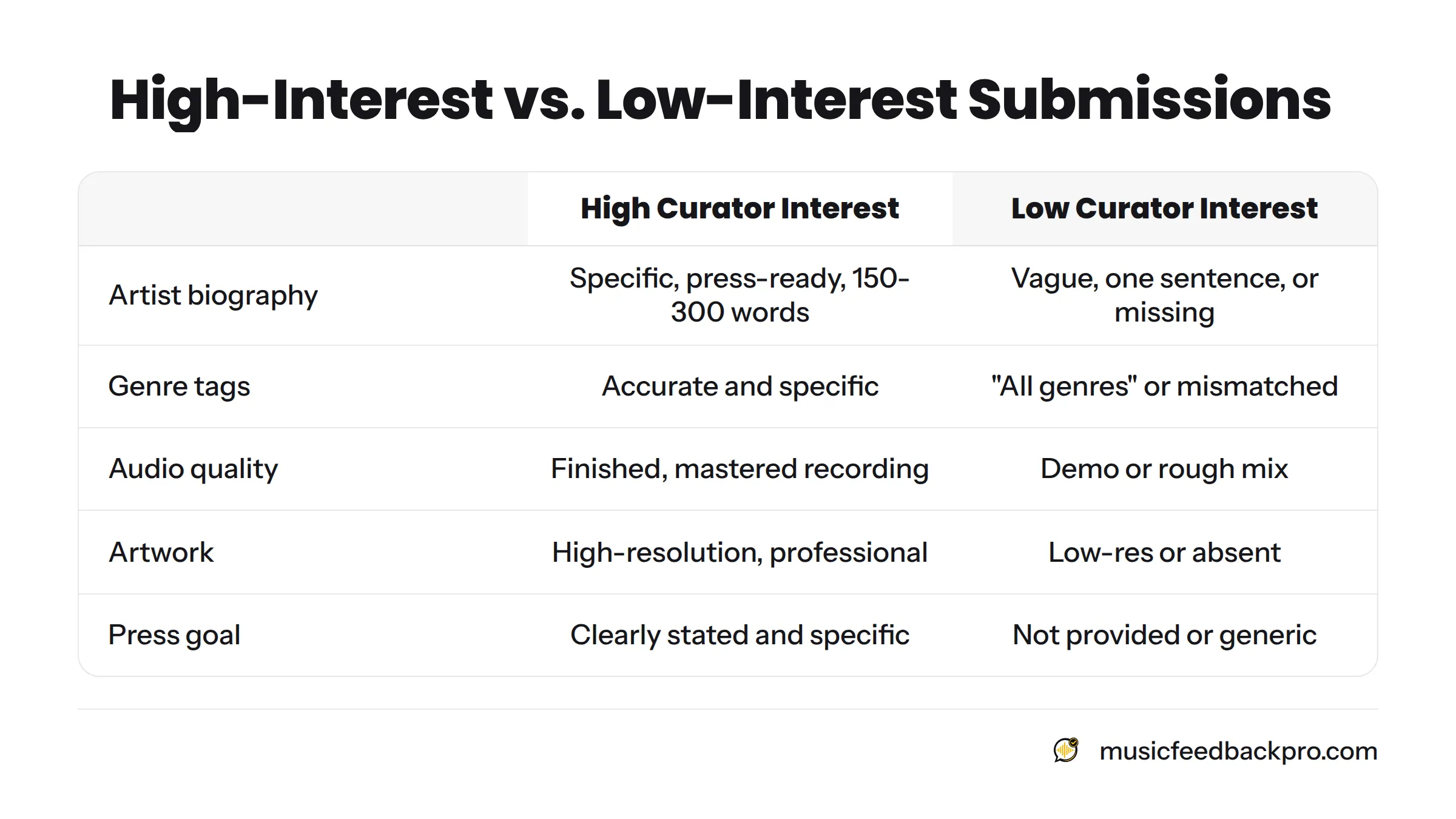
Here is what high-interest submissions consistently look like, compared to those that struggle:
| Signal | High Curator Interest | Low Curator Interest |
|---|---|---|
| Artist biography | Specific, press-ready, 150-300 words | Vague, one sentence, or missing |
| Genre tags | Accurate and specific to the release | "All genres" or mismatched to the music |
| Audio quality | Finished, mastered recording | Demo, rough mix, or unfinished |
| Artwork | High-resolution, professional | Low-res, placeholder, or absent |
| Press goal | Clearly stated and specific | Not provided or generic |
The pattern is consistent: critics are professionals offering their time and expertise. They browse campaigns the way an editor browses pitches - looking for signals that the artist knows what they want and has prepared a submission worth engaging with. Vague bios and mismatched tags are not small oversights. They are the submission-stage equivalent of sending a pitch email with the wrong artist name in the subject line.
Every one of these signals is entirely within your control before you hit submit. If you are unsure how to write a press-ready bio, the free artist bio generator on MFP's blog is a practical starting point.
How Artists Turned Reviews Into Press Quotes and Career Wins
The press quote is the most direct downstream use of a written music review. It works because it is third-party validation - someone other than you, with a named publication behind them, made a specific claim about your work.
Here are three patterns from MFP's first-party records, anonymised but representative:
Artist A - a DIY Electronic producer - received an honest song review that described their production as "meticulous and emotionally spacious." They pulled that phrase into their Bandcamp artist description, their EPK header, and a Spotify for Artists bio update. Within three months, they used the same quote in a successful pitch to a mid-tier music blog they had previously been unable to get a response from. The review gave them a credibility anchor.
Artist B - an indie folk singer-songwriter - was pitching to sync licensing agencies with no prior press coverage. After their MFP campaign, they received two written reviews. They selected the stronger of the two quotes and placed it at the top of their licensing one-sheet. The supervisor they pitched told them directly that the presence of a critical assessment made the submission stand out from the standard "here is my SoundCloud link" pitches.
Artist C - a Jazz vocalist - used their MFP review not for external pitching but for local press. They shared the full review with a regional arts publication, which then ran its own short feature citing the review as evidence of wider critical recognition. One piece of coverage generated the conditions for a second.
These examples make a simple point: a written review is not a vanity document. It is a reusable asset with a shelf life measured in years, not days. You can read more real music review examples to understand the range of formats and tones MFP's critics produce.
Ready to Get Your Music Reviewed?
The process is straightforward. Submit your track free, let MFP's editorial team review your campaign, and pay the one-off £15 only after approval. Vetted critics then send you written review offers. You choose which to accept, and you receive a long-form written review - a press asset you own and can use anywhere.
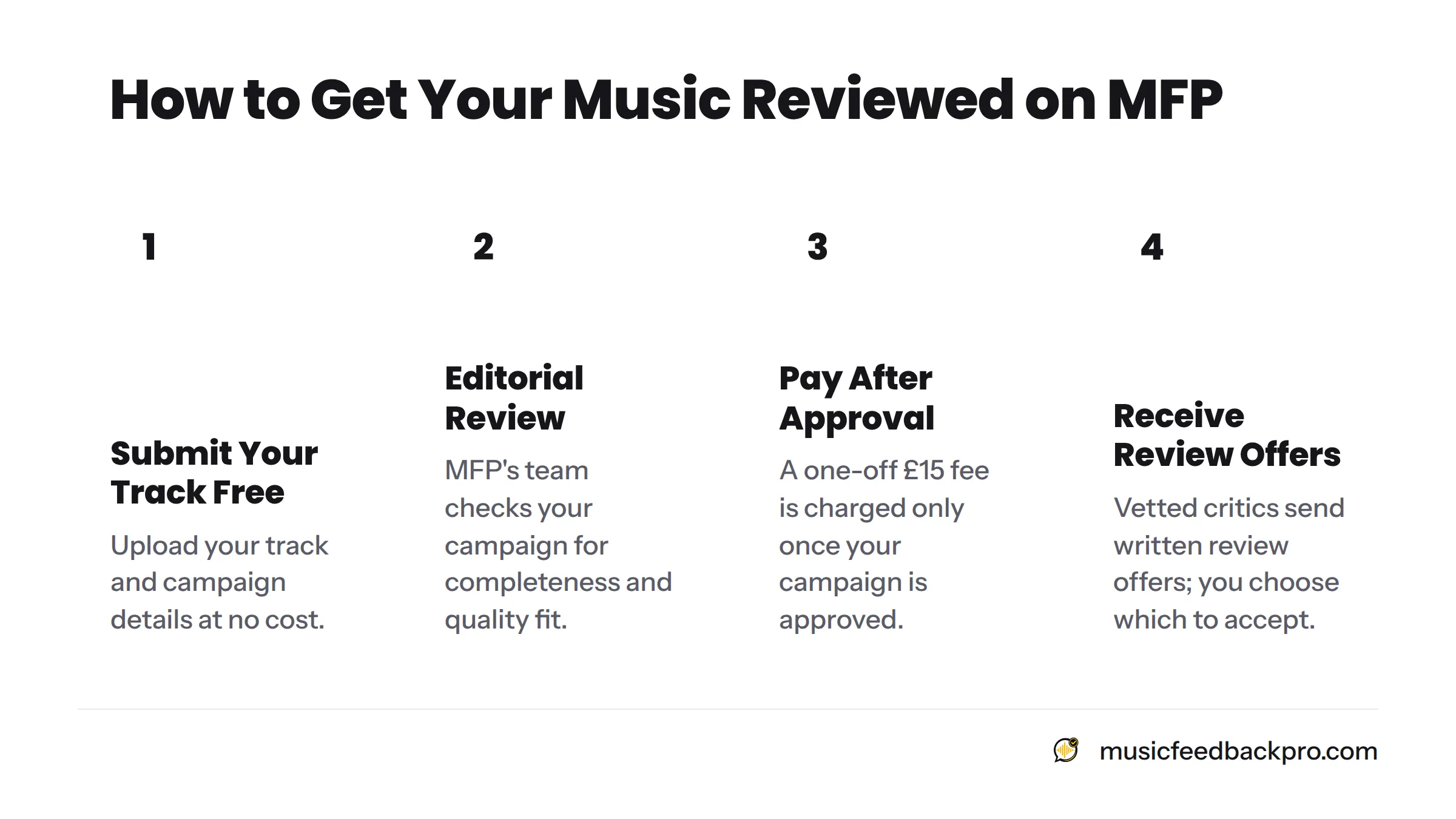
Free to submit. No charge until approved. Your payment protected by escrow until delivery is confirmed.
Submit Your Track Free - No Charge Until Approved
Explore more about how music reviews built for independent artists work at every stage of the process.
Frequently Asked Questions
How do I get my music reviewed professionally?
Submit your track for free at Music Feedback Pro and the editorial team reviews your campaign for completeness and quality fit. Once approved, you pay a one-off £15 fee and your campaign is offered to vetted critics and bloggers for 30 days. Critics send you written review offers, you choose which to accept, and the review is delivered to you directly.
Do I pay before my music is approved?
No. Submission is completely free and the £15 campaign fee is charged only after editorial approval. Any fees agreed with individual curators are held in escrow until the review is delivered and you confirm receipt.
Who writes the reviews?
Verified critics, bloggers, and media outlets that Music Feedback Pro has reviewed and approved before they join the platform. Reviewers are hand-picked by the editorial team rather than accepted through open registration, so every critic offering to review your music has already cleared a vetting process.
Can I use the review in my press kit?
Yes. Written reviews are designed to be quoted as credible press assets - in your EPK, artist biography, media pitches, and social proof materials. Check each curator's terms on public use when you accept their offer, as individual publication policies on reproduction and attribution vary.