Fill in the form below to generate a press-ready artist bio - the kind music critics and curators can lift directly into a review or feature. Every field in this music artist bio generator was designed by Music Feedback Pro's vetting team based on what our reviewers actually need when they open a campaign submission. No sign-up required.
Why Most Artist Bios Fail the Press Test
A press-ready artist bio is a third-person biography that gives a music critic or curator everything they need to write about you without asking for more information - your genre, geographic base, influences, current release, and a streaming or contact link.
That definition matters because most bios circulating in campaign submissions were written for social media, not for press. They use first-person voice, skip influences entirely, and describe a general vibe rather than a specific release. A journalist cannot paste "I make music from the heart" into a review. A curator cannot pitch a track to a blog without knowing your genre label, your city, or what you're releasing.
Quick definitions:
- Press-ready bio - a biography a journalist or curator can copy, quote, or summarize without contacting you for more information.
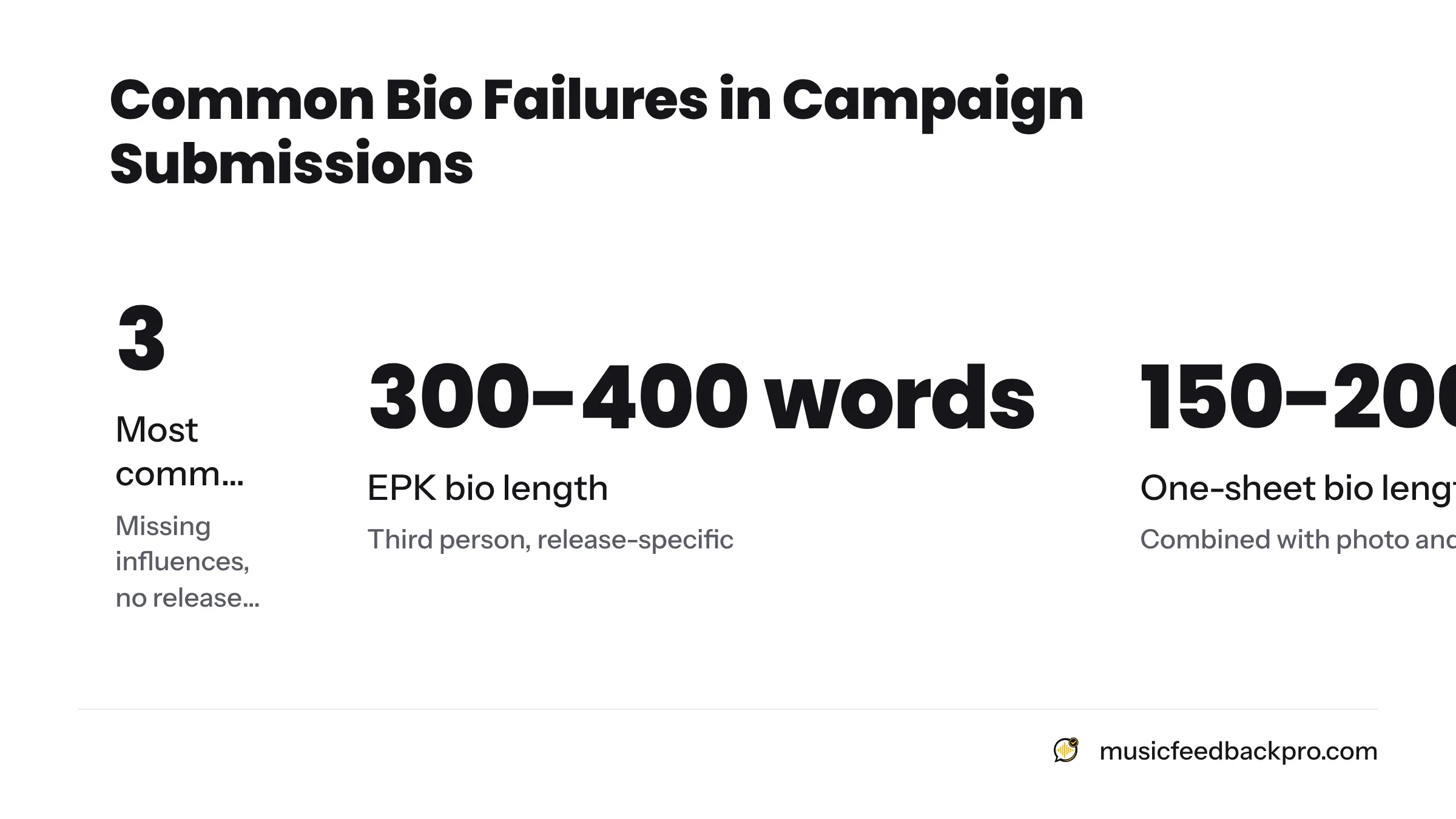
- EPK bio - the biography section inside an Electronic Press Kit, typically 300-400 words, third person, and release-specific.
- One-sheet - a single-page press document combining your bio, photo, and contact details; the bio on a one-sheet runs 150-200 words.
Based on our vetting team's review of campaign submissions, the three most common failures are missing influences, absent release context, and no streaming or contact link. All three are fixable in under two minutes with the generator below.
Artist Bio Generator: Fill In Your Details
Use the fields below to build your bio. Each label explains why that field matters to a reviewer.
| Field | Why it matters |
|---|---|
| Artist / band name | Your professional name exactly as it should appear in print |
| Genre | Curators filter submissions by genre - "indie vibes" is not a filter; "indie folk" is |
| Geographic base / city | Reviewers often write about local scenes; city context adds credibility |
| Key influences | The single most commonly missing element in submitted bios - gives reviewers a reference point for your sound |
| Current release or project | Gives reviewers something current to write about; without this, your bio is a biography, not a campaign asset |
| One standout achievement or milestone | Optional - the generator produces a strong bio even if you leave this blank; no fabricated credits, ever |
| Streaming link / contact link | A bio without a listen link is unusable for review purposes |
| Bio length | Short (150-200 words) for one-sheets and email pitches; Standard (300-400 words) for press kits and EPKs |
[ Generate My Bio - CTA button ]
Here is how the process works: fill in your details above, click Generate, then copy your bio and check it against the 7-element checklist below before you send it anywhere.
Sample Output: What Your Generated Bio Looks Like
The examples below are annotated by our editorial team to show exactly what each element does for a reviewer.
Standard version - for press kits and EPKs (~300 words)
Nadia Voss is a soul-influenced alt-R&B artist based in Bristol, UK, whose music sits at the intersection of classic Motown songwriting and contemporary bedroom production. [Genre + city - natural, not forced. Bristol signals a known independent music scene; the genre label is specific enough for a curator to place her.]
Drawing on the warmth of Erykah Badu and the textural experimentation of Bon Iver, Voss crafts songs that feel simultaneously nostalgic and forward-looking. [Influences named - this is what most submitted bios skip. Two names give a reviewer an immediate sonic frame of reference.]
Her debut EP, Quiet Hours, releases on 14 March 2026 and comprises five tracks recorded live-to-tape at a converted studio in South Bristol. The project explores grief and routine - the small rituals people use to hold themselves together - and was produced entirely without samples or programmed drums. [Release context - what, when, and why it matters. A curator now has a release date, a sound, and a human story to anchor a feature around.]
Voss has performed at Rough Trade Bristol and supported acts at the Fleece, and she is currently booking tour dates for spring 2026. [One standout achievement - grounded, verifiable, not inflated.]
Press enquiries and streaming: [Streaming or contact link - without this, reviewers cannot follow up. This is the most easily forgotten element and the one that most often causes a submission to stall.]
All elements written in third person throughout - required for press. Journalists copy your bio into their own writing; "I" breaks that the moment it appears.
Short version - for one-sheets and email pitches (~150 words)
Nadia Voss is a Bristol-based alt-R&B artist whose soul-influenced songwriting draws on Erykah Badu and Bon Iver. Her debut EP, Quiet Hours, releases 14 March 2026 - five live-to-tape tracks exploring grief and daily routine, recorded without samples or programmed drums. For press and streaming:
Notice how the short version preserves the four non-negotiables: genre, geographic base, influences, and release context. Everything else can be trimmed. Those four cannot.
Press-Ready Bio Checklist: 7 Elements Reviewers and Curators Need
This checklist mirrors what vetted curators on Music Feedback Pro tell us they need before they can write about an artist. Run your generated bio against it before you submit anywhere.
- Third-person voice - journalists copy your bio into their own writing; "I" breaks that the moment it appears, and editors will reject the submission or rewrite it without credit to you
- Genre clearly stated - not "indie vibes" or "alternative sounds," but a recognizable genre label curators actually use when filtering submissions (alt-R&B, dream pop, trap soul, post-punk)
- Geographic base - city or region; reviewers write about local scenes and regional movements, and your location gives them a contextual hook
- Named influences - the single most commonly missing element in submitted bios; two or three artist names give a reviewer an immediate sonic frame of reference without listening to a single second of your music
- Release context - what you're promoting, what it sounds like, and when it drops; a bio that describes who you are but not what you're releasing gives curators nothing current to write about
- A streaming or EPK link - a bio without a listen link is a dead end for review purposes; curators will move to the next submission rather than search for you independently
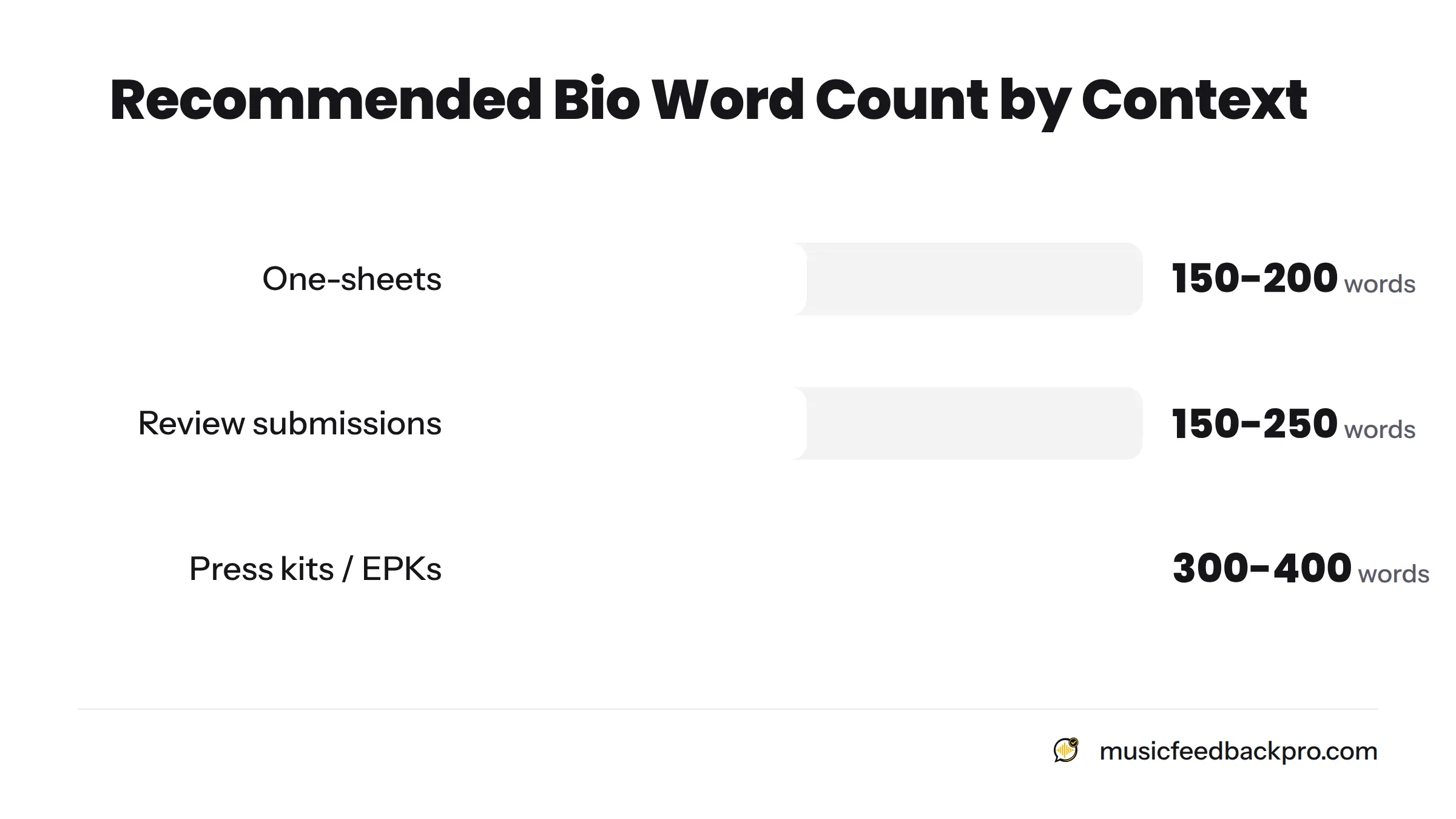
- Word count appropriate to context - 150-200 words for short submissions and one-sheets; 300-400 words for press kits and EPKs; anything longer than 400 words rarely gets read in full by a reviewer on deadline
Three Bio Gaps Our Vetting Team Flags Most Often
Informed by our editorial team's review of bios across thousands of campaign submissions, these gaps appear more than any others - and all three are avoidable.
Missing influences. This is the most flagged omission we see. Artists often skip influences because they worry about appearing derivative, but a reviewer without a sonic reference point cannot write about your music with any confidence. Two or three names is enough. You are not claiming to sound exactly like them - you are giving a reviewer a starting point.
No release context. A well-written biography that describes your background, your artistry, and your journey is genuinely useful - for your website's About page. For a press campaign, a reviewer needs to know what you're releasing, when, and what it sounds like. Without release context, your bio cannot anchor a feature or a review. Our vetting team flags this in a significant portion of submissions that otherwise show real promise.
No streaming or contact link. A bio is a dead end without a way to hear the music. Reviewers do not search for artists independently; if the link is missing from your bio or your submission, the campaign stalls. This is the most easily fixed gap and the one that costs artists the most time when it's overlooked.
If you want to avoid wider press asset mistakes, our guide on press kit gaps to avoid covers what else curators notice when they open a full campaign package.
How to Use Your Generated Bio Across Platforms
Your generated bio is a press-submission asset first. Here is how to adapt it for each context without starting from scratch.
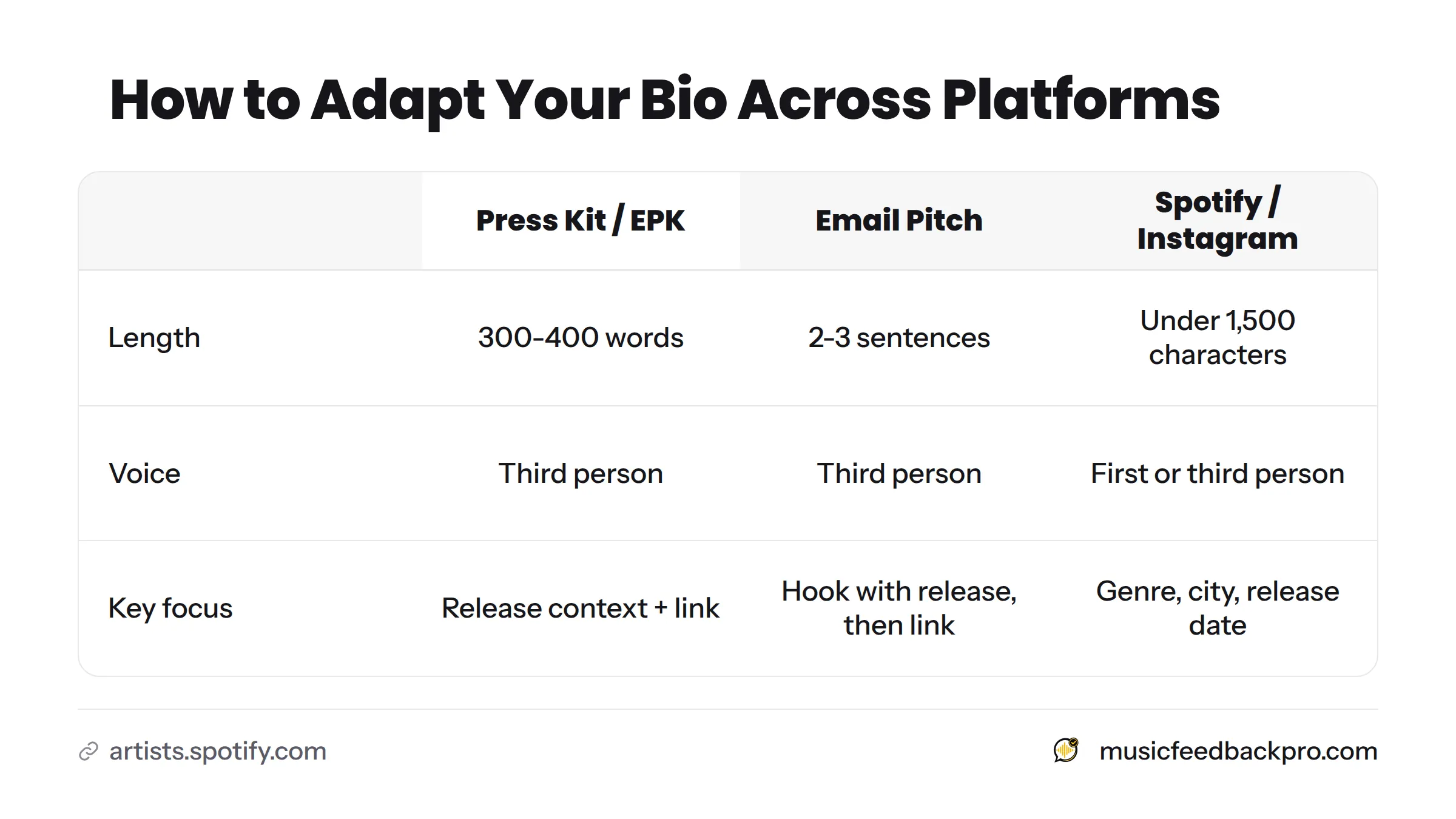
| Context | Length | Voice | Key tip |
|---|---|---|---|
| Press kit / EPK | 300-400 words | Third person | Include release context and a streaming or EPK link |
| Music review submission | 150-250 words | Third person | Lead with genre and current project; link first |
| Email pitch | 2-3 sentences | Third person | Hook with the release, then link; save the full bio for the attachment |
| Spotify for Artists | Under 1,500 characters | First or third person | Adapt from your generated bio; Spotify for Artists confirms the 1,500-character limit |
| Instagram profile | ~150 characters | First person | Pull your genre, city, and release date - nothing more fits |
Before you finalize your bio, make sure your artist name is working as hard as it should. If you're still deciding on a stage name, the singer name generator can help you land on something that works across platforms and press contexts.
For guidance on how to describe a specific song or single in pitch copy, see our page on how to describe a song. And once you have press quotes from reviewers, our guide on using review quotes in your press kit will show you where and how to place them for maximum impact.
This video from From Musician To Artist walks through the core principles behind writing a compelling artist bio if you want a broader perspective before you generate yours:
Submit Your Music Once Your Bio Is Ready
Your press-ready bio is the first thing a curator sees when they open your campaign on Music Feedback Pro. A bio that passes the 7-element checklist means your campaign clears vetting faster and lands in front of reviewers who are ready to write.
Once your bio is ready, submit your music for a professional review - the platform is free to submit, and you only pay £15 once your campaign is approved. You can also explore all free tools for music artists to build out the rest of your press assets before you launch.
FAQ
What is a press-ready artist bio?
A press-ready artist bio is a third-person biography that gives a music critic or curator everything they need to write about you without asking for more information - including your genre, geographic base, key influences, current release, and a streaming or contact link. It is written to be copied, quoted, or summarized directly by a journalist.
How long should an artist bio be?
For a press kit or EPK, aim for 300-400 words. For a one-sheet or music review submission, 150-250 words is the right range. Keep your Spotify bio under 1,500 characters. Anything longer than 400 words rarely gets read in full by a reviewer on deadline, so shorter and tighter always wins.
Should my artist bio be in first or third person for a press submission?
Always third person for press submissions, review campaigns, EPKs, and one-sheets. Journalists copy your bio into their own writing, and first-person language breaks that the moment it appears. First person is appropriate only for social media profiles where you're speaking directly to fans, not to the press.
What information does a music curator need in a bio?
Based on Music Feedback Pro's vetting team observations, curators need:
- Genre (a specific, recognizable label - not a vague descriptor)
- Geographic base (city or region)
- Named influences (two or three artist names for sonic context)
- Release context (what you're promoting, when it drops, what it sounds like)
- A streaming or contact link (without this, the bio is unusable for review purposes)
What if I don't have many achievements yet - can I still generate a good bio?
Yes. The achievement field in the generator is optional. The tool produces a complete, press-ready bio from your genre, influences, geographic base, and release context alone. No achievements are fabricated - if you leave the field blank, the output focuses on your sound and your release, which is often more useful to a reviewer than a list of small milestones anyway.
What is the difference between a short artist bio and a standard one?
Length is only part of it. A short artist bio - typically 150-200 words - strips everything down to the four non-negotiables: genre, location, influences, and release context. It suits one-sheets, email pitches, and music review submissions where brevity signals professionalism. A standard bio at 300-400 words adds production detail, live history, thematic context, and anything else that helps a journalist build a fuller picture. Both formats are available through this musician bio generator, and both follow the same 7-element checklist.
Can I use this as a band bio generator?
Yes. Every field in the form works for solo artists and bands equally. For a band, use your collective name in the artist name field, describe the group's geographic base, and list influences that reflect the group's shared sound. The output will read as a band bio generator result - written in third person, structured for press, and ready to drop into a campaign submission or EPK.
Sources
Related: singer name generator, submit your music for a professional review