
Written by the Music Feedback Pro editorial review team. Last reviewed: October 27, 2026.
Is Music Feedback Pro worth it? For independent artists who want honest written critique and press-ready coverage, yes. Submission is free, and the flat fee only kicks in after editorial approval - so the upfront risk is zero. If your only goal is playlist plays or streaming numbers, this is not the right platform for that.
Submit your track free - no fee until approved
Who Music Feedback Pro is actually built for
Artists building a press kit or seeking real critique
If you are an independent artist assembling a press kit, pitching to blogs, or trying to understand how your music lands with an informed listener, Music Feedback Pro delivers something concrete. Campaigns produce written critiques, blog features, video reviews, and artist interviews - outputs you can quote, publish, and circulate. That is a meaningfully different outcome from a playlist pitch, and it is the outcome this platform was built for.
The editorial review team vets every submission before any fee is charged. That single fact changes the risk calculation entirely. You are not paying to be ignored; you pay only once the platform believes your campaign has a genuine chance of connecting with the right curators.
Artists chasing streams
Playlist promotion is a separate discipline, served by a different set of tools. Music Feedback Pro does not place tracks on Spotify playlists or pitch to DSP editorial teams. If monthly listeners and stream counts are your primary metric right now, the platform will disappoint you - not because it fails, but because it was never designed for that goal.
The one-sentence verdict: Music Feedback Pro is worth it if you want honest, written, press-usable feedback from vetted critics - and it costs nothing if your campaign is not approved.
Does Music Feedback Pro actually deliver honest feedback?
What "honest" means in practice
Honest feedback is not the same as positive feedback. Curators on the platform are encouraged to write what they actually think. That means a review may identify weaknesses in a mix, question a lyrical choice, or note that a track feels unfinished. That transparency is the point.
An independent artist reading a critical review from a vetted critic learns something they can act on. A five-star response that says nothing useful does not.
The platform does not guarantee positive coverage. If a curator accepts a campaign offer and writes a review that is honest but unflattering, that review stands. Artists retain the right to decide which outputs they share publicly - more on that below.
How curator vetting underpins feedback quality
Every critic and blogger on the platform goes through an approval process before they can receive campaign offers. The for reviewers page at Music Feedback Pro outlines the standards curators must meet. Writers responding to your campaign have a demonstrable track record: a live publication, an established YouTube channel, or a credible podcast presence. That vetting is what separates a Music Feedback Pro campaign from sending a cold email to a random blog.
Curators can also apply to become a verified curator - which keeps the pool current and accountable.
What a campaign can actually produce
Possible outputs from a campaign:
- Private written critique (for your development only)
- Published blog feature or review (press-usable quote material)
- Video review on a YouTube channel
- Artist interview (text or audio format)
- Press-kit-ready pull quotes from any of the above
Which outputs arrive depends on which curators accept your offer during the campaign window. You control which offers you accept - no curator publishes anything without your agreement.
Do I pay if curators reject my submission?
How the free submission and post-approval fee model works
Submitting a track costs nothing. Once you submit, the editorial review team assesses whether your campaign is ready to go live. If approved, you pay the flat campaign fee - currently £15, with full terms on the Music Feedback Pro pricing page. If the campaign is not approved, no charge is made. Full stop.
Zero cost on rejection: If the editorial team does not approve your campaign, you pay nothing.
This is the answer to one of the most common music feedback pro questions: no, you are not charged unless your campaign clears the editorial review.
Editorial rejection versus curators not accepting your offer
These are two distinct outcomes, and conflating them causes real confusion. An editorial rejection happens before the fee is charged - the team reviews your submission and decides it is not ready for the platform. No payment is taken.
A situation where curators do not accept your offer is different: your campaign has been approved, the fee has been paid, and your offer sits live on the platform during the campaign window. If no curator picks it up, that is a separate outcome. The how it works page explains exactly how the campaign window and offer mechanics operate. The escrow model means your fee is protected: funds are held and only released to a curator once they deliver the agreed output.
On the question of a Music Feedback Pro refund - the escrow structure is the mechanism that protects artists. Funds for accepted offers are not released until delivery is confirmed, so payment is tied directly to output.
What kinds of artists get accepted, and what gets rejected?
What the editorial review team looks for
The team is not gatekeeping based on genre popularity or follower counts. The assessment focuses on whether a campaign is ready for press: does the artist present a coherent identity, does the music meet a baseline of production quality, and is the submission complete enough for a curator to write about meaningfully?
Across thousands of reviewed submissions, the most consistent approval signals are a well-written bio, a clearly identified genre or sound, and at least one press-ready asset - a high-resolution photo, a Spotify artist profile, or an existing press release.
The most common rejection reasons
Based on first-party data from campaign submissions:
- Thin or missing bio: A one-sentence bio gives a curator nothing to work with. Reviews require context.
- Missing press kit basics: No artist photo, no Spotify link, no release details - campaigns that arrive incomplete get rejected before a curator ever sees them.
- Genre mismatch or unclear positioning: Submitting a track labelled "everything / all genres" makes it impossible to match the right curators. Curators specialise; your submission needs to meet them where they are.
- Underdeveloped production quality: Not every track needs a major-label budget, but it does need to be finished. Demos and scratch recordings are not ready for press.
How to improve approval odds before resubmitting
Yes, you can resubmit after a rejection. Here is a pre-submission checklist that maps directly to the editorial team's approval criteria:
Pre-submission checklist:
- Artist bio of at least 150 words covering background, influences, and this release
- High-resolution artist photo (minimum 1000px on the short side)
- Spotify artist profile link (or equivalent DSP link)
- Release date confirmed (or already live)
- Genre clearly identified - be specific (e.g. "indie folk" not "alternative / everything")
- Track fully mixed and mastered
- At least one existing press asset or social media presence for curators to reference
The complete guide to getting feedback on your music covers preparation in depth if you want to go further before resubmitting.
Is the feedback usable for press kits and promotion?
Written blog features and review quotes as press assets
A published blog feature from a vetted Music Feedback Pro curator is a legitimate press asset. You can quote it in a press kit, link to it in a pitch email, and display it on your artist website. The press coverage page explains the specific types of coverage available and how to use them.
Pull quotes from reviews carry weight precisely because they come from identifiable, independent sources - not from the artist's own marketing copy. That distinction matters when you are pitching to a booking agent, a sync library, or a label A&R team.
Video reviews and interview outputs
A video review hosted on a curator's YouTube channel gives you a shareable URL you can embed, clip, and post across social platforms. An artist interview, whether text or audio, adds depth to your press profile and gives future interviewers something to reference. Both formats are available through vetted critics on the platform.
How to use what you receive
You control which curator offers you accept, which means you decide what goes public. A private critique stays between you and the critic. A published review, once live on the curator's platform, is yours to reference and share. The practical move is to collect everything into a living press kit - a Google Doc or dedicated press page that you update each time new coverage arrives.
How long does it take to get results?
The 30-day campaign window explained
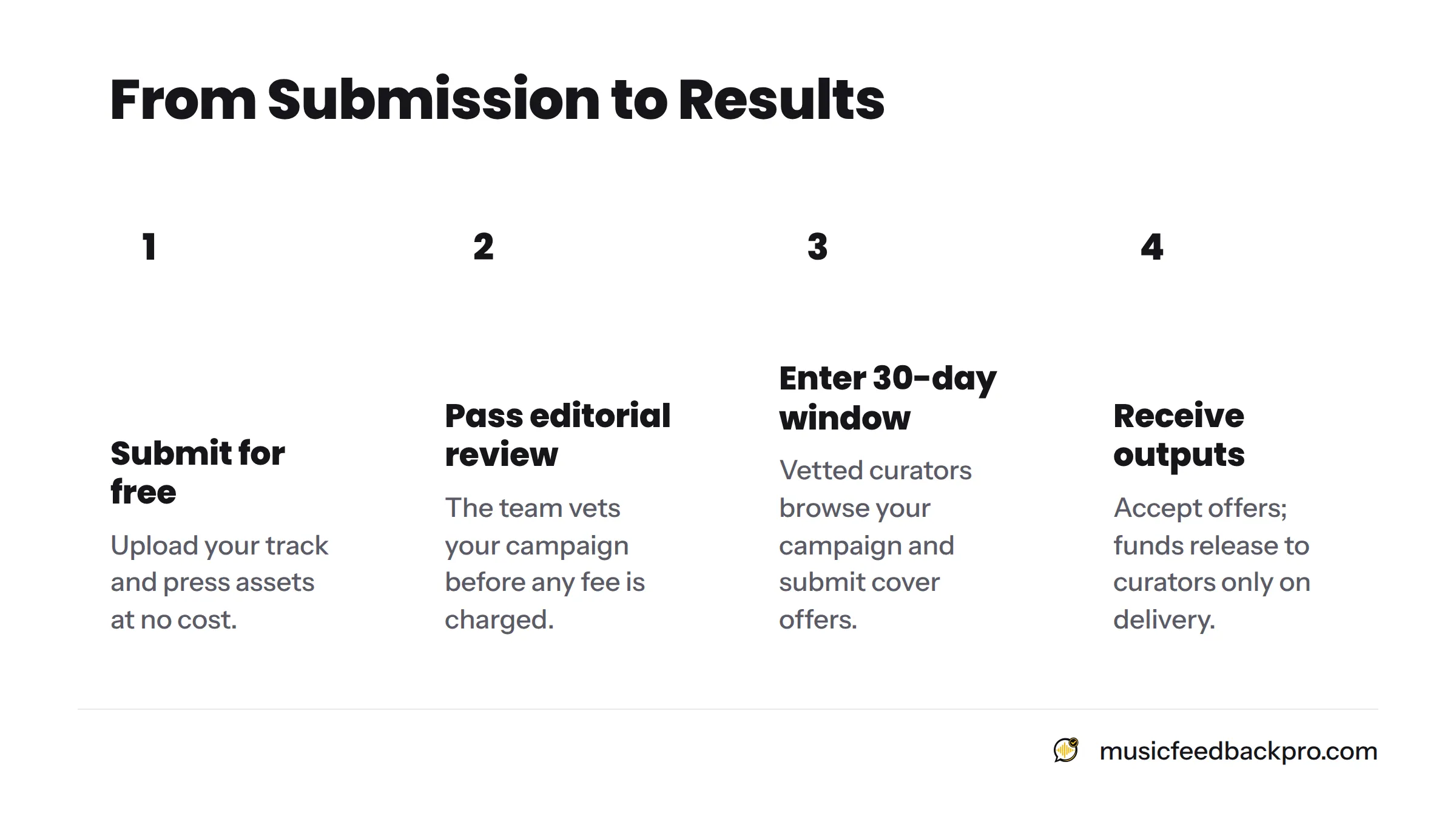
Once your campaign is approved and the fee is paid, it enters a 30-day active window. During that window, vetted curators browse active campaigns and submit offers to cover your track. You review those offers and accept or decline them. Accepted offers move into delivery - the curator writes, records, or produces the agreed output.
When to expect curator offers
Most campaign activity happens in the first two weeks. Some curators move fast; others take time to listen carefully before committing to a review. There is no algorithmic shortcut here - the timeline reflects the reality of genuine editorial work. The full step-by-step process is explained on the campaign guide page.
When is Music Feedback Pro not worth it?
If you only want Spotify playlist placements
Playlist pitching rewards volume and metadata optimisation. Music Feedback Pro operates in written and video editorial - a different world with different mechanics. If streams are the only metric you care about this release cycle, look at tools built for playlist promotion and return to Music Feedback Pro when you are ready to build press assets.
If you need guaranteed coverage
No platform - not Groover, not SubmitHub, not a traditional PR agency - can guarantee that a critic will publish a positive review of your music. Anyone who promises guaranteed coverage is selling something other than editorial credibility. Music Feedback Pro does not make that promise, and that restraint is part of why coverage from its curators carries weight.
If your release is too underdeveloped for editorial review
Releasing a track before it is ready just to get developmental feedback is understandable - but it is not what this platform is built for. The music feedback platforms overview covers the full range of tools available, including those suited to earlier-stage critique. Music Feedback Pro sits at the press-ready end of that spectrum.
When to look elsewhere: If your goals are playlist streams, guaranteed coverage, or early-stage demo feedback - there are better-matched tools. See the best music feedback platforms compared for a full breakdown.
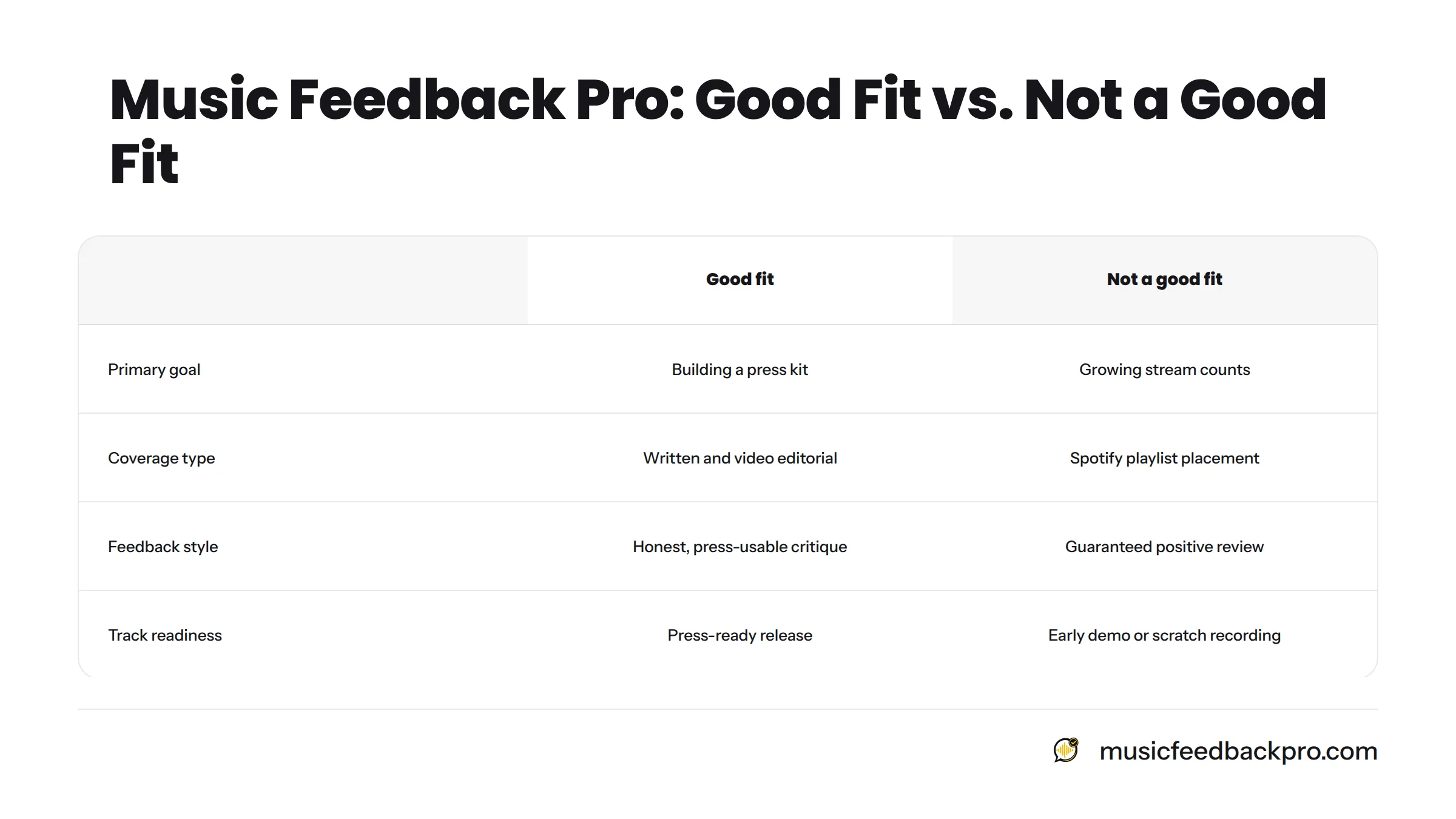
Worth it / Not worth it - at a glance:
| Good fit | Not a good fit |
|---|---|
| Independent artist building a press kit | Artist whose only goal is Spotify streams |
| Artist seeking honest written critique | Artist needing guaranteed positive coverage |
| Release that is fully mixed and mastered | Demo or unfinished recording |
| Artist with a clear genre and bio | Submission with no press kit basics |
| Labels or PR teams pitching on behalf of clients | Anyone expecting playlist placements |
| Any genre, provided genre is clearly stated | Submissions labelled "all genres / undefined" |
Quick-answer FAQ
Is Music Feedback Pro worth it?
Yes, for independent artists who want honest written critique and press-usable coverage. Submission is free and the flat fee only applies after editorial approval - so the financial risk is zero. It is not worth it if your only goal is streaming numbers or playlist placements.
Is Music Feedback Pro legit?
Yes. The platform vets both artists and curators before any money changes hands. Curators must demonstrate a credible, active publication or channel to join. Payments operate through an escrow model, so funds are only released when a curator delivers the agreed output. You can read what artists say in Music Feedback Pro reviews for independent evidence.
Does Music Feedback Pro work?
It works for what it is designed to do: connecting press-ready artists with vetted critics who produce written and video coverage. It does not work as a streaming growth tool - that is simply outside its scope. Artists who submit complete, well-prepared campaigns consistently report receiving credible, usable feedback and press assets.
Is Music Feedback Pro free to submit?
Submitting your track is free. The £15 flat campaign fee - detailed on the pricing page - applies only if the editorial team approves your campaign and decides it is ready to go live on the platform.
Do I pay if my campaign is rejected?
No. You pay nothing if the editorial team does not approve your campaign. The £15 flat fee is charged only after approval.
Does Music Feedback Pro guarantee press coverage or a positive review?
No. Coverage depends on curators accepting your campaign offer during the 30-day window. Reviews reflect honest editorial opinion and can be critical. No platform can ethically guarantee a positive review - and Music Feedback Pro does not try to.
What do I actually get from a campaign?
Depending on which curator offers you accept:
- Private written critique
- Published blog feature or review
- Video review (YouTube)
- Artist interview
- Press-kit-ready pull quotes
Why do some submissions get rejected?
The most common reasons are a thin or missing artist bio, absent press kit basics (photo, DSP link, release details), unclear genre positioning, and underproduced or unfinished recordings. All of these are fixable before resubmission.
Can I resubmit if my campaign is rejected?
Yes. Address the specific feedback given by the editorial team, complete the pre-submission checklist above, and resubmit. The guide to launching a successful campaign walks through exactly how to prepare.
How does Music Feedback Pro vetting work?
Artist submissions go through an editorial review before approval. Curators apply separately and must demonstrate a credible, active publication or channel. Both sides of the platform are screened - which is what makes the feedback credible rather than arbitrary. The for reviewers page outlines the curator side of that process.
Submit your track free - no fee until approved
Sources
- Music Feedback Pro - Homepage
- Music Feedback Pro - Pricing
- Music Feedback Pro - How It Works
- Music Feedback Pro - For Reviewers
- Best Music Feedback Platforms Compared (2026) - Music Feedback Pro Blog
- Music Feedback Platforms: Are They Worth It in 2026? - Music Feedback Pro Blog
- How to Get Feedback on Your Music: Complete Guide - Music Feedback Pro Blog
- A Guide to Launching a Successful Music Feedback Campaign - Music Feedback Pro Blog
- Groover vs Music Feedback Pro - Music Feedback Pro
- 7 Best SubmitHub Alternatives for Artists (2026) - Music Feedback Pro Blog
Related: how it compares with Groover, become a verified curator