
Reviewed by the Music Feedback Pro editorial team - October 2026. Full competitor disclosure: Music Feedback Pro is a direct alternative to Groover. This review applies our editorial rubric transparently and notes where Groover is the stronger choice.
Groover is a legitimate platform with a real curator network and a response guarantee that it actually enforces. Whether it's worth your money depends on one question: what do you need from those curator responses? If you need curators to listen and write back, Groover delivers. If you need quotable, long-form editorial coverage for a press kit, it falls short more often than not.
That distinction matters before you spend your first credit.
The Quick Verdict on Groover
Groover is an established music submission platform founded in Paris in 2018. It operates a real network of curators spanning blogs, playlists, labels, and radio. Artists spend Grooviz credits to pitch their music, and the platform guarantees every curator responds within seven days. If a curator goes silent, the credits are refunded automatically.
Verdict at a Glance
Dimension Rating Feedback quality ★★★☆☆ Press-asset usability ★★☆☆☆ Pricing transparency ★★★★☆ Curator response reliability ★★★★☆ Best for Broad curator exposure, playlist pitching, quick campaign turnaround Not best for Long-form editorial reviews, press kit building, EPK-ready quotes
Groover does what it promises: it gets curators to listen and reply. Where it struggles is the quality and usability of those replies for artists who need more than a brief pass-or-share note. If your goal is building editorial credibility through quotable written reviews, Groover is not built for that outcome - and you should know that before you commit budget.
Music Feedback Pro is a competitor of Groover. We have applied our editorial rubric transparently throughout this review and acknowledge where Groover is the stronger choice for specific goals.
What Groover Is and How It Works
Groover connects independent artists directly with music industry curators through a self-serve, credit-based submission model. Artists browse a directory, pay per pitch using Grooviz credits, and receive a guaranteed response within seven days. It sits somewhere between a DIY email pitch and a full PR campaign - faster than the former, less comprehensive than the latter.
The platform works for its defined purpose. Real curators receive your music, the response guarantee means you are not paying into a void, and the directory spans enough territory and genre coverage to run a meaningful campaign. The question is always what those responses look like and what you can actually do with them.
How a Groover Campaign Runs
- Create a free account at groover.co
- Purchase Grooviz credits (more on pricing below)
- Browse the curator directory and filter by genre, type, and territory
- Write a pitch and select the curators you want to target
- Submit your track and wait for responses within seven days
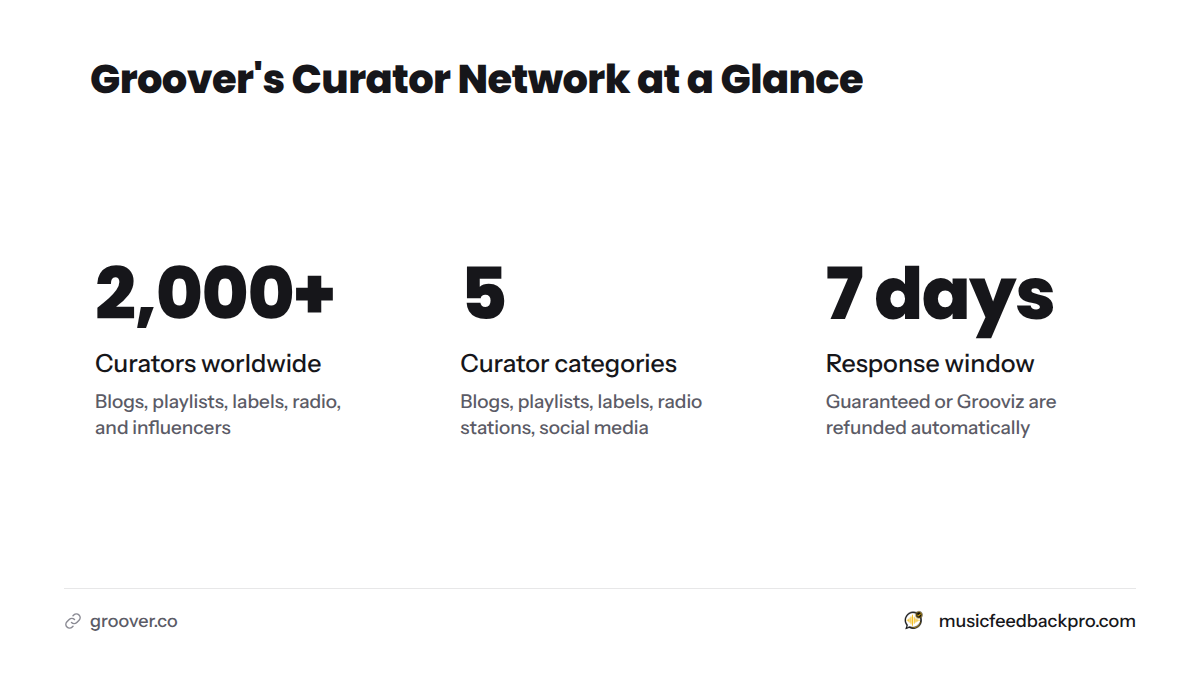
Curators on the platform fall into five main categories: music blogs, Spotify playlist curators, independent labels, radio stations, and social media influencers. That range is one of Groover's genuine strengths. An artist running a release campaign can target a blog reviewer, a playlist curator, and a radio producer in a single submission run.
Grooviz Credits, Explained
Grooviz are Groover's proprietary submission credits. One Grooviz covers one submission to one curator. The number of Grooviz required varies by curator - more established curators with larger audiences cost more per submission.
According to Groover's pricing page (verified October 2026, prices subject to change), credits are sold in packs. The approximate tiers as of October 2026:
| Credit Pack | Approximate Cost (EUR) | Approximate Submissions |
|---|---|---|
| Starter pack | ~€20 | ~10 submissions |
| Mid-tier pack | ~€50 | ~28 submissions |
| Larger pack | ~€100 | ~60 submissions |
Groover pricing is in euros and changes periodically. Always verify current rates on Groover's official pricing page before purchasing. Curator costs per submission range from roughly €2 to €10+, depending on reach and response record.
The credit model means your actual campaign cost depends on which curators you target. Pitching ten mid-range curators at three Grooviz each, at a pack rate of roughly €1.80 per Grooviz, puts one campaign at approximately €54 - a useful benchmark for budgeting.
Groover Music Review: What Artists Actually Receive
This is where most Groover reviews leave artists without a clear picture. Let's break it down.
What "Guaranteed Response" Actually Means
Groover's guarantee is a response guarantee, not a coverage guarantee. According to Groover's help documentation (verified October 2026), curators are required to listen to your track and leave a written response within seven days. If they don't, the Grooviz spent on that submission are refunded automatically.
Three things worth understanding precisely:
- A "response" means the curator listened and sent back a message. It does not mean they shared your track, published a blog post, added you to a playlist, or said anything quotable.
- A "feature" or "share" happens at each curator's discretion. Most responses are brief pass-or-share decisions with a short note explaining the choice.
- The refund policy protects you from non-responsive curators. It does not protect you from brief or unhelpful feedback.
Artists debating whether Groover delivers value often conflate these two outcomes. The platform is transparent about the distinction in its documentation - the problem is that many artists discover it after spending their first credit pack.
Is Groover Feedback Usable as a Press Asset?
Here is the editorial rubric the Music Feedback Pro team applies when evaluating whether feedback qualifies as a press asset for an electronic press kit:
Press-kit-ready feedback must include:
- A named author or publication with a verifiable URL
- A minimum of three to four sentences of substantive commentary on the music
- Language that can be quoted independently without losing context
- Publication context - meaning a live blog post that can be linked, not an in-platform message
Applying that rubric to typical Groover responses: most fall short. The majority of curator replies are short in-platform messages - a sentence or two explaining why the curator is or isn't sharing the track. Useful for understanding your music's reception, yes. Formatted as editorial reviews with bylines and public URLs, no.
The exception exists. When a Groover curator writes a full blog post about your track and publishes it at a public URL, that absolutely qualifies as a press asset. It does happen. It just isn't the standard outcome - it's an above-average one that depends entirely on which curators you target and whether they choose to feature you.
For a closer look at why written editorial coverage matters beyond curator exposure, the article on press coverage vs playlist plays breaks down the practical difference for indie artists.
Curator Network: Who Reviews Your Music on Groover
Groover's curator directory is one of its strongest selling points. The platform connects artists with over 2,000 curators worldwide across blogs, playlists, labels, radio stations, and influencer accounts (source: groover.co, verified October 2026). That scale gives artists genre coverage and territory reach that a DIY email pitch campaign simply cannot match.
The curators are real industry participants - not bots, not fake playlist operators. Groover's internal vetting process requires curators to maintain an active response record to stay on the platform, which keeps the directory reasonably clean.
Worth knowing: Curator quality varies significantly. A "music blog" curator on Groover might run a publication with tens of thousands of monthly readers or a personal blog with a small following. The platform shows curator stats including follower counts and response rates, but it does not guarantee the editorial quality or reach of any individual curator's output. Verify a curator's publication directly before spending Grooviz on a pitch. For a broader view of where Groover sits among submission options, see best music blog submission sites in 2026.
Curator categories available on Groover:
- Music blogs and online publications
- Spotify and streaming playlist curators
- Independent record labels
- Radio stations and podcast hosts
- Social media influencers and content creators
The breadth is real. For artists whose primary goal is broad exposure across multiple curator types in a single campaign, Groover's network is genuinely hard to match at this price point.
Groover Pricing and Credits in 2026
Understanding the economics of a Groover campaign matters before you commit budget. Here is how the numbers actually work.
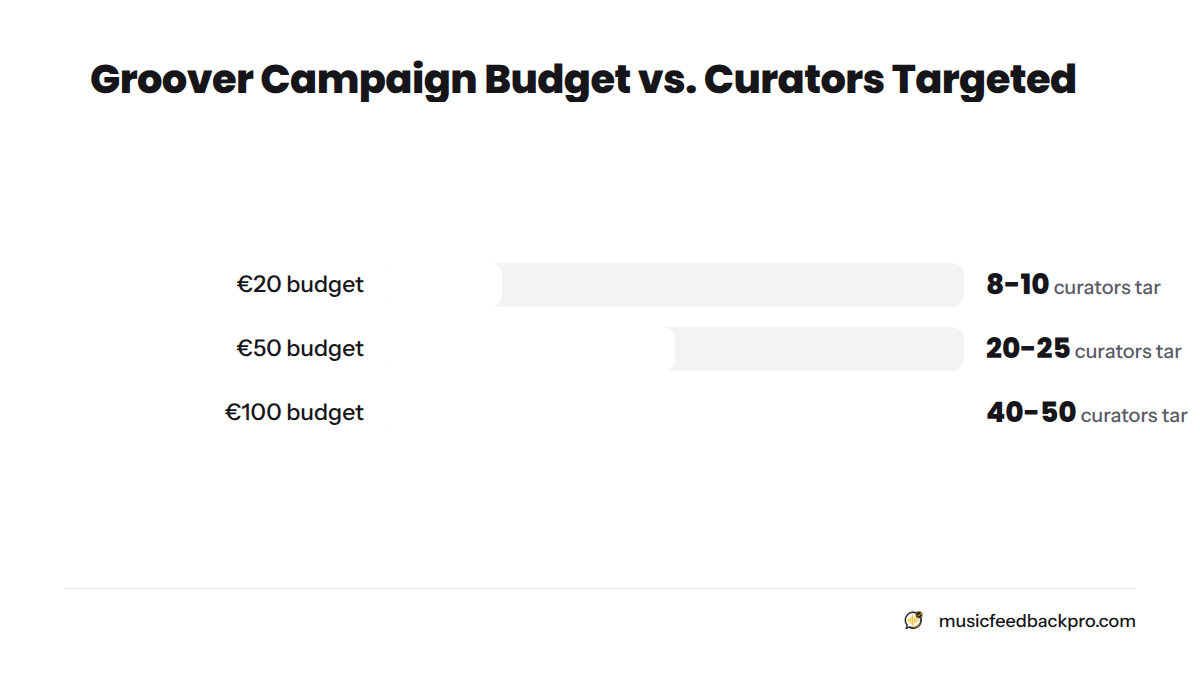
Grooviz are purchased upfront in credit packs from Groover's pricing page (verified October 2026). Each curator listing shows a Grooviz cost, and you spend those credits at submission time. The cost per submission typically ranges from approximately €2 to €10+ depending on the curator's reach and historical response quality.
What happens if a curator does not respond?
According to Groover's help documentation (verified October 2026), if a curator fails to respond within the seven-day window, the Grooviz spent on that submission return to your account automatically. Grooviz credits do not expire, so refunded credits roll into future campaigns.
Sample campaign budget:
| Budget (EUR) | Approx. Grooviz | Curators Targeted | Expected Responses | Realistic Blog Features |
|---|---|---|---|---|
| €20 | ~11 | 8-10 | 8-10 (guaranteed) | 1-3 (variable) |
| €50 | ~28 | 20-25 | 20-25 (guaranteed) | 3-7 (variable) |
| €100 | ~55 | 40-50 | 40-50 (guaranteed) | 6-15 (variable) |
Feature estimates are based on typical Groover platform averages and artist-reported outcomes. They are not guaranteed by Groover. Actual results vary by genre, track quality, and curator selection.
For a direct comparison of how Groover's credit model stacks up against flat-fee alternatives, the music feedback platform worth it guide walks through the financial decisions artists face when allocating a promotion budget.
A Groover campaign at €50-€100 is a reasonable starting point for most indie artists. The risk exposure is managed by the refund policy. The uncertainty lies not in whether you receive responses - you will - but in the depth and press-asset value of those responses.
Can You Use Groover Feedback in a Press Kit?
This is the most important question artists don't ask before spending credits. The answer is: sometimes yes, usually no - and you can improve your odds by knowing what to look for.
When Groover feedback qualifies as a press asset:
- A curator publishes a full written review or feature article at a public URL
- The post carries a byline or is published under the blog's editorial name
- The review contains enough substantive commentary to be quoted out of context without misleading the reader
- The URL remains live and accessible
When it does not qualify:
- The response is an in-platform text message with no public URL and no publication context
- The feedback is one or two sentences with a pass or share decision
- The curator says "nice track" or "not my style" without elaborating
- There is no named author or publication attached to the response
Press-asset quality checklist for Groover responses:
- Does the response include a public URL to a published blog post or feature?
- Is there a named author or publication credit?
- Does the text run to at least three substantial sentences about your music specifically?
- Can a sentence from the response be quoted in an EPK without losing its meaning?
- Does the publication have a verifiable audience - social following, domain authority, or Spotify follower count?
Clear all five and that Groover response is press-kit-ready. Clear fewer than three and treat it as useful private feedback - not a public asset.
When a Groover curator does feature you, ask for the direct URL to the published post, note the publication name, and save the full text. If the feature doesn't appear within a week of the curator's approval response, follow up. The why indie artists need music reviews in 2026 article explains how to structure those press assets once you have them.
Where Groover Falls Short for Independent Artists
Groover is a solid platform for what it does. Artists whose primary goal is building press credibility will run into recurring limitations, though.
Inconsistent feedback depth. Curator response quality varies enormously. One curator might write a thoughtful paragraph about your production choices; the next might send "Good track but not for me right now." Both count as fulfilled responses on Groover's side. There's no way to filter for response depth before submitting.
No editorial vetting of curator output quality. Groover vets curators for responsiveness, not for the quality of their written feedback or the editorial standards of their publications. A curator's response rate tells you they will reply - it tells you nothing about whether that reply will be useful or publishable.
Guaranteed response is not guaranteed coverage. This distinction gets blurry in how Groover is marketed and discussed online, but the platform's own documentation is clear: response is guaranteed, publication is not. Artists expecting features often receive predominantly pass messages with brief explanations.
Credit costs accumulate without guaranteed press output. A €100 campaign that delivers 50 responses might yield only two or three blog posts worth citing in a press kit. The remaining responses are private feedback - valuable for your craft, but not for your press kit.
Not built for long-form editorial feedback as a standard output. Groover was designed around curator exposure and response rate, not editorial depth. Its structure rewards speed of response, not the analytical rigor of feedback.
For artists who want to explore the broader landscape, the music PR without a label guide covers what actually moves the needle in 2026. For a direct side-by-side breakdown, the page on alternatives to Groover worth considering covers the full picture.
Here is a candid artist account that illustrates the experience many Groover users describe. The video below shows one artist's breakdown of spending $200 on Groover submissions and what they actually received:
Groover vs Music Feedback Pro: A Different Approach to Coverage
Full disclosure: Music Feedback Pro is a direct competitor of Groover. This comparison is honest because artists make better decisions with accurate information.
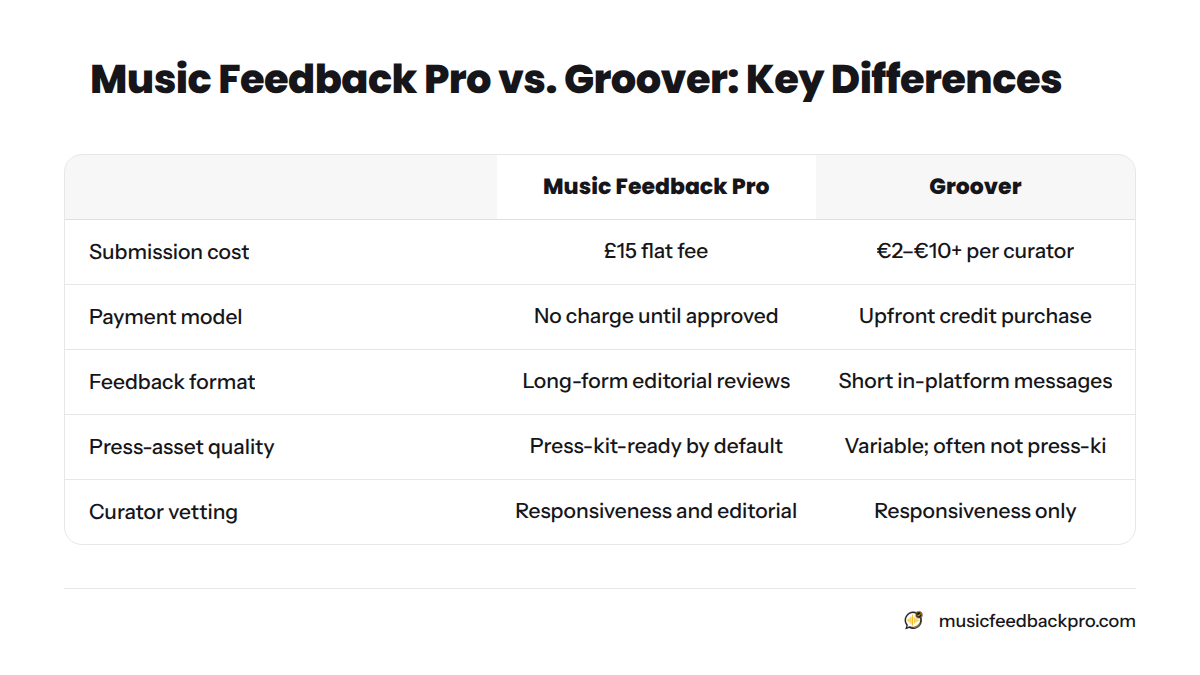
| Feature | Groover | Music Feedback Pro |
|---|---|---|
| Submission cost | Credits (Grooviz), €2-€10+ per curator | £15 flat fee, charged only after campaign approval |
| Payment model | Upfront credit purchase | No charge until approved |
| Response guarantee | Yes - 7-day response or credit refund | Yes - vetted placement, not just a response |
| Feedback format | Short in-platform messages (standard); blog posts (occasional) | Long-form editorial reviews as the standard output |
| Press-asset quality | Variable; often not press-kit-ready | Designed to be press-kit-ready by default |
| Curator vetting | Vetted for responsiveness | Vetted for both responsiveness and editorial quality |
| Artist control | Choose curators yourself from directory | Campaign matched to relevant outlets by the editorial team |
| Best for | Broad curator exposure, playlist pitching, fast turnaround | Artists who need quotable editorial coverage and EPK-ready reviews |
How a Music Feedback Pro campaign works differs from Groover's self-serve model at a structural level. Groover puts curator selection in your hands, charges you upfront, and guarantees a response. Music Feedback Pro vets your submission first, matches your music to appropriate editorial reviewers, and only charges the £15 flat fee once the campaign is approved and ready to run.
When Groover is actually the better choice:
If you want fast, broad exposure across multiple curator types, if your goal is playlist placement alongside blog pitching, or if you prefer to manage your own curator selection - Groover is the right tool. Its network size and self-serve flexibility are genuine advantages for artists running awareness campaigns who are not yet focused on press kit building.
You can read what artists say about their own experience with Music Feedback Pro at the artist reviews page.
Final Verdict: Who Should Use Groover in 2026?
Groover is a legitimate, well-run platform that delivers on its core promise: get your music in front of real curators and guarantee they respond. For certain goals, it is genuinely the right tool. For others, it leaves artists with credits spent and nothing press-kit-ready to show for it.
Decision framework:
| Choose Groover if... | Choose Music Feedback Pro if... |
|---|---|
| You want broad curator exposure across blogs, playlists, radio, and labels | You need long-form editorial reviews for a press kit or EPK |
| You prefer to select curators yourself | You want a vetted campaign matched to the right editorial outlets |
| Fast turnaround matters more than feedback depth | Quotable, press-kit-ready feedback is the primary goal |
| You are building awareness ahead of a release | You are building editorial credibility for industry pitching |
| Your budget allows for a self-managed campaign | You want to pay only after your campaign is approved |
The Groover experience is positive for artists who go in with realistic expectations. Treat responses as listener feedback and potential curator relationships - not as guaranteed press assets - and Groover offers real value. Treat every response as a future press quote and you will be disappointed.
For artists whose primary goal is editorial credibility: Music Feedback Pro charges a £15 flat campaign fee - and that fee only applies once your campaign has been reviewed and approved. Submit your music free, get a verdict on whether it is a good fit, and pay only when the campaign is ready to run. Long-form editorial feedback, designed to be press-kit-ready from the start, is the standard output, not the exception.
Ready to get feedback that belongs in your press kit? Submit your music free at Music Feedback Pro - the £15 flat fee via Music Feedback Pro's £15 flat campaign fee only applies once your campaign is approved. No credits, no guesswork.
Frequently Asked Questions
Is Groover legit?
Groover is an established, legitimate platform that connects independent artists with a real network of curators, blogs, and labels. The response guarantee is enforced: if a curator does not respond within seven days, your Grooviz credits are refunded automatically. Whether it suits your goal depends on whether you need guaranteed responses or guaranteed long-form editorial coverage - those are different outcomes. Check Groover's current terms at groover.co before purchasing credits.
How does Groover pricing work?
Groover charges per submission using Grooviz, its proprietary credits purchased in advance from Groover's pricing page. Each curator listing shows how many Grooviz a submission costs, typically ranging from roughly €2 to €10+ depending on the curator's reach. Credit prices and pack sizes change, so always verify current rates on Groover's site before buying. Music Feedback Pro takes a different approach: a £15 flat fee, charged only after your campaign is reviewed and approved.
Does Groover guarantee press coverage?
No. Groover guarantees that curators respond to your submission within seven days - not that they publish coverage. A share, playlist addition, blog feature, or label inquiry happens at each curator's individual discretion. The response guarantee protects you against being ignored; it does not protect you against receiving a brief pass message with no press-asset value.
What is a good Groover alternative for written reviews?
Platforms focused on vetted long-form editorial critique suit artists who need quotable press assets rather than curator exposure. Music Feedback Pro vets both artists and editorial reviewers before any campaign proceeds, and long-form written feedback is the standard output. Submit free and pay only after approval at musicfeedbackpro.com.