
The best Groover alternatives for indie artists in 2026 are Music Feedback Pro, SubmitHub, Musosoup, Artymind, Submittable, Two Story Melody, and Boost Collective. Each suits a different goal - from press-ready written reviews to high-volume playlist pitching. This page ranks all seven by the output they produce, not just how the submission process works, so you can match the right platform to your actual release strategy.
Disclosure: Music Feedback Pro is listed as the top pick on this page and is the publisher. The ranking criteria below are drawn from the Music Feedback Pro editorial team's own vetting data - which submission types earn approval and which output formats artists actually reuse as press assets. The same criteria apply to every platform on this list.
What Makes a Strong Groover Alternative?
Not every music submission platform is trying to solve the same problem. Before comparing groover competitors and sites like groover, it helps to know what you're actually evaluating. The Music Feedback Pro editorial team uses three criteria.
1. Output type - Does the platform produce a written press asset (a quotable review or blog feature you can put in your EPK), a curator listen with brief feedback, a playlist placement, or a structured campaign report? Press asset output is the most reusable result an artist can get from a submission platform. A written review or blog feature can appear in your artist media opportunities, your label pitch, your grant application, and your social proof. A playlist placement rarely travels the same way.
2. Vetting and approval quality - Are curators screened before they join the network? Are submissions filtered before going live? Platforms that vet on both sides protect you from paying for a response from someone who barely engaged with your music.
3. Cost model - Pay-per-submission credits, monthly subscription, flat fee after approval, or free outreach tool? The differences between these pricing models change your risk exposure considerably. Credit-based systems charge you regardless of outcome. Approval-gated models charge only after something of value is confirmed.
What is a press asset? A press asset is a quotable written review or blog feature you can add to your EPK or share with promoters. Not all platforms produce them - check the output type before you submit.
1. Music Feedback Pro - Best for Press-Ready Written Reviews
Music Feedback Pro runs on an approval-gated model: submitting your track is free, and a flat fee of £15 applies only after your campaign passes editorial review and a curator accepts your track. Curator payments are held in escrow and released only after delivery is confirmed - meaning curators earn their fee by completing the review, not just by signing up.
The output is a long-form written review or blog feature, published by a real music blogger or independent critic. That is a genuine press asset: quotable, shareable, and reusable across your press kit, grant applications, and artist profiles.
For anyone looking at alternatives to groover for musicians that are also cheaper than groover, the approval-gated model here is worth understanding clearly. You pay nothing unless your campaign clears editorial review and a curator commits. That's a meaningfully different risk profile than credit-based systems, which charge per submission regardless of what comes back.
Best for: Artists building a press kit, supporting a release with credible written coverage, or wanting serious vetting on both sides of the transaction. If you want to see how this compares directly to Groover, the Groover vs Music Feedback Pro breakdown covers the model differences in full.
Where it falls short: Music Feedback Pro is not built for artists whose primary goal is volume playlist placements or raw streaming metric growth. The platform focuses on editorial quality, not reach velocity.
Ready to submit? Music Feedback Pro is free to submit. You pay £15 only if your campaign is approved - and curators are paid only on confirmed delivery. Submit your track free →
2. SubmitHub - Best for Volume Submissions to Blogs and Playlists
SubmitHub runs a credit-based pay-per-submission model. Artists purchase credits and spend them sending tracks to curators - bloggers, playlist managers, and record labels. Premium submissions guarantee a decision within 48 hours, and curators must listen for at least 20 seconds before earning their credit back, according to SubmitHub's own published rules.
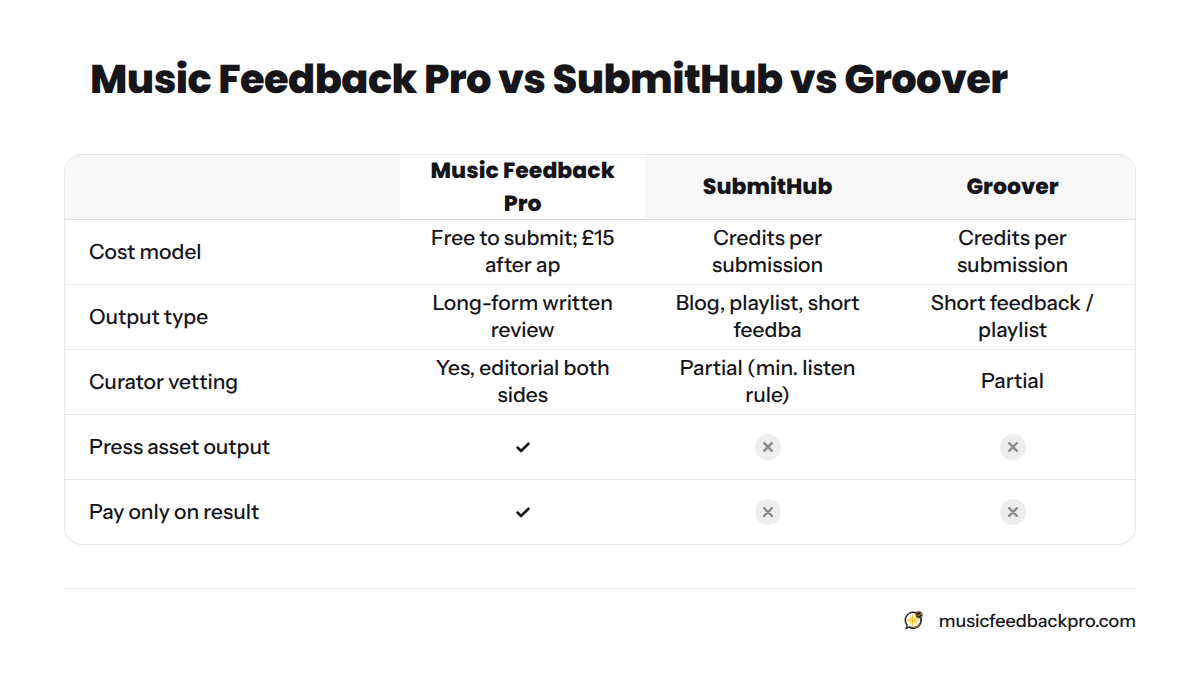
The output is a mix of blog features, playlist placements, and short feedback snippets - the feedback running to a few sentences rather than a full written review.
The groover vs submithub question comes up often, and the honest answer is that they operate on similar mechanics. Both charge per submission, both offer curator response guarantees of some kind, and neither produces a long-form written press asset as standard output. SubmitHub's advantage over Groover is raw catalogue size - thousands of curators across genres gives you genuine breadth if volume is the goal.
Best for: Artists who can handle high rejection rates and want to reach a large number of curators quickly. If your release strategy is about speed and scale, SubmitHub's network delivers on that.
Where it falls short: Credits accumulate cost quickly at scale. A campaign targeting 50 curators with premium submissions runs to real money, with no guarantee of a single placement. Curator quality is not editorially vetted - the minimum listen requirement is a mechanical check, not an editorial standard. The feedback you receive is rarely long enough to function as a press asset. For a wider view of music blog submission alternatives that address these gaps, the best music blog submission sites in 2026 guide covers the full field.
3. Musosoup - Best for Sustainable Ongoing Campaigns
Musosoup flips the submission model: instead of artists pitching to curators, curators apply to cover the artist. Artists pay a monthly subscription for campaign access, and the platform manages outreach on their behalf, matching them with press writers, bloggers, and playlist curators who actively want to engage.
The output covers press features, blog articles, and playlist inclusions - a broader mix than most single-model platforms.
Best for: Artists releasing music consistently who need ongoing campaign infrastructure without rebuilding their outreach list from scratch each release cycle. The subscription model starts to pay off the more releases you run through it.
Where it falls short: You pay the monthly fee regardless of whether a specific release gains traction. Artists dropping a one-off single often find the subscription expensive relative to the return. For a full cost-benefit breakdown, the Musosoup review goes deep on when the numbers make sense.
4. Artymind - Best for AI-Assisted Feedback Before You Campaign
Artymind pairs an AI feedback layer with an optional curator submission network. Submit a track and receive a structured report covering arrangement, mix characteristics, genre fit, and commercial potential - before deciding whether to push it to a wider audience.
Best for: Artists who want honest development feedback on a track before investing in a full press campaign. Knowing where a track stands before spending on outreach is genuinely useful, especially early in a release career.
Where it falls short: AI feedback is not a press asset. It cannot be quoted in a press kit, attributed to a named critic, or submitted as evidence of editorial coverage. If your goal is credible third-party written coverage, Artymind's feedback report does not fill that role. For a detailed comparison of how Artymind stacks up against other feedback tools, that page covers the specifics.
5. Submittable - Best for Grant and Press Submission Pipelines
Submittable is a submission management platform used by publications, grant bodies, record labels, and arts organisations to receive and process applications. Artists don't submit to Submittable itself - they submit through it to organisations that have chosen it as their intake system.
Best for: Artists submitting to music grants, competitions, residencies, or media outlets that require a formal intake process. If a grant you're applying for runs through Submittable, you'll need an account. It's also useful for tracking multiple formal submissions in one dashboard.
Where it falls short: This is not a curator discovery platform. There is no feedback guarantee, no curator network, and no press asset output. The outcome of any submission depends entirely on the receiving organisation's editorial or grant decisions. It belongs on this list because artists genuinely use it as part of their press and grant pipeline - but it should not be confused with platforms that actively match artists to curators.
6. Two Story Melody - Best for Long-Form Independent Editorial Coverage
Two Story Melody is an independent music blog that accepts artist pitches and publishes long-form editorial features. Coverage is written by staff and contributing writers - real editorial voices, not algorithmic placements.
Best for: Artists who want a credible, independent written perspective on their music. A Two Story Melody feature carries genuine editorial weight and produces the kind of long-form press asset that works in a press kit or as social proof.
Where it falls short: Capacity is limited, editorial standards are high, and there is no guaranteed response time. You cannot scale Two Story Melody across multiple outlets - it's a single publication, not a network. Think of it as a high-quality target pitch rather than a campaign tool. Understanding the difference between press coverage vs playlist plays is worth your time before you decide how to split your promotion budget.
7. Boost Collective - Best for All-in-One Promotion Packages
Boost Collective offers managed promotion packages that bundle playlist pitching, press outreach, and social media coverage into a single purchase. Artists pay a package fee and receive a multi-channel campaign report when the campaign closes.
Best for: Artists who want to hand off the full promotion workflow for a release. If you don't have time to manage separate pitching pipelines and want one point of contact for your campaign, a managed package reduces the operational load.
Where it falls short: Bundled pricing makes it harder to assess the value of each individual element. Individual curator quality is less transparent than on platforms with formal vetting processes. Artists who want editorial control over which curators accept their track - or who specifically need a quotable written review - may find the bundle format too broad for a precise goal.
Side-by-Side: Groover Alternatives Compared
| Platform | Best For | Cost Model | Output Type | Curator Vetting |
|---|---|---|---|---|
| Music Feedback Pro | Press-ready written reviews | Free to submit; £15 flat fee after approval | Long-form written review / blog feature | Yes - editorial approval on both sides |
| SubmitHub | Volume blog & playlist pitching | Credits per submission | Blog features, playlists, short feedback | Partial (minimum listen requirement) |
| Musosoup | Sustainable ongoing campaigns | Monthly subscription | Press features, blog articles, playlists | Yes - platform-managed |
| Artymind | AI-assisted track feedback | Per submission / subscription | AI feedback report + optional curator | Partial |
| Submittable | Grant & press intake pipelines | Per organisation / subscription | Formal submission receipt | No (organisation-dependent) |
| Two Story Melody | Long-form independent editorial | Free pitch | Editorial blog feature | Yes - editorial staff |
| Boost Collective | All-in-one promotion bundle | Package pricing | Multi-channel coverage report | Partial |
How to Choose the Right Platform for Your Goals
The platform you choose should match the output you need, not just the price you're willing to spend. Here is a decision framework based on release goal.
| Your Goal | Best Platform Type | Recommended Pick |
|---|---|---|
| Quotable press asset for EPK or media coverage | Approval-gated editorial review | Music Feedback Pro |
| Volume pitching to blogs and playlists | Credit-based marketplace | SubmitHub |
| Ongoing campaign for consistent releases | Subscription model | Musosoup |
| Development feedback before you campaign | AI-assisted feedback | Artymind |
| Grant or competition submissions | Intake management tool | Submittable |
| Single long-form editorial feature | Independent music blog | Two Story Melody |
| Outsourced full promotion bundle | Managed package | Boost Collective |
A few practical rules worth applying before you commit:
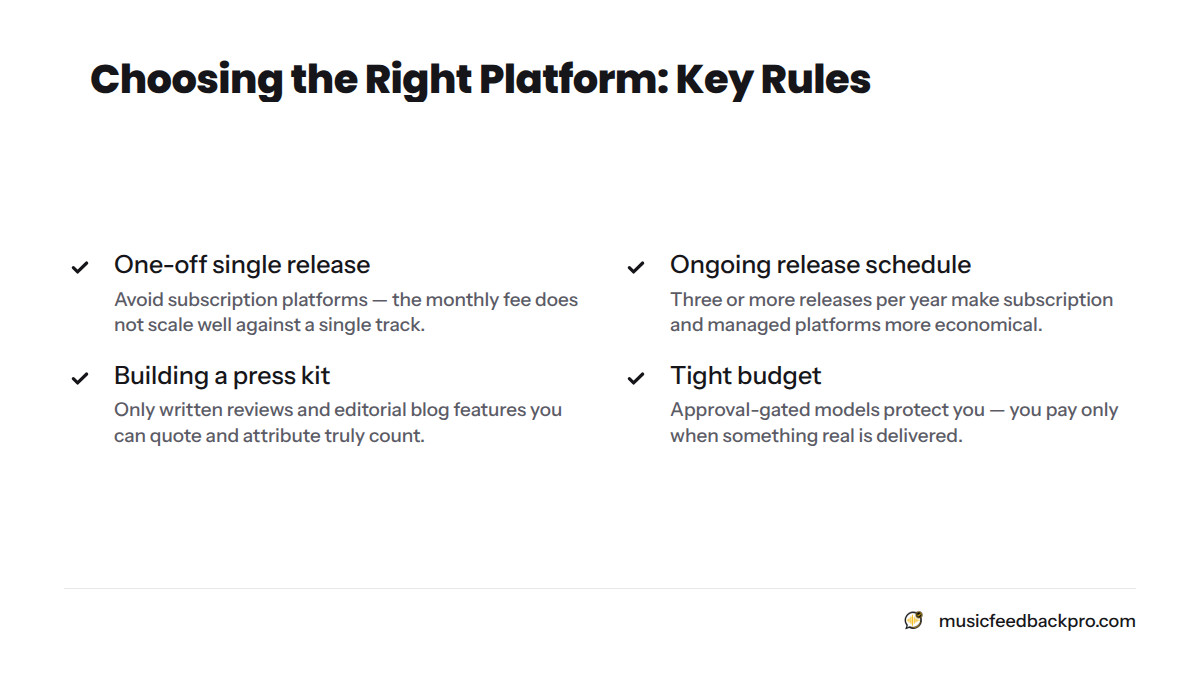
- For a one-off single release, avoid subscription platforms. The monthly fee does not scale well against a single track.
- For an ongoing release schedule (three or more releases per year), subscription and managed platforms start to make more economic sense.
- For press kit building, the only outputs that genuinely count are written reviews and editorial blog features you can quote and attribute. AI reports and short feedback snippets do not fill that role.
- For a tight budget, approval-gated models protect you - you only pay when something real is delivered. Credit-based platforms charge you for the act of submitting, not for the result.
- You can run more than one platform at the same time. Many artists run a Music Feedback Pro submission for press coverage alongside a SubmitHub campaign for playlist volume, treating them as different channels with different output goals rather than competing choices.
For a full breakdown of every model type, choosing between music feedback platforms covers each mechanic in detail.
Frequently Asked Questions
What is the best alternative to Groover for indie artists?
The best alternative depends on what you need back from the platform. Artists building a press kit or EPK and wanting quotable written reviews should start with Music Feedback Pro - it is free to submit, charges a flat £15 only after editorial approval, and produces long-form written coverage you can actually use. Artists who want to reach large numbers of curators quickly will find SubmitHub's credit-based network better suited to that goal.
Are there free alternatives to Groover?
Some platforms allow free submissions with limited functionality or paid upgrades. Music Feedback Pro is free to submit; the £15 fee applies only if your campaign passes editorial review and a curator accepts your track. Two Story Melody accepts free pitches with no submission fee at all, though acceptance is entirely at editorial discretion and capacity is limited.
Is Groover better than SubmitHub?
They operate on different models and suit different goals rather than competing directly. Groover uses a credit-based system with a focus on curator response guarantees; SubmitHub uses a similar credit model with a broader curator catalogue and a minimum listen enforcement rule. Neither platform produces a long-form written press asset as standard output. For a full side-by-side of how both compare to a platform that does, see the full Groover review.
Submit free. Pay £15 only if approved. Music Feedback Pro is free to submit. A flat £15 fee applies only after your campaign passes editorial review - and curators are paid from escrow only on confirmed delivery. No credits, no upfront spend, no guessing. Submit your track free →
Sources
- How SubmitHub Works - SubmitHub
- Musosoup - Platform Overview
- Artymind - Platform Overview
- Submittable - Platform Overview
- Two Story Melody - Music Blog and Submission
- Boost Collective - Promotion Packages
- Groover - Platform Overview
- Music Feedback Pro - Submit Free, Pay £15 Once Approved
- Press Coverage vs Playlist Plays - Music Feedback Pro
- Best Music Blog Submission Sites in 2026 - Music Feedback Pro
- Groover Review 2026: Honest Verdict for Indie Artists - Music Feedback Pro
- Musosoup Review 2026: Is It Worth It for Artists? - Music Feedback Pro
- Music Feedback Platforms: Are They Worth It in 2026? - Music Feedback Pro
- Land Artist Media Opportunities as an Indie Musician - Music Feedback Pro
- Groover vs Music Feedback Pro: Which Is Better for Artists? - Music Feedback Pro