
Five music feedback platforms are worth serious consideration this year: Music Feedback Pro, Groover, SubmitHub, Musosoup, and Soundout. They differ on four axes: how rigorously reviewers are vetted, what format of feedback you receive, when you pay and what protects your money, and whether the output can serve as a press asset. The right platform depends on what you actually need from the process.
What this comparison covers: curator vetting rigour, feedback format, cost model and payment timing, and press-asset utility. Music Feedback Pro's editorial team wrote this page and is included in the comparison on the same criteria as every other platform. That position is disclosed openly below.
The Real Problem With Music Feedback Platform Marketing
Independent artists searching for honest critique face a genuine problem: platform marketing copy sounds identical across the board. Every site promises "real feedback from real curators." What that copy never explains is who those curators are, whether anyone screened them, what you will actually receive, and whether you can quote any of it somewhere useful.
This comparison closes that gap. Our editorial team at Music Feedback Pro has processed thousands of artist submissions and curator applications on both sides of the platform. The patterns from that vetting data inform every assessment below.
Before diving into the comparison, the guide on how music feedback platforms work is a solid starting point for understanding the broader category.
The Four Criteria That Actually Separate These Platforms
Every platform below is assessed on the same four criteria - no exceptions, no special treatment.
Curator Vetting Rigour
A "vetted curator" means very different things depending on the platform. On some, it means the platform approved a curator's application after reviewing their audience, publication history, and genre expertise. On others, it means the curator created a profile and listed some genre tags. That distinction matters: a curator who passed a real editorial screen is accountable in a way a self-registered profile simply is not. Dual-sided vetting goes further still, screening both the curator and the artist campaign before either goes live.
Feedback Format
The format of feedback determines what you can do with it. Long-form written critique from a named reviewer can appear in your electronic press kit (EPK), your artist bio, or a media pitch. A three-sentence curator note or a star rating cannot. Platforms in this space deliver everything from timestamped audio comments to quantitative listener-panel reports, and treating them as equivalent leads artists to choose the wrong tool for their goal.
Cost Model and Payment Timing
Paying upfront for credits before you know whether anyone finds your music compelling is a fundamentally different risk profile from paying a flat fee only after an editor has reviewed and approved your campaign. Credit-based models, subscription access, and post-approval flat fees each distribute risk differently. Escrow adds a further layer: the fee is held until delivery is confirmed, so neither party can walk away with money owed.
Press-Asset Utility
This criterion asks one question: can this output be quoted in a bio, an EPK, or a media pitch? A long-form written review from a named music journalist is press-ready. An anonymous listener score is not. If building a credible press profile is part of your goal, this criterion alone can eliminate several platforms from your shortlist.
Here is the full side-by-side view before we get into each platform in detail.
| Platform | Curator Vetting | Feedback Format | Cost Model | Press-Asset Utility |
|---|---|---|---|---|
| Music Feedback Pro | Dual-sided (curators + campaigns screened) | Long-form written critique, blog features, interviews | £15 flat fee, post-approval, escrow held | Yes - quotable, named reviewer |
| Groover | Platform-side approval | Short curator note (≤7 days) | Credits purchased upfront | Partial - brief notes, not full reviews |
| SubmitHub | Listing only (self-registered) | 1-3 sentence note (premium credits) | Premium/standard credits upfront | Rarely - too brief for press use |
| Musosoup | Platform vets curators | Written reviews, blog features, playlist placements | Monthly artist subscription | Yes - varies by curator offer |
| Soundout | Consumer listener panel | Quantitative scoring report | Per-report fee, upfront | No - numerical output only |
Music Feedback Pro
Disclosure: Music Feedback Pro publishes this comparison. We have assessed ourselves on the same four criteria applied to every other platform. Where another platform serves a specific use case better, we say so.
Who the Reviewers Are
Music Feedback Pro runs a dual-sided vetting model. Curators - music journalists, bloggers, and independent press - apply to join the platform and are screened on publication history, genre expertise, and writing quality before their profiles go live. Artist campaigns go through an editorial review before entering the marketplace. This two-stage screen is what separates a guaranteed credible response from a guaranteed fast one.
From our own vetting data: the campaigns that pass editorial review, matched with curators who pass profile review, are the combinations that produce feedback with long-term press utility. Campaigns or curator applications that do not meet the editorial bar are declined rather than silently deprioritised.
Feedback Format
Accepted campaigns receive long-form written critique from named reviewers. The output can include blog features, artist interviews, and media placements. Every piece of feedback is attributed, structured as editorial writing, and formatted so it can be quoted directly in a press kit, shared on social media, or used as a reference in a label or sync pitch. Press-asset-ready feedback is the design intent, not a byproduct.
Cost Model
Submitting a campaign is free. The flat £15 campaign fee is charged only after editorial approval. Accepted curator offers are held in escrow until delivery is confirmed, which means the artist carries no financial risk if a curator accepts and then fails to deliver. For a full breakdown, see the pricing page.
Best For
Independent artists and music PR teams who need quotable press coverage, not just streaming metric boosts. If your goal is building a credible EPK, securing blog features, or generating press assets for a label or sync pitch, Music Feedback Pro is built around that output. The guide on why indie artists need music reviews in 2026 explains why press assets carry real weight at this stage of the market.
Groover
Who the Reviewers Are
Groover lists curators from music blogs, radio stations, playlist channels, and labels. The platform applies its own approval process before curators are listed, but the vetting is platform-side rather than dual-sided: artist campaigns are not editorially screened before submission. The result is a wide curator network with varying depth of expertise across genres. For a thorough breakdown, the Groover review 2026 covers the platform in full detail.
Feedback Format
Groover guarantees a response within seven days. That response is a short curator note - typically a paragraph or two - rather than long-form written critique. The guaranteed delivery model prioritises speed and reach over depth. You will hear back from every curator you contact; what you actually receive varies significantly by curator.
Cost Model
Groover runs on a credit system. Artists purchase credits upfront and spend them to contact curators. There is no refund for negative or unhelpful feedback - the guarantee is delivery, not quality. Your financial outlay is committed before you know whether any curator will respond positively.
Best For
Artists who want fast, wide outreach to a large number of curators at once and can absorb the upfront credit cost. Groover suits release campaigns where volume of contact matters as much as depth of feedback. Artists who need substantive written critique or press-asset output will find the short-note format limiting.
SubmitHub
Who the Reviewers Are
SubmitHub runs an open listing model: blogs, playlist curators, and labels register and tag themselves by genre. There is no formal editorial vetting of reviewers before they appear on the platform. The breadth of the network is a genuine advantage for discovery; the absence of screening means quality varies widely across the curator pool.
Feedback Format
Premium credits on SubmitHub guarantee a written response, typically one to three sentences explaining why a submission was accepted or declined. Standard credits offer a pass or decline with minimal rationale. The short-form note is useful for understanding curator taste at a surface level but is rarely detailed enough to quote as editorial coverage or include in a press kit.
Cost Model
SubmitHub sells premium and standard credits upfront. Premium credits cost more and guarantee a written response; standard credits are cheaper but carry no response obligation. Both are purchased before submission, so the outlay is committed regardless of outcome.
Best For
Artists testing playlist fit or blog interest at scale, particularly those releasing regularly who want to identify which curators respond to their sound. SubmitHub is not well suited to artists seeking substantive critique, long-form written reviews, or press assets.
Musosoup
Who the Reviewers Are
Musosoup vets its curators - music journalists, bloggers, and playlist curators - before listing them on the platform. The vetting process focuses on curator credentials and publication history. Artist campaigns are not screened editorially before going live; any subscribed artist can post a campaign. The full picture of what the platform delivers is covered in the Musosoup review 2026.
Feedback Format
Musosoup curators can offer written reviews, blog features, playlist placements, and social posts. The format varies by curator and by the specific offer they make on your campaign. Long-form written reviews are possible and, when they come from named music journalists, can function as press assets.
Cost Model
Musosoup charges artists a monthly subscription fee for platform access. Curators then apply to individual campaigns. Coverage is not guaranteed - curators choose which campaigns to engage with, so a subscription month without interest from relevant curators is still a month paid.
Best For
Artists who release music regularly and want ongoing PR access across a broad curator network without pitching individual curators manually. The subscription model makes more economic sense the more frequently you release. For a single release, the per-month cost versus the probability of meaningful coverage is worth calculating carefully. The analysis on whether a feedback platform is worth paying for lays out a clear framework for that decision.
Soundout
Who the Reviewers Are
Soundout takes a categorically different approach: feedback comes from a large consumer listener panel rather than industry curators or music critics. Panellists are recruited listeners who rate tracks against standardised criteria. The output is statistically representative of a general audience segment, not an industry professional's editorial opinion.
Feedback Format
Soundout produces quantitative scoring reports. Your track is rated on dimensions including hook strength, lyrical content, production quality, and originality, with scores benchmarked against genre norms. The output is a numerical report, not prose critique. It cannot be quoted as editorial coverage and is not designed as a press asset.
Cost Model
Soundout charges a per-report fee paid upfront, with pricing varying by panel size and report specification. There is no subscription or credit system; each report is a discrete paid transaction.
Best For
Artists who need data-led evidence of commercial readiness: radio pluggers looking for hook-strength scores, A&R teams benchmarking a track before investment, or artists who want quantitative listener data before committing to a release. Soundout is the wrong tool if your goal is editorial critique, press coverage, or curator relationships.
What Music Feedback Pro's Vetting Data Reveals About Platform Quality
Across thousands of artist submissions and curator applications, clear patterns emerge that marketing copy never surfaces.
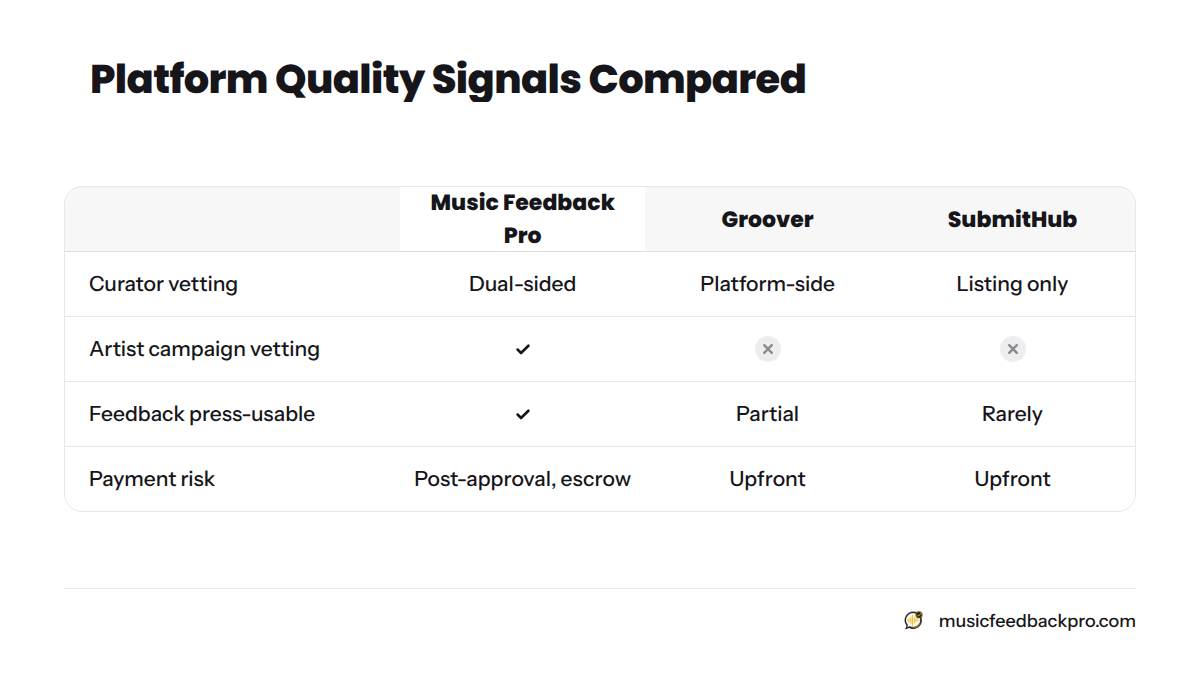
The first pattern: a platform that guarantees a response is not the same as a platform that guarantees a credible one. Groover's seven-day guarantee and SubmitHub's premium-credit guarantee both ensure delivery. They do not ensure that the person delivering feedback has been assessed for writing quality, editorial accountability, or genuine genre expertise.
The second pattern: dual-sided vetting consistently produces higher output quality because it removes the two weakest links at once. When a curator's application is declined because their writing sample is thin or their publication has no real audience, artists never encounter that curator. When an artist campaign is declined because the recording quality or submission details do not meet the editorial bar, curators are protected from wasting time on submissions unlikely to produce meaningful coverage. Both sides benefit from that higher floor.
The third pattern: press-asset utility correlates directly with the accountability structure of the reviewer. Named reviewers with a verifiable publication history write differently from anonymous consumer panellists. They write for an audience, not a scoring rubric. That difference is what makes the output quotable.
Here is how those patterns translate to platform quality signals across all five platforms.
| Platform | Curator Vetting | Artist Campaign Vetting | Feedback Press-Usable | Payment Risk |
|---|---|---|---|---|
| Music Feedback Pro | Dual-sided | Yes | Yes | Post-approval, escrow |
| Groover | Platform-side | No | Partial | Upfront |
| SubmitHub | Listing only | No | Rarely | Upfront |
| Musosoup | Yes | No | Yes | Subscription |
| Soundout | Panel (anonymous) | No | No | Upfront |
Artists who want to understand the full mechanics behind this model can read the guide on how to launch a successful music feedback campaign on Music Feedback Pro.
Which Platform Fits Your Situation?
No single platform wins across every use case. Here is the honest match.
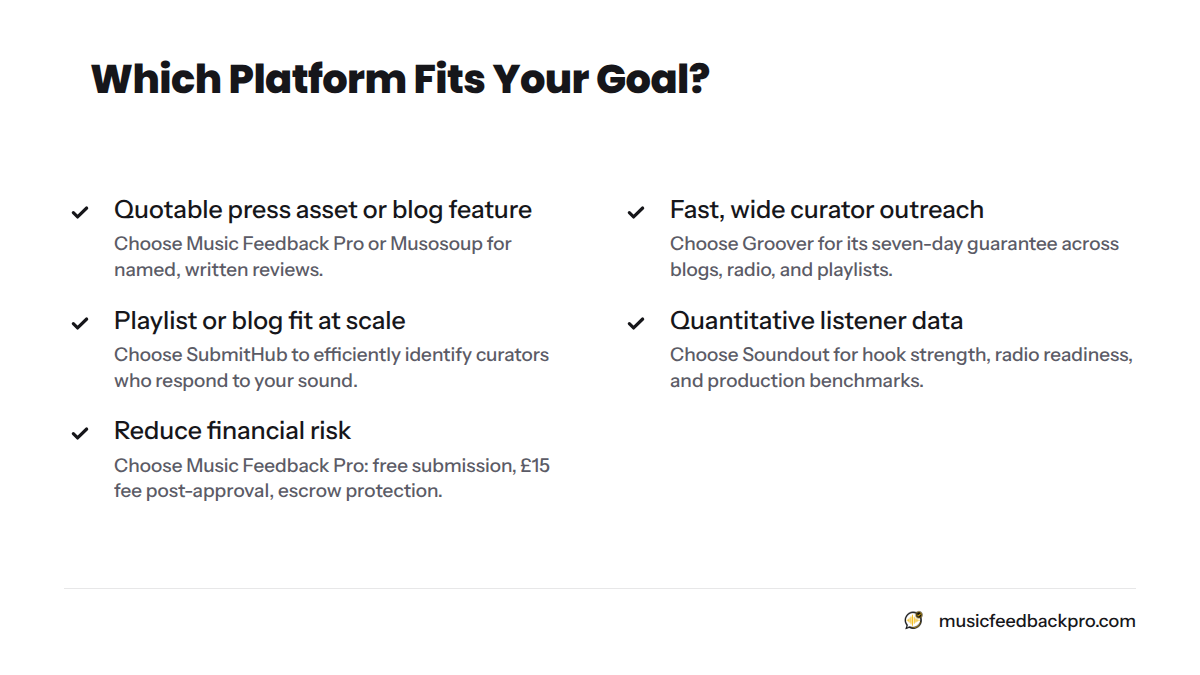
If you need a quotable press asset or blog feature
Choose Music Feedback Pro or Musosoup. Both produce named, written reviews that can be used in press materials. Music Feedback Pro's post-approval fee and escrow model add a layer of financial protection that Musosoup's subscription model does not.
If you want fast, wide curator outreach
Choose Groover. Its credit system and seven-day guarantee give you the fastest path to hearing from a large number of curators across blogs, radio, and playlists. Accept that the feedback depth will be limited.
If you are testing playlist or blog fit at scale
Choose SubmitHub. The premium-credit model lets you contact many curators efficiently and build a picture of which genres and tastemakers respond to your sound. Do not expect the output to serve as press coverage.
If you want quantitative listener data
Choose Soundout. No other platform on this list produces statistically grounded audience data on hook strength, radio readiness, or production benchmarks. It answers a different question from the others.
If you want to reduce financial risk
Choose Music Feedback Pro. Submission is free. The £15 flat fee is charged only after editorial approval, and accepted offers are held in escrow until delivery is confirmed. You know your music has passed an editorial screen before any money changes hands. For artists releasing their first single, that approval signal has real value beyond the feedback itself.
For a ranked view of the broader category, the ranked list of the best music feedback platforms and the guide on the best music blog submission sites in 2026 extend this comparison into specific submission contexts.
Ready to submit your campaign? Submit free - pay the flat £15 fee only after editorial approval. See how Music Feedback Pro works | View the flat £15 campaign fee and escrow terms
Frequently Asked Questions
What is a music feedback platform? A music feedback platform is an online service that connects artists with reviewers, critics, or listeners who give opinions on unreleased or released music. Models range from open peer swaps to vetted critics writing long-form reviews.
How do I choose between music feedback platforms? Compare who the reviewers are and whether they are vetted, what format of feedback you receive, and when you pay. Prefer platforms where you can use the output as a press asset and where fees are conditional on approval or delivery.
Are paid music critique platforms better than free ones? Not automatically. Free options can be useful for quick reactions, while paid, vetted options tend to deliver longer, more accountable critique. The right choice depends on whether you need private input or quotable coverage.
Do music feedback platforms guarantee coverage? Reputable ones do not guarantee a positive review or publication. You are paying for a credible, honest assessment from a reviewer who has accepted your music.