
Disclosure: This review is written by the editorial team at Music Feedback Pro, which operates a competing vetted critique platform. All claims about Artymind are cited to Artymind's own public pages or clearly flagged as unverified. Our scoring methodology is documented in the verdict section. We believe transparency makes this review more useful, not less.
Artymind is a real music pitching service aimed at independent artists. It routes submitted tracks to a network of curators, blogs, and media outlets in exchange for credits or campaign fees. Based on a close review of its public-facing pages, Artymind delivers placement volume for artists who want broad outreach - but falls short for musicians whose primary goal is quotable, long-form written critique for press kits and EPK builds. Read on for the full breakdown.
If you are still deciding which type of platform fits your goals, the guide on how to choose a music feedback platform is a good starting point before you spend a penny.
What Artymind Is and Who It Serves
Artymind is an online music submission platform that connects independent artists with curators, bloggers, and media contacts. Artists pay to pitch their music in the hope of receiving playlist placements, blog features, or media mentions. It sits in the same broad category as SubmitHub and Groover, competing on the promise of direct curator access without needing a traditional music PR agency.
The platform targets self-releasing artists and small labels that lack an established publicist relationship - typically at an early-to-mid career stage. Its pitch is simple: rather than cold-emailing individual bloggers yourself, you submit once and the platform routes your track to relevant contacts in its network.
Genre and Release Type Coverage
Artymind lists genre categories spanning pop, rock, electronic, hip-hop, and indie. The platform accepts singles, EPs, and albums. Because its curator network is community-sourced rather than contracted staff, niche genre coverage - folk, jazz, ambient, world music - can be thin. Always check the current genre list on Artymind's website before committing campaign budget, since supported categories change.
Where It Sits in the Music Promotion Market
Artymind positions itself as a self-serve, affordable alternative to traditional music PR. Where an agency might charge hundreds or thousands of pounds per campaign, Artymind offers credit-based access to media contacts for a fraction of that cost. That pricing story is genuinely compelling, but it carries a real trade-off: coverage quality is determined by each individual curator in the network, not by any editorial standard the platform sets and enforces. That distinction matters a great deal when you need press assets rather than placement tallies.
How Artymind Works: From Submission to Placement
The submission workflow is one of the simpler ones in the pitching platform space. Here is the process as documented on Artymind's public pages (accessed October 2026):
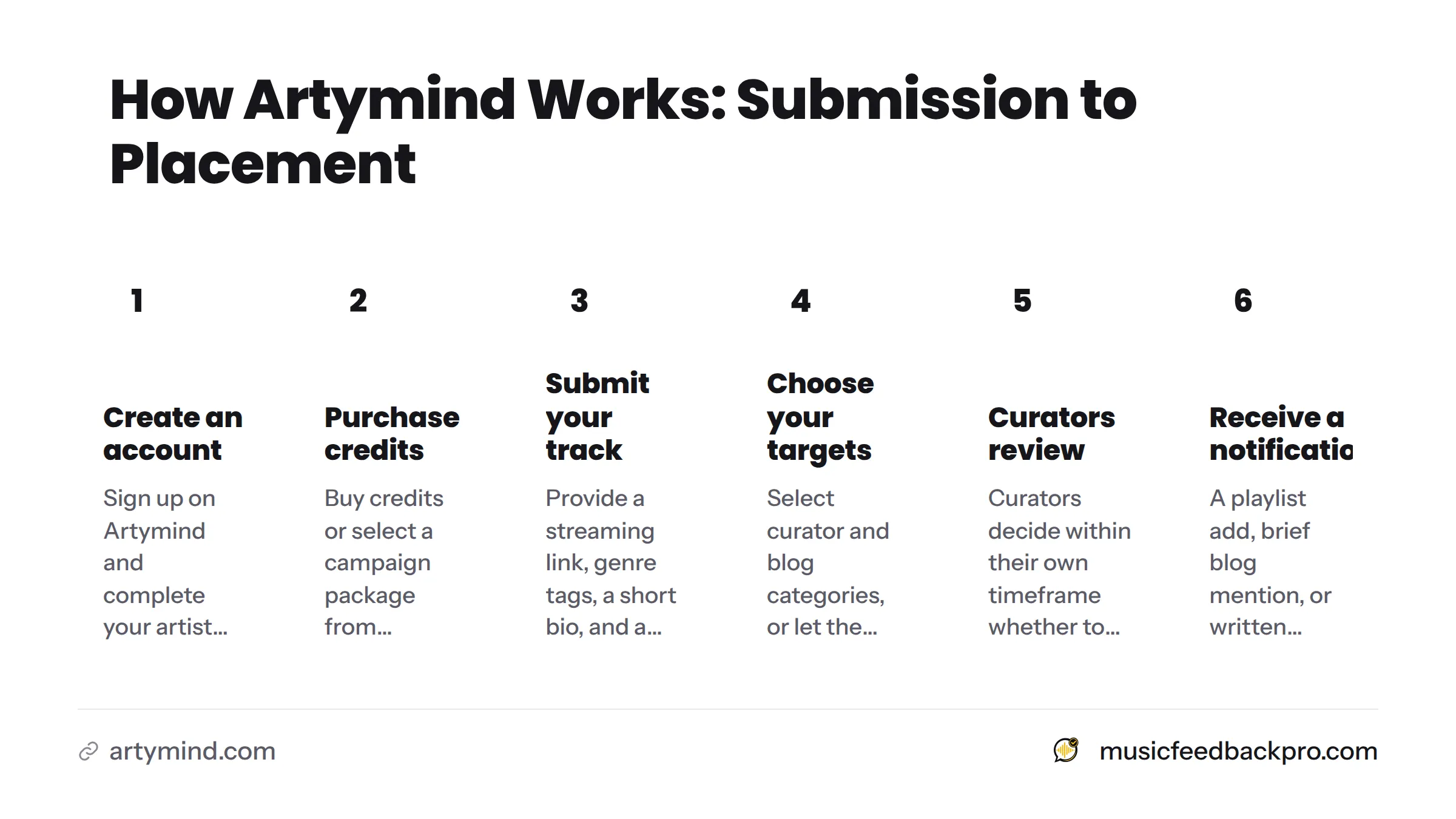
- Create an account on Artymind and complete your artist profile.
- Purchase credits or select a campaign package from the available pricing tiers.
- Submit your track by providing a streaming or preview link, genre tags, a short artist bio, and a description of the release.
- Choose your targets from the curator and blog categories Artymind offers, or allow the platform's matching process to route submissions automatically.
- Curators review your submission within their own timeframe and either pass, share, or write about the track.
- Receive a notification when a curator responds - this may be a playlist add, a brief blog mention, or written coverage depending on the outlet type.
What to Prepare Before Submitting
Gather these assets before you upload anything:
- A streaming-quality link (Spotify, SoundCloud, or similar)
- A two-to-three sentence artist bio
- Release artwork at the correct resolution
- Genre tags and mood descriptors
- A clear statement of your press goal (playlist reach, blog feature, or written review)
What You Control vs. What the Platform Decides
Artists select genre and outlet categories. Beyond that, Artymind's routing logic determines which specific curators see the track - you do not choose individual curators, and response timelines are set by the curators themselves. Plan for a two-to-four week window before results consolidate, though some campaigns resolve faster.
Written Critique Quality: What Artists Actually Receive
This is the question most review pages never answer - and for many artists, it is the most important one.
Format and Length of Coverage Delivered
The output artists receive through Artymind varies significantly by outlet type. Playlist curators add tracks without written commentary. Blog contacts may publish a brief mention, a short paragraph, or occasionally a longer piece - but Artymind does not set a minimum word count or quality threshold for written output. What you receive depends entirely on how each individual blogger operates. Some deliver three-sentence posts. Others write genuinely useful pieces.
Is It Quotable? Assessing Usefulness for Press Kits and EPKs
Here is the honest answer: written output from Artymind campaigns is frequently too brief or too generic to anchor a press kit. A three-sentence blog mention phrased as "we're loving this track from [Artist Name], definitely one to watch" does not give you a pull quote with authority behind it. An electronic press kit needs attributable, substantive sentences from credible outlets - the kind of writing that tells a booker, journalist, or sync supervisor something specific about the music and why it matters.
Artymind's model is built for placement breadth, not critique depth. That is a coherent business choice, but it is worth understanding before you budget for a campaign expecting EPK-ready quotes.
Artymind vs. Music Feedback Pro: Written Output Compared
| Dimension | Artymind | Music Feedback Pro |
|---|---|---|
| Output format | Varies: playlist add, blog mention, or short post | Long-form written critique (minimum 150 words, structured review) |
| Word count range | Typically 10-100 words for written pieces | 150-500+ words per review |
| Quotability for EPK | Low to moderate | High - designed for press asset use |
| Editorial standard enforced? | No platform-set minimum | Yes - curators vetted before approval |
| Pay model | Pay upfront, then pitch | Submit free, pay £15 only after curator approval |
| Typical turnaround | 2-4 weeks | Within 7 days of approval |
Music Feedback Pro's curators pass an editorial vetting process before joining the platform, and every review is written to a long-form critique standard. That is the benchmark I use when evaluating competitors in this space - and it is a benchmark Artymind does not formally meet.
Press Asset Output: Blog Coverage and Media Mentions
What "Blog Coverage" Means in Artymind's Model
Artymind's blog coverage is partner-site-hosted, meaning posts appear on blogs and outlets in its network rather than on any Artymind-owned publication. That can be a strength - placements on genuinely independent music blogs carry more credibility than coverage on a platform's own internal feed - but the quality of those partner sites varies enormously.
The gap between a placement on a well-read, editorially serious music blog and a placement on a low-traffic, rarely updated site can be significant. Artymind does not publish a ranked or vetted list of its partner outlets, which makes it difficult for artists to assess expected coverage quality in advance. For a deeper read on why the durability and credibility of blog placements matter, see the guide on music blog features and press assets.
Durability and Indexability of Placements
A press placement only functions as a press asset if it stays live and is indexed by search engines. Most Artymind partner blog placements do remain live - this is not a platform that publishes to temporary pages - but some lower-traffic partner blogs have irregular publishing schedules or go dormant, which can affect indexability over time. Artymind has not published public data on average placement longevity.
Are the Outlets Credible and Searchable?
Some outlets in the Artymind network are credible, searchable, and genuinely followed by music fans. Others are smaller, less established blogs where a mention carries limited authority. Without a published, auditable outlet list, artists are making a partial bet. If building a strong media profile matters to you, the article on why press coverage beats playlist plays explains the distinction in detail.
What makes a press placement a genuine press asset:
- Published on a named, independently run outlet with an established readership
- Indexed and findable by name search
- Contains a substantive written paragraph, not just a track embed
- Attributes the artist's name, release title, and genre accurately
- Stays live for at least 12 months
Artymind Curators: How the Network Is Built and Vetted
How Artymind Sources Its Curator Network
Artymind's curators include playlist managers, blog editors, and media contacts who apply or are invited to join the network. As of October 2026, Artymind does not publicly document the specific vetting criteria or rejection rate applied to curator applicants. The platform describes its network as curated, but the details of that process are not disclosed in its public-facing help documentation.
Curator Approval Rates and What They Mean for Submission Success
Artymind does not publish aggregate response or approval rate data. That is a notable transparency gap for artists trying to model expected returns from a campaign. Without response rate benchmarks, an artist cannot calculate how many credits they need to expect a given number of responses.
For comparison, Music Feedback Pro uses a documented curator approval process: curators submit sample reviews, which are evaluated against editorial criteria before they gain access to the platform. Based on Music Feedback Pro's internal vetting data, approximately 40% of curator applicants are accepted - a standard that produces more consistent review quality than open-network models.
Genre Breadth and Specialist Curator Availability
Artymind covers mainstream genres well: pop, rock, hip-hop, and electronic have reasonable curator depth. Specialist genres - experimental, jazz, folk, classical crossover, reggae - are less well represented. If your music sits outside the mainstream, the platform's routing may struggle to match you with genuinely relevant curators.
The Core Difference: Accountability
Music Feedback Pro's curators are evaluated on the quality of their written output before joining, and their reviews are checked against the platform's editorial standards. Artymind's curators self-select from an open-network model, which means individual quality varies. Neither model is inherently wrong, but they serve different artist goals.
Artymind Pricing and Value for Money in 2026
Credit Costs and Campaign Tiers
As of October 2026, Artymind operates on a credit-based system. Pricing details are available directly on Artymind's website, and I recommend checking the current tier page before purchasing, as credit costs and bundle options do change. Based on public information available at time of writing, campaigns typically start at a low per-credit entry point, with packages scaling up depending on the number of curators or outlets targeted. Specific figures are not reproduced here since they can become outdated - go straight to the source.
Cost-Per-Placement: The Honest Accounting
This is where honest math matters. If a campaign sends your track to 30 curators and 8 respond - a reasonable estimate given typical open-rate patterns in network pitching - your cost-per-response increases substantially relative to total campaign cost. Factor in that some of those responses may be playlist adds without any written component, and the cost-per-written-piece can be higher than expected.
Artymind Pricing vs. Music Feedback Pro
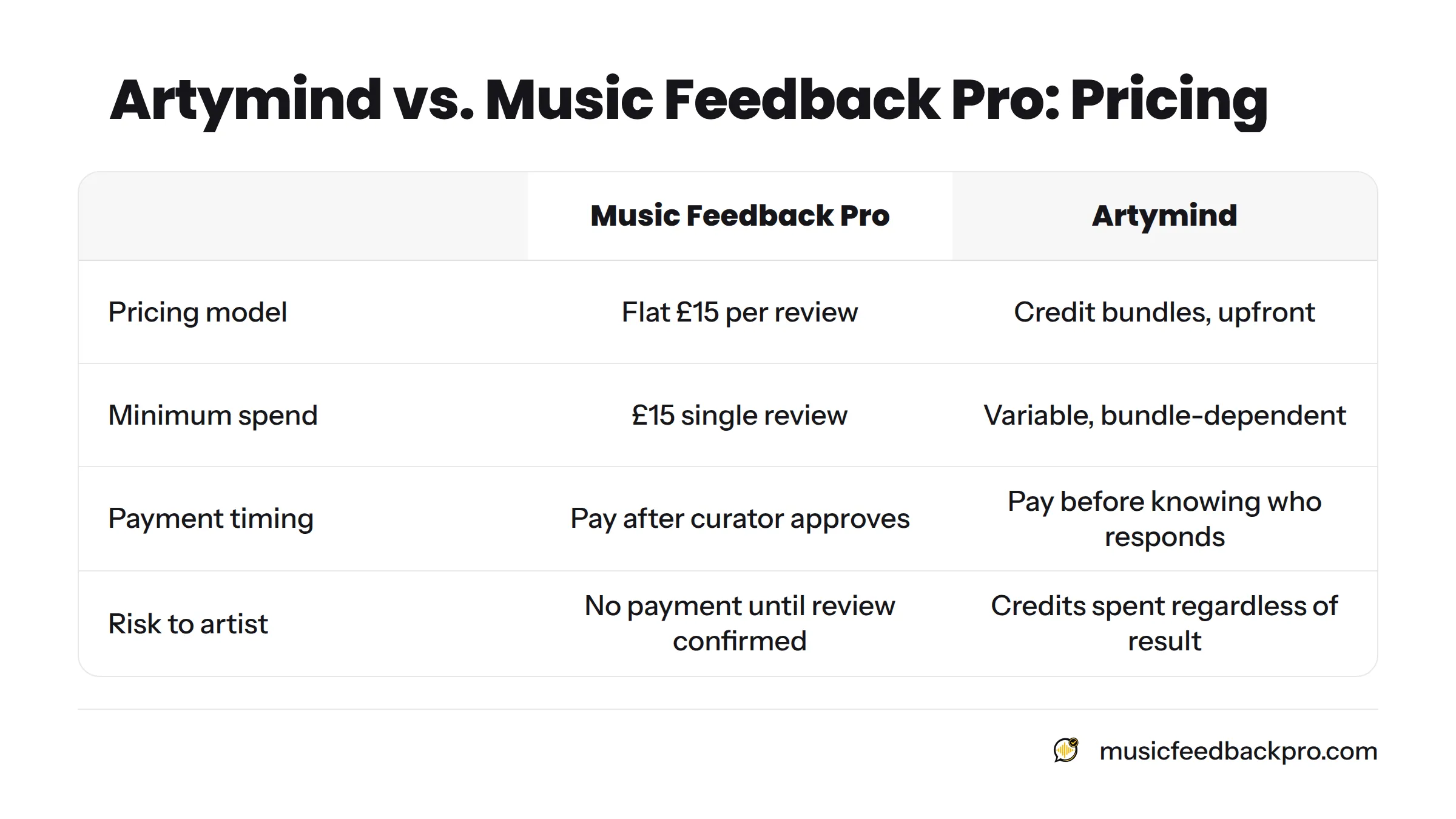
| Dimension | Artymind | Music Feedback Pro |
|---|---|---|
| Pricing model | Credit bundles, upfront payment | Flat £15 per review, pay after approval |
| Minimum spend | Variable - bundle-dependent | £15 (single track, single review) |
| Payment timing | Pay before knowing who responds | Pay only after a curator approves and reviews |
| Risk to artist | Credits spent whether or not responses are useful | No payment until a review is confirmed |
| Transparent pricing page | Check artymind.com | See Music Feedback Pro pricing |
The pay-after-approval model at Music Feedback Pro is structurally the better deal for artists managing a lean budget: you only spend money when a vetted curator delivers a completed review. For full fee details and how the escrow arrangement works, visit the pricing page.
Where Artymind Falls Short
Volume Over Substance
Artymind's fundamental design choice is breadth over depth. It reaches more outlets with lighter-touch coverage rather than fewer outlets with deeper engagement. For artists building streaming numbers, that breadth has genuine value. For artists building a media profile, it often does not produce the long-form written critique that a serious press kit requires.
Transparency Gaps
Several pieces of information artists need to make an informed decision are not publicly documented: curator vetting criteria, response rate benchmarks by genre, outlet quality rankings, and placement durability data. These are not reasons to dismiss the platform outright, but they are gaps that should shape your expectations before you commit a budget.
For a platform-by-platform comparison that includes transparency scoring, the Musosoup review provides a useful adjacent benchmark. The Groover Review 2026 is worth reading if you are also evaluating that option.
When Artymind Is the Wrong Tool
If your goal is a quotable, long-form review for an EPK, a grant application, or a media pitch, Artymind is not designed to deliver that. Its written output is inconsistent in depth and not held to a minimum editorial standard. Choosing it for that purpose will likely leave you with a collection of brief mentions that read like promotional copy rather than independent critical writing.
If your goal is playlist reach or broad name awareness across a network of blogs, Artymind is a more natural fit.
If your goal is a quotable long-form review - the kind of substantive written critique that tells a booker or journalist something specific about your music - Music Feedback Pro is built exactly for that. Every review is long-form, written by a vetted curator, and designed to be press-kit ready.
Genre Limitations
Artists in underrepresented genres may find the curator matching unsatisfying. If you make ambient, jazz-fusion, or world music and the platform routes you to generic "indie" curators, the feedback and coverage you receive will lack specificity and credibility. Genre fit matters as much as placement count.
Artymind Verdict: Is It Worth It for Musicians in 2026?
Artymind is worth it for independent artists who want broad pitching reach across a curator and blog network at a relatively low per-submission cost - and who define success as placement volume: playlist adds, brief blog mentions, and name exposure. It is less suitable for artists who need quotable, long-form written critique, transparent curator vetting, or EPK-ready press assets, because the platform's model does not consistently deliver at that standard.
Who Artymind Is Best Suited For
- Self-releasing artists at an early career stage building broad awareness
- Artists in mainstream genres (pop, electronic, hip-hop) where curator depth is stronger
- Musicians with a defined pitching budget who understand they are paying for outreach probability, not guaranteed written coverage
- Artists who already have EPK assets and want to add placement volume on top
Who Should Consider an Alternative
- Artists whose primary goal is long-form written critique for press kits or grant applications
- Musicians in niche genres who need specialist curator engagement
- Artists who need pricing clarity and certainty before committing spend
- Anyone who wants to pay only after a reviewer delivers a completed, vetted review
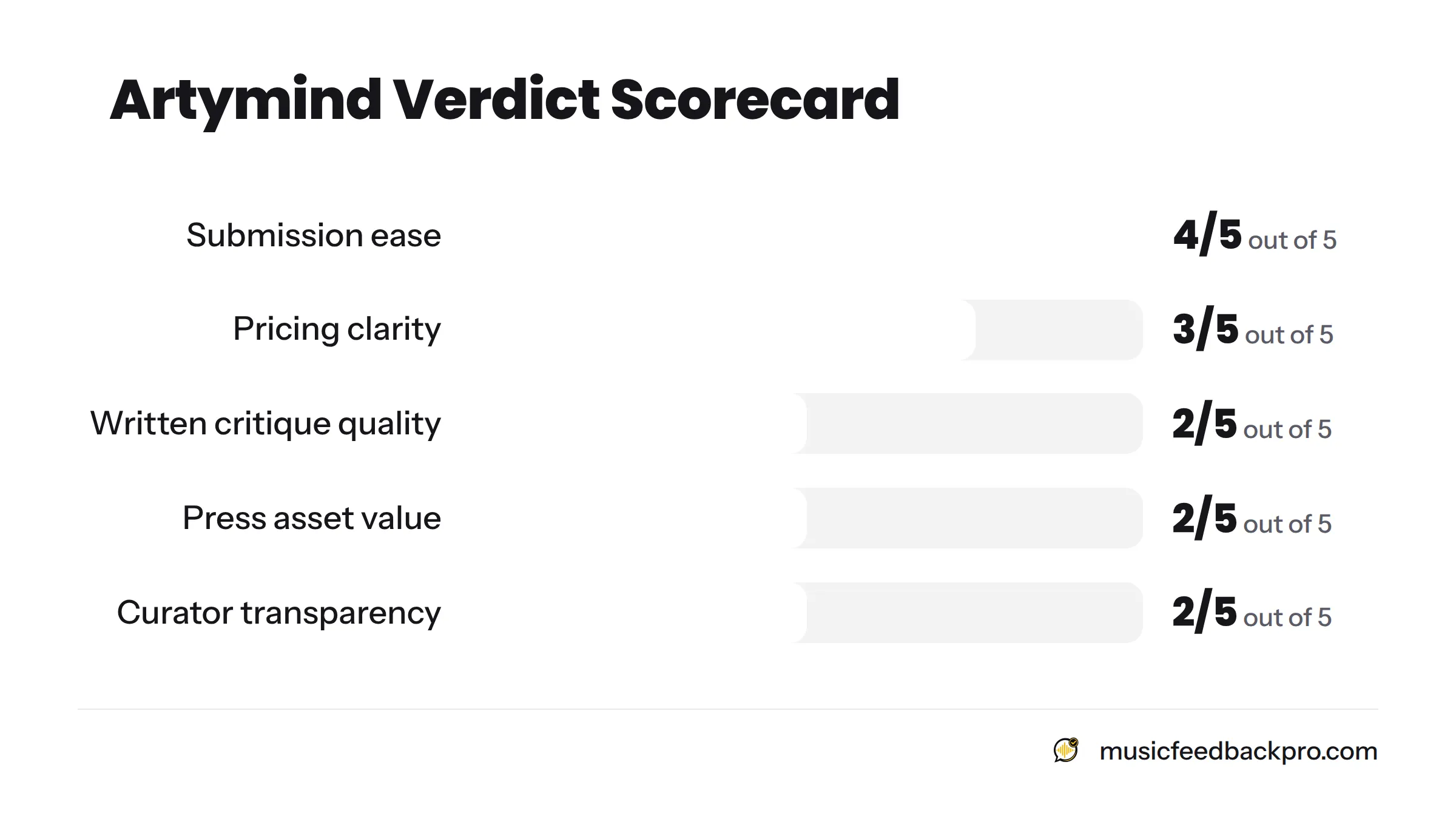
Artymind Verdict Scorecard
| Dimension | Score (out of 5) | Notes |
|---|---|---|
| Submission ease | 4/5 | Clean, low-friction process |
| Written critique quality | 2/5 | Output depth is inconsistent; no minimum standard enforced |
| Press asset value | 2/5 | Short mentions rarely produce EPK-usable quotes |
| Curator transparency | 2/5 | Vetting criteria and response rates not publicly disclosed |
| Pricing clarity | 3/5 | Credit model is clear; cost-per-output is harder to calculate |
| Overall | 2.6/5 | Solid for placement breadth; limited for press asset building |
Scoring methodology: each dimension was assessed against publicly available platform information (pricing, curator process, output format) and benchmarked against Music Feedback Pro's internal curator and editorial data. Scores reflect fit for an artist whose primary goal is press-asset output.
For artists who want to explore more options before deciding, the guide to best music feedback platforms in 2026 covers the full comparison. And if you are specifically researching Groover alternatives, the Groover alternatives list has seven options rated by category.
Ready to get a long-form, quotable review for your music? Submit your track free to Music Feedback Pro - you pay £15 only after a vetted curator approves and reviews your release. No upfront commitment, no guesswork.
Frequently Asked Questions
Is Artymind legit? Artymind is a real, operating music pitching service used by independent artists. It routes submitted tracks to curators, blogs, and media contacts in exchange for credits or campaign packages. Legitimacy is less the question than fit: judge it by whether its outputs - playlist adds, brief blog mentions, or written coverage - match what your specific career goals require right now.
How does Artymind work? Artists create an account, purchase credits or a campaign package, and submit their track with genre tags, a bio, and a streaming link. The platform routes the submission to relevant curators and bloggers in its network, who respond within their own timeline. Artists receive a notification when a curator acts - this may be a playlist add, a blog mention, or a short written piece. The full process typically resolves within two to four weeks, though check Artymind's current help pages for up-to-date process documentation, as workflows change.
Is Artymind good for press coverage? It depends on what you mean by press coverage. Artymind can generate blog placements and media mentions across its partner network, but the written content attached to those placements is variable in depth. If you need substantive, long-form written critique that you can quote in a press kit or grant application, Artymind's model is not consistently structured to deliver that. If broad name visibility across a network of blogs is the goal, it is a more credible option.
How does Artymind compare to Music Feedback Pro? Artymind focuses on pitching across a broad curator and blog network, with output ranging from playlist adds to brief written mentions. Music Feedback Pro centres on vetted, long-form written critique: every review is written to an editorial standard, by a curator who passed the platform's approval process, and artists pay £15 only after that review is delivered. The right choice depends on whether you need placement breadth or a quotable, EPK-ready press asset.
What genres does Artymind support? Artymind covers mainstream genres including pop, rock, hip-hop, and electronic with reasonable depth. Specialist genres have thinner curator coverage. Check the current genre categories on Artymind's website before submitting, as the supported list is subject to change.