
Disclosure: Music Feedback Pro is a direct alternative to Musosoup. We've published this scoring rubric and our full methodology so you can weight this review accordingly. Every dimension is cited or based on patterns our editorial team has observed across thousands of artist submissions.
Getting covered by music blogs and curators used to mean sending dozens of cold emails and hoping one landed. Musosoup flips that. Curators come to you - and for artists who've spent hours on outreach with nothing to show for it, that alone sounds like a relief.
But the real question isn't whether Musosoup is convenient. It's whether the coverage it generates gives you anything you can actually use: a quote in a pitch email, a line in your bio, a credible link in your Electronic Press Kit. This review answers that directly, using our Usable Press Asset rubric and sourced pricing data from musosoup.com (accessed October 2026).
How Musosoup Actually Works
Musosoup inverts the traditional PR model. You upload a track, it enters a curator-browsable pool, and curators who like what they hear send you coverage offers. You review each offer, accept the ones that fit, and decline the rest. No mass emails, no follow-up sequences.
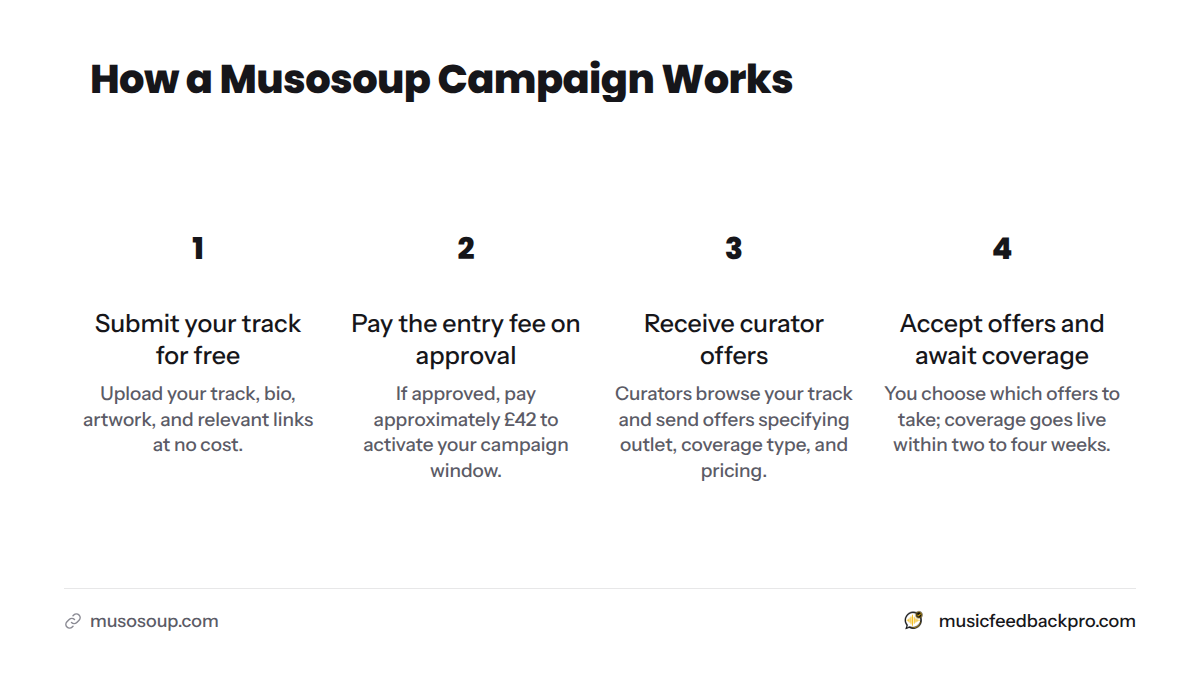
Here is the full campaign flow, step by step:
- Submit your track for free. Upload your track, bio, artwork, and relevant links. No charge at this stage.
- Wait for approval, then pay the entry fee. If Musosoup approves your submission, you pay approximately £42 to activate your campaign window (per musosoup.com, accessed October 2026). This is a flat platform fee, not a per-placement charge.
- Receive curator offers. During your campaign window, curators browse your track and send offers specifying the outlet, coverage type, and whether the placement is free or paid.
- Accept offers and wait for delivery. You choose which offers to take. Coverage goes live on the curator's schedule, and you get notified when pieces are published.
A typical window runs two to four weeks from activation to the first published pieces, though individual blog schedules vary.
Musosoup's curator network spans music bloggers, playlist editors, radio presenters, podcast hosts, YouTube channel owners, and social media accounts. The breadth is genuine - and, as I'll get into below, it's also where the platform's consistency problems begin.
Quick summary: Submit free → pay ~£42 on approval → curators send offers → you accept the ones that fit → coverage goes live within weeks.
What Coverage Musosoup Actually Delivers
Not all coverage is equal, and knowing what each type produces as a press asset is the most useful thing I can tell you before you spend anything.
Coverage types and how usable they are
| Coverage Type | What It Typically Delivers | Press Asset Usability |
|---|---|---|
| Blog review / article | 200-800 word write-up, sometimes with an artist quote | Medium-High (if long enough to quote) |
| Interview feature | Q&A on a music blog or podcast transcript | High (quotable, attributable) |
| Social media post | Instagram/Facebook post with track link | Low (rarely survives as a citable asset) |
| Playlist placement | Track added to a curated playlist | Low (no text to quote) |
| Radio airplay | Track played on internet or community radio | Low-Medium (mention, not quotable) |
| YouTube feature | Embedded or reviewed on a channel | Medium (survives as a linkable asset) |
Musosoup positions itself around editorial and blog coverage rather than playlist promotion - and that distinction matters. Playlist plays generate stream counts. Editorial reviews generate text you can quote. The platform's framing leans into the blog and press angle, which is why artists building press kits are the most natural fit.
Checking curator quality before accepting any offer
Curator quality on Musosoup is uneven. Before you accept an offer, run through these checks:
- Domain Authority (DA): Does the blog rank on Google? A DA above 30 suggests real audience reach. Moz's free checker gives you a rough read.
- Publication frequency: Is the blog actively publishing in 2026? A site with no posts since 2024 is not delivering a real audience.
- Review depth: Read three existing reviews. Are they 400+ words with specific observations, or generic two-sentence blurbs?
- Social presence: Is the outlet's following real and engaged, or inflated with dormant accounts?
- Audience geography: Does the blog's readership overlap with your target listeners?
A weak offer from a low-DA blog costs you nothing to decline. Declining is always the right move when the outlet doesn't meet your standard.
Submission Process: What Happens at Each Stage
Let's break it down precisely, because the detail matters when you're planning a release around it.
Free submission: Go to musosoup.com, create an artist account, and upload your track with bio, press photo, social links, and release notes. Musosoup reviews submissions before activating any campaign, so approval is not automatic.
Campaign activation: Once approved, you pay the £42 entry fee to open your campaign window. This is the minimum you'll spend regardless of how many offers arrive.
Offer review: During the window, curators send offers. Each one shows the outlet name, coverage type, and whether it's free or paid. Musosoup's model includes both - read each offer carefully before accepting.
Delivery and payment: Musosoup holds payments in escrow rather than releasing funds to curators upfront. If a curator accepts your offer and doesn't deliver, the payment doesn't release to them. That said, Musosoup does not guarantee that any coverage will be published - more on that below.
Expect two to six weeks from campaign activation to seeing the first pieces go live, depending on individual curator workflows.
Checklist: What to include in your Musosoup submission
- High-quality audio file (WAV or high-bitrate MP3)
- Professional press photo (minimum 1500px wide)
- Bio of 100-200 words written in third person
- Three to five genre descriptors or influences curators can reference
- Streaming links (Spotify, Apple Music, Bandcamp, or your primary DSP)
- Social links and current follower counts
- A brief release story or angle (why this track, why now)
- Any existing press quotes, even small ones, to signal credibility
Are Musosoup Blog Features and Reviews Actually Usable?
This is the question the rest of the Musosoup review space tends to skip. I've assessed enough artist submissions at Music Feedback Pro to know that what you get and what you can use are frequently different things.
What "usable" means in practice
A usable press asset passes three tests. It's quotable - it contains a specific, articulate sentence about your music you can excerpt without losing meaning. It's attributable - it comes from a named outlet with a real URL that a booking agent or label can verify. And it carries credibility - the outlet has enough authority and audience that the attribution adds to your profile rather than raising questions.
A 60-word blog post that says "great song, check it out" fails all three tests. A 600-word review with specific observations about your production and songwriting, published on a DA-35 blog with 8,000 monthly readers, passes all three.
What Musosoup's network actually looks like
Musosoup's curator network contains outlets across a wide quality range. Some participating blogs are well-established music publications with genuine readerships. Others are micro-blogs that exist primarily to participate in promotion platforms. The platform doesn't publish a vetted directory with DA figures or traffic data, so quality screening falls entirely on the artist at the point of offer review.
For a grounded look at what makes coverage genuinely useful, our guide on earning music press coverage explains why source credibility matters as much as the text itself.
Features vs. mentions - and why the difference matters
A feature is a dedicated piece about your music: its own URL, its own headline, its own argument. A mention is your track referenced inside a roundup or playlist post. Features are press assets. Mentions rarely are. When reviewing offers on Musosoup, check whether the curator is proposing a dedicated piece or simply slotting you into an existing post.
Music Feedback Pro's Usable Press Asset rubric: Our editorial team evaluates coverage on five criteria - quote specificity, source DA, publication reach, attribution permanence (does the URL stay live?), and review length. A passing press asset scores at least 3 of 5. You can see what a professional music review does for your career and make a direct comparison.
Musosoup Pricing: What You'll Actually Pay
Musosoup's pricing model differs from platforms like SubmitHub or Groover, where you pay per curator submission. Here you pay once to open a campaign window, then negotiate offers individually.
Entry fee and free offer requirement
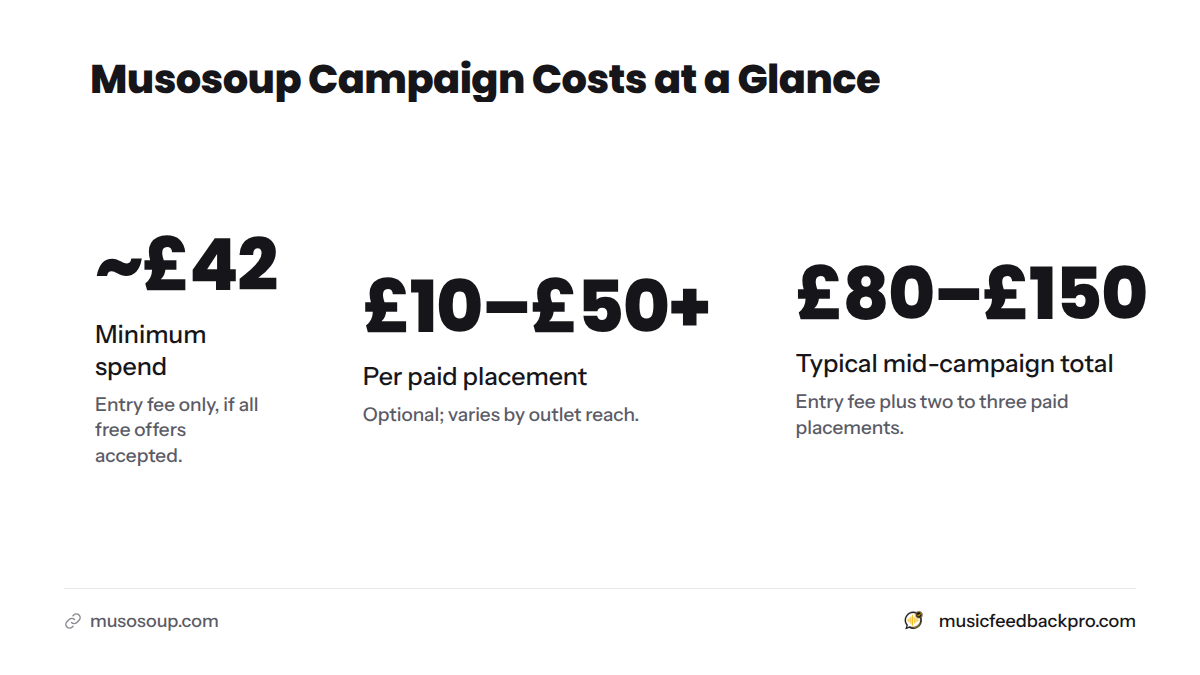
The campaign activation fee is approximately £42 as of October 2026, per Musosoup's published terms. Musosoup also requires curators to provide a minimum number of free coverage offers alongside any paid offers, so you receive some return even if you decline every paid option.
What total campaign cost looks like
The £42 entry fee is your floor. Paid curator offers - priced at roughly £10-£50 per placement depending on outlet reach - stack on top. A campaign where you accept two paid placements could total £80-£140. For context, community benchmarks on Reddit's r/Songwriters put traditional PR firm retainers at £500-£1,500. Musosoup is meaningfully cheaper, though the scale and prestige of coverage are also different.
| Cost Element | Amount (October 2026) | When You Pay |
|---|---|---|
| Campaign entry fee | ~£42 | On campaign activation (after free submission approved) |
| Free curator offers | £0 | Included in entry fee |
| Paid curator offers | £10-£50+ per placement | Optional; accepted individually |
| Total minimum spend | ~£42 | If only free offers accepted |
| Realistic mid-campaign spend | £80-£150 | Entry fee + two to three paid placements |
Musosoup's public-facing pricing is clear about the entry fee but less specific about curator pricing, which varies by individual offer. Treat £42 as a minimum and budget realistically if you want to reach higher-DA outlets.
Where Musosoup Falls Short
Musosoup has real limitations, and they matter more for some artists than others.
Curator quality is uneven
The open-marketplace model means any outlet that registers as a curator can send offers. Musosoup vets curators to some degree, but the network still contains blogs with minimal readership, inactive social accounts, and reviews too short to quote. Quality control lands on the artist during offer review.
Watch specifically for:
- Blogs with fewer than five published reviews total
- Outlets with no identifiable author name or editorial identity
- Offers that don't specify coverage type, length, or publication date
- Social-only offers from accounts with under 1,000 engaged followers
- Blogs whose existing content is clearly templated or AI-generated
Coverage is not guaranteed
If curators browse your track and no one sends an offer, you've spent £42 for a campaign window with no output. This is the sharpest real-world risk the platform carries. Artist accounts in this Reddit thread reflect exactly that frustration.
Published reviews don't always produce searchable assets
Even when coverage goes live, a review on a low-DA blog that Google doesn't index effectively generates no searchable trail. Booking agents and labels who search an artist's name won't find it. The press asset exists technically - it just doesn't work practically.
What offer rates actually look like
Musosoup doesn't publish data on average offers per campaign. Community reports suggest well-produced tracks in popular genres attract five to fifteen offers; niche genres or lo-fi recordings may attract one to three, or none. Set expectations before you spend.
One check before accepting any curator offer: Search the outlet's name on Google right now. Does it appear on the first page with real content? If not, the offer almost certainly won't produce a press asset you can use.
Musosoup vs. Music Feedback Pro and Other Press Platforms
The most practical comparison for most artists reading this is Musosoup against Music Feedback Pro - both serve independent artists seeking editorial coverage, but they approach it differently.
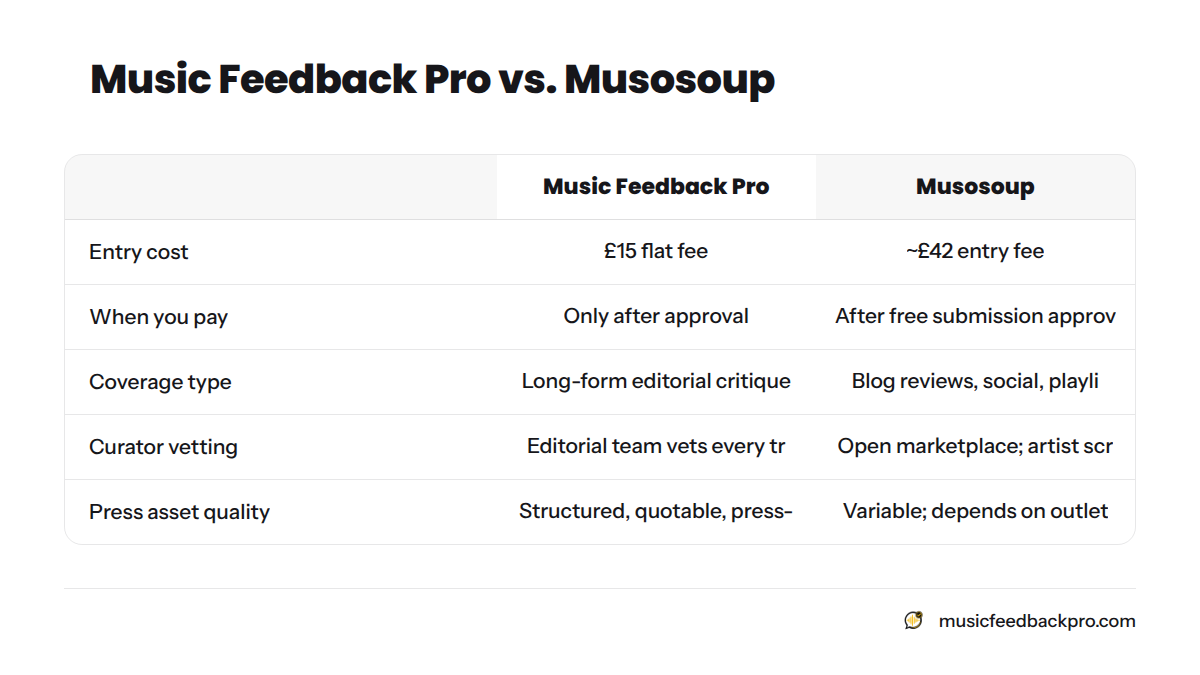
| Dimension | Musosoup | Music Feedback Pro |
|---|---|---|
| Pricing model | ~£42 entry fee + optional paid curator offers | £15 flat fee, charged only after submission is approved |
| Submission cost | Free to submit; fee activates campaign | Free to submit; £15 paid only on approval |
| Coverage type | Blog reviews, social posts, playlists, radio | Long-form written editorial critique |
| Curator vetting | Open marketplace; artist screens offers | Editorial team reviews every track before matching |
| Press asset quality | Variable; depends on curator and outlet | Structured, quotable critique designed for press kits |
| Payment protection | Escrow-style hold; release tied to delivery | No payment until submission approved |
| Coverage guarantee | Not guaranteed | Not guaranteed; approval ensures match quality |
| Best for | Volume of outreach across mixed outlet types | Artists who need one strong, quotable editorial review |
Music Feedback Pro's flat £15 campaign fee and approval-first model remove the financial risk of paying before you know the outcome. Reviews are written to be quotable, attributed, and press-kit-ready from the first sentence.
For a full side-by-side breakdown, read our dedicated Musosoup vs Music Feedback Pro comparison.
When Musosoup is the right choice
Musosoup suits you if you want broad outreach across multiple outlet types in a single campaign, you have the time to screen curator offers carefully, your music fits popular or crossover genres that attract higher curator interest, and you're comfortable with variable output quality in exchange for volume.
When a vetted editorial platform is a better fit
Music Feedback Pro is the stronger choice when you need one or two substantial, quotable reviews to anchor your press kit, when you want a clear and consistent standard for what a "review" means, or when your budget is tight and you need certainty that your money produces a deliverable. Our guide on comparing music feedback platforms covers the broader category.
If you're weighing Musosoup against credit-per-submission platforms, our Groover review for indie artists gives a direct assessment of that model. The best music blog submission sites in 2026 covers the wider range of options.
Three questions to find the right platform for your release
- Do you need one strong, quotable review for a press kit - or broad outreach across many outlets? (One strong review → Music Feedback Pro. Broad outreach → Musosoup.)
- Is your budget fixed? (Fixed budget with zero-risk entry → Music Feedback Pro's pay-on-approval model. Flexible budget → Musosoup's campaign model.)
- Are you releasing in a mainstream or crossover genre? (Yes → Musosoup attracts more curator interest. Niche/experimental → Music Feedback Pro's editorial team reviews all genres equally.)
Here's how Musosoup describes its own approach directly:
Verdict: Is Musosoup Worth It for Independent Artists in 2026?
My honest take after applying the Usable Press Asset rubric: Musosoup is a legitimate platform that delivers real value for the right artist profile. It is not the right tool for every artist or every release goal.
What Musosoup does well:
- Removes the burden of cold outreach entirely
- Offers genuine access to a range of editorial outlets, bloggers, and playlist curators
- The entry fee sits well below traditional PR agency rates
- Escrow-style payment mechanics provide basic delivery protection
- Potential offer volume per campaign exceeds most individual DIY outreach efforts
What Musosoup does less well:
- Curator quality varies too widely to trust every offer without screening
- Coverage is not guaranteed - a real financial risk at £42+
- Many coverage outputs are too short or too low-credibility to function as press assets
- No assurance that participating outlets have real, engaged audiences
- Total cost rises quickly when paid curator offers stack up
Overall rating
| Dimension | Score (out of 10) | Weight |
|---|---|---|
| Submission process ease | 8 | 20% |
| Curator network quality | 5 | 25% |
| Press asset usability | 5 | 25% |
| Pricing transparency | 6 | 15% |
| Payment protection | 6 | 15% |
| Weighted average | 5.75 / 10 |
Musosoup earns a 5.75 out of 10. It is not a scam, it is not a top-tier press machine, and it is not a replacement for a strong long-form editorial review. It is a volume-outreach tool that rewards artists who screen offers carefully and understand exactly what they're buying.
For a wider look at what actually moves the needle in music PR without label backing, the article on music PR without a label is worth reading alongside this one.
Want press coverage that produces a quotable, press-kit-ready review? Submit your track free to Music Feedback Pro - you pay the flat £15 campaign fee only after your submission is approved. No campaign window. No offer screening. Just a structured editorial review written to be used.
Frequently Asked Questions
Is Musosoup legit?
Yes. Musosoup is a legitimate platform that has been operating since 2020, processes real artist campaigns, and connects artists with genuine music bloggers and curators. It holds payments in escrow and only releases funds to curators on delivery. The real risk is not fraud - it's that coverage quality and output volume vary significantly across campaigns, and nothing is guaranteed.
How much does Musosoup cost?
As of October 2026, Musosoup charges approximately £42 to activate a campaign after your free submission is approved. That is the minimum cost. Accept paid curator offers on top of the entry fee and total spend rises to £80-£150 or more. Submitting a track for initial review is free.
Does Musosoup guarantee coverage?
No. If curators browse your track and no offers are made, or if you decline every offer received, you will have paid the entry fee with no press output. This is the platform's most significant risk for artists with small budgets.
What is the difference between Musosoup and Music Feedback Pro?
Musosoup runs an open-marketplace campaign model where multiple curator types send offers across a two-to-four-week window. Music Feedback Pro provides a single, structured, long-form editorial review written by a vetted reviewer, charged at a flat £15 only after your submission is approved. Musosoup offers broader reach across outlet types; Music Feedback Pro offers a higher-certainty, press-kit-ready editorial asset. The full comparison is on our Musosoup vs Music Feedback Pro page.
Can I use Musosoup coverage in a press kit?
Sometimes. Coverage from a well-established music blog with a detailed, attributed review is press kit material. A generic social post, a one-paragraph mention, or a review from a low-DA blog with no real readership is not. Before accepting any offer, evaluate the outlet's existing content, DA, and review depth to determine whether the resulting asset will be usable.