
Editorial disclosure: This list was compiled by a Music Feedback Pro editorial reviewer. Music Feedback Pro ranks first and competes with every platform listed. Claims about PlaylistPush are cited from its public pages, accessed October 2026. We have noted our conflict of interest so you can weigh this accordingly.
If you want written reviews and press coverage rather than playlist placements, the right PlaylistPush alternative is a vetted critique platform. This page ranks 7 real options - from editorial feedback services to hybrid blog-and-playlist networks - so you can match the tool to what you actually need. Top picks include Music Feedback Pro, Musosoup, and Groover.
What PlaylistPush Does - and Why Some Artists Look Elsewhere
The PlaylistPush model in brief
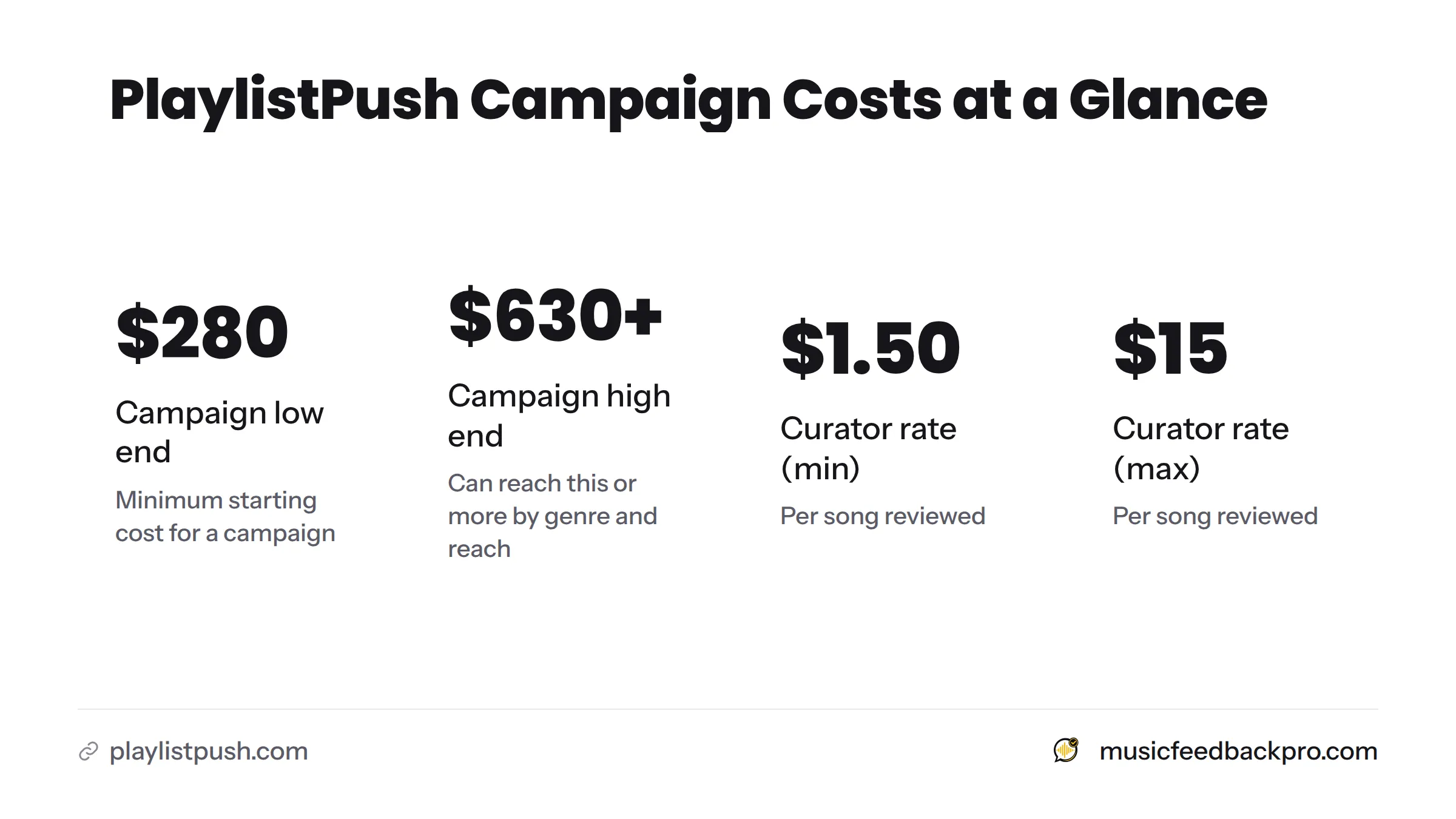
PlaylistPush pitches your track to a network of verified Spotify playlist curators. Campaigns start at roughly $280 on the lower end and can reach $630 or more depending on genre and target reach. The service matches your track to curators through what PlaylistPush calls its "Playlist DNA" algorithm - a genre-matching layer designed to reduce irrelevant submissions. Curators are paid per listen, with rates typically ranging from $1.50 to $15 per song reviewed. There is no guaranteed placement. You pay for consideration, not for a result. If curators pass, you get feedback but no add.
Why some artists want something different
That model works for one specific goal: getting onto active Spotify playlists to generate streams. For artists with a different priority, the mismatch becomes clear fast. Stream spikes from playlist adds tend to be temporary. A track can land on a mid-tier playlist, pick up a few hundred streams over two weeks, and then drop off entirely - leaving you with nothing tangible to show for the spend.
What a playlist add cannot produce is a reusable press quote, a published blog review you can link from your artist website, or a credible written opinion you can drop into an electronic press kit (EPK). For those outcomes, you need a different category of service entirely. I've seen artists spend $400 on a PlaylistPush campaign and then struggle to answer a promoter's question: "Where has your music been reviewed?" A playlist add doesn't answer that. A written review does.
Read more about how these two outcomes compare in our breakdown of press coverage versus playlist plays.
If your goal is a reusable press quote or blog feature - not just a temporary stream spike - this list is for you.
How We Ranked These PlaylistPush Alternatives
Ranking criteria
Every platform on this list was evaluated against five observable attributes - not subjective opinion:
- Output type - Does the platform produce a written review, a playlist add, or a hybrid of both?
- Curator and reviewer vetting - How does the platform screen the people giving feedback or making placements?
- Cost transparency - Is pricing visible before you commit? Is there a low entry point?
- Artist control - Can you choose which offers to accept, or is the outcome automatic?
- Press kit suitability - Does the output give you something you can reuse in an EPK, bio, or grant application?
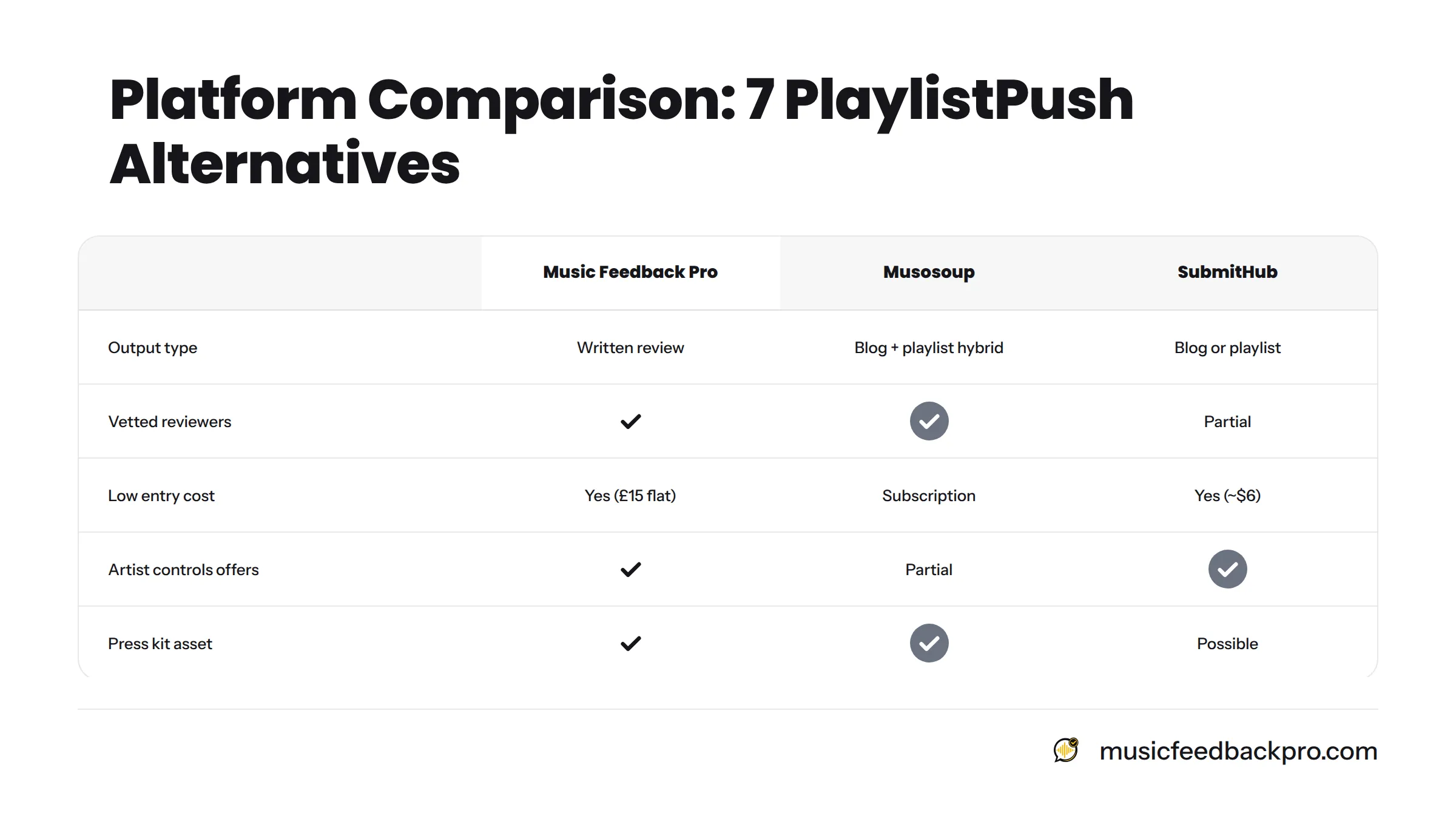
Here is how those criteria map across all seven platforms:
| Platform | Output Type | Vetted Reviewers | Low Entry Cost | Artist Controls Offers | Press Kit Asset |
|---|---|---|---|---|---|
| Music Feedback Pro | Written review | Yes | Yes (£15 flat) | Yes | Yes |
| Musosoup | Blog + playlist hybrid | Yes | Subscription | Partial | Yes |
| Artymind | AI feedback report | Automated | Yes | No | No |
| SubmitHub | Blog or playlist (you choose) | Partial | Yes (~$6) | Yes | Possible |
| Groover | Blog + radio + playlist | Yes | Coin-based | Partial | Yes |
| ReverbNation | Varied opportunities | Partial | Subscription | Partial | Possible |
| One Submit | Blog + playlist hybrid | Partial | Yes | Partial | Possible |
1. Music Feedback Pro - Written Reviews Without the Playlist Pressure
Music Feedback Pro was built on a deliberate rejection of the playlist model. Every campaign produces written editorial feedback - not a stream count. Reviewers from the platform's network pitch artists directly with written critique, blog features, and editorial commentary. Artists read each pitch and decide which offers to accept. Nothing is automatic.
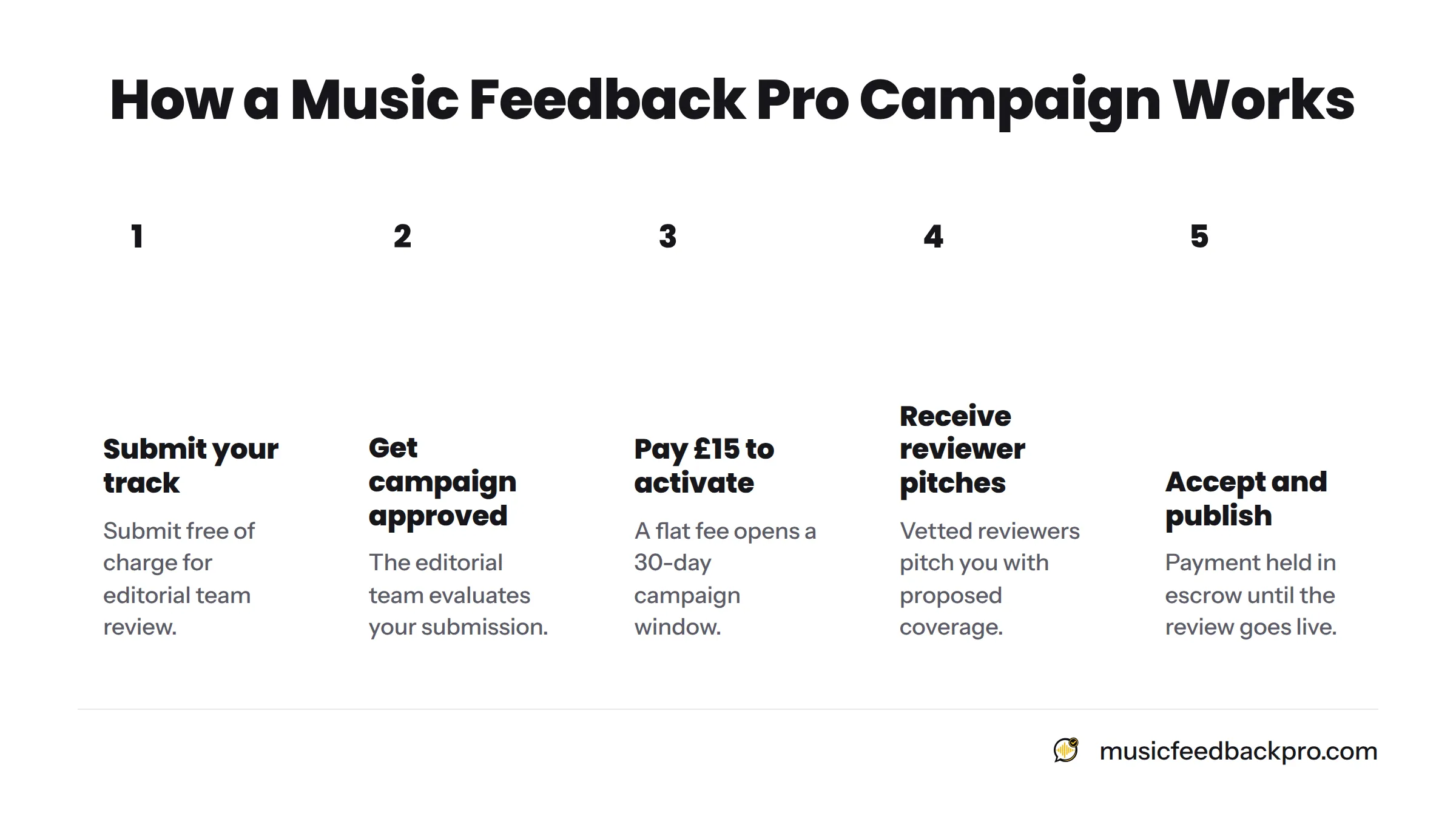
Here is how a campaign works in practice: you submit your track free of charge. If the editorial team approves your campaign, you pay a flat £15 to activate a 30-day window. During that window, vetted reviewers from the Music Feedback Pro network pitch you directly with their proposed coverage. You accept the offers that fit your goals. Payment to the reviewer is held in escrow until the review is published, protecting both sides.
Pros:
- Written reviews you can paste into a press kit immediately
- No playlist pressure - every outcome is editorial
- Vetted reviewers, not anonymous curators
- Artist controls which offers to accept
- Risk-free entry point - you pay £15 only after approval, never upfront on a gamble
- Flat, transparent fee with no hidden campaign minimums
Limits:
- Not the right tool if your sole goal is raw Spotify stream volume
- The network operates at editorial scale, not mass-reach playlist scale
Artists who received written reviews through the Music Feedback Pro network consistently cited those reviews in their EPKs six months after the campaign. Few ever returned to reference a playlist placement - because a playlist placement leaves no quotable trace.
Learn more about how Music Feedback Pro campaigns run and the kind of music press coverage you can reuse from a successful campaign.
Best for: Indie artists who need a credible written review, a blog feature, or a press quote for their kit - especially ahead of a grant application, a tour pitch, or a label conversation.
Submit your track free. Pay £15 only if we approve your campaign. Submit Free →
2. Musosoup - Curator Network With Editorial Outcomes
Musosoup operates as a subscription-based platform connecting artists to music journalists, bloggers, playlist curators, and social media creators. Unlike PlaylistPush's single-output model, Musosoup offers a hybrid: a given campaign can produce a blog feature, a playlist add, a social post, or a combination, depending on which curators respond.
Pricing runs on a subscription basis - check Musosoup's current plans for the latest rates, as subscription tiers have evolved. The platform vets participating curators and journalists, which gives it a credibility edge over open-submission marketplaces.
Pros:
- Genuine mix of editorial and playlist outcomes - useful for building a varied press kit
- Vetting process filters out low-quality curators
- Good for artists who want both streaming presence and written coverage in one campaign
Limits:
- Subscription costs accumulate, especially across multiple campaigns
- Not purely press-focused - blog features are one possible outcome, not the default
- Curator quality can still vary across niches and genres
Best for: Artists who want to cover multiple bases - some streaming exposure and some written coverage - without running two separate campaigns.
See our full Musosoup Review 2026 for a detailed verdict.
3. Artymind - AI-Assisted Feedback Focused on the Track Itself
Artymind takes a fundamentally different approach. Rather than connecting you with human curators or reviewers, it uses automated analysis to give you qualitative feedback on your track's production, arrangement, and songwriting structure. The output is a feedback report, not a published review.
Pros:
- Fast turnaround - often within hours rather than days
- Genuinely useful for pre-release refinement before you spend money on any promotion
- Lower cost than campaign-based platforms
Limits:
- The output is not a press asset. There is no human byline, no publication, and nothing quotable for a press kit
- AI-generated feedback, however useful for craft development, carries no editorial authority
- It cannot produce a blog feature, a Spotify playlist add, or any form of public-facing coverage
Best for: Artists at the production stage who want structured critique before committing to a release - not for those seeking press coverage or curator placements.
Read our Artymind Review for a full breakdown of what the platform actually delivers.
4. SubmitHub - Blog and Zine Submissions at Scale
SubmitHub is a submission marketplace where artists pitch directly to a large database of music blogs, zines, playlist curators, and radio stations. You browse curator profiles, select the ones that match your genre and goals, and send submissions using a credits system. Single-curator submissions start from roughly $6, making it one of the lowest-cost entry points on this list.
The key distinction from PlaylistPush vs SubmitHub comes down to targeting: SubmitHub lets you deliberately select blog curators rather than playlist curators. If you filter for blogs and zines at the point of selection, you can build a campaign that produces written reviews rather than playlist adds. That filtering is on you - the platform doesn't steer you toward press by default.
Pros:
- Large network spanning blogs, zines, playlists, and radio
- Blog-targeting is genuinely possible with deliberate curator selection
- Transparent curator profiles with response rates and feedback samples
- Low entry cost for single-curator testing
Limits:
- Manually selecting curators is time-intensive, especially if you are unfamiliar with the network
- Blog-focused curators are a subset of the total network - not the default experience
- Review quality is not vetted by SubmitHub; the platform surfaces curator profiles, not editorial standards
- Response is not guaranteed even when using paid credits
Best for: Artists willing to invest time in curator research who want flexible, low-cost access to both blog and playlist coverage.
For a full breakdown of how SubmitHub compares to other options, see our guide to SubmitHub alternatives. When you are ready to compare feedback platforms more broadly, our guide to choosing a music feedback platform covers the decision in depth.
5. Groover - European Press and Radio Network
Groover is a Paris-based submission platform connecting artists to music blogs, radio stations, press contacts, and playlist curators across Europe and beyond. It uses a coin-based pricing system - check Groover's current coin rates for exact costs, as these are updated periodically. One of Groover's most practical guarantees: every submission receives a response within seven days, whether that is a pass or an offer. That kind of accountability is rare in this space.
Groover's genuine differentiator is its European press and radio reach. If you are targeting French music blogs, German radio stations, or broader continental European coverage, Groover's network outperforms most English-language alternatives.
Pros:
- Guaranteed response within 7 days - no silence, no wasted submissions
- Strong European press and radio presence that no other platform on this list matches
- Hybrid outcomes: blog coverage, radio airplay, and playlist adds are all possible
- Professionally managed curator relationships
Limits:
- Less suited for US or UK artists whose target market is specifically North American press
- Playlist adds are available alongside press outcomes - not a press-only platform
- Coin costs can add up across a broad submission campaign
Best for: Artists targeting European markets, or any artist who wants a guaranteed response rather than radio silence after submitting.
Our full Groover alternatives guide covers related platforms for artists who want similar outcomes beyond Groover's network.
6. ReverbNation Opportunities - Broad Exposure Including Press
ReverbNation is one of the longest-standing artist-development platforms in the independent music space. Its "Opportunities" feature surfaces a variety of submission calls: sync licensing, label A&R, music blog features, press placements, and live performance opportunities. Unlike the other platforms on this list, ReverbNation is not built specifically around playlist pitching or press coverage - it covers a wide spectrum of opportunity types at once.
Pros:
- Long track record and established reputation in the indie artist community
- Wide variety of opportunity types, including sync and label contacts that other platforms don't cover
- Press opportunities do appear within the Opportunities feed
Limits:
- Opportunities are not curated for press specifically - a press-seeking artist has to filter manually
- Quality and relevance of individual opportunities vary considerably
- The broad scope can feel unfocused for artists with a clear, single campaign goal
- Less suited to building a consistent stream of editorial coverage compared to press-first platforms
Best for: Artists who want to explore multiple opportunity types at once - sync, press, A&R - rather than running a focused press campaign.
7. One Submit - Genre-Matched Blog and Playlist Hybrid
One Submit matches artist submissions to Spotify playlists and music blogs by genre, using a matching layer to reduce irrelevant placements. You submit once and the platform distributes your track to relevant curators across both categories. Blog coverage is included in the platform's scope, which gives it a hybrid character similar to Musosoup and Groover.
Pros:
- Genre matching reduces irrelevant submissions and curator passes
- Music blogs are included alongside playlist curators in a single submission
- Straightforward interface with a low learning curve
Limits:
- Playlist placement is the primary model - blog features are secondary, not the core product
- The platform does not specialise in press-kit-grade editorial output
- Less vetting transparency than Music Feedback Pro or Groover on the reviewer side
Best for: Artists who want a single submission to reach both playlists and blogs, with genre matching doing the heavy lifting, and who are comfortable with playlist adds as the primary likely outcome.
Which PlaylistPush Alternative Is Right for You?
The single most useful question to ask before spending money on any of these sites like PlaylistPush: do you need a press asset, or do you need streams?
A playlist add generates streams for as long as your track stays on the list. A written review generates a press asset you can use for the rest of your career - in grant applications, EPKs, booking pitches, and label conversations. These are different products serving different goals. Choosing the wrong one wastes money regardless of how well the platform executes.
Use this table to match your goal to the right platform:
| Your goal | Best pick |
|---|---|
| Written review for your press kit | Music Feedback Pro |
| Hybrid: blog features + some playlist adds | Musosoup or Groover |
| AI track feedback before release | Artymind |
| Large-scale blog and playlist submissions | SubmitHub |
| European press and radio coverage | Groover |
| Broad opportunities including sync and label | ReverbNation |
| Genre-matched blog and playlist hybrid | One Submit |
The press-versus-playlist distinction is the lens that most comparison pages on this topic ignore. Spend ten minutes thinking about which column your goal sits in, and the right platform choice becomes much clearer. Our deeper analysis of press coverage versus playlist plays walks through the trade-offs for different career stages, and our guide to choosing a music feedback platform covers the mechanics of each model in detail.
Submit Your Track to Music Feedback Pro - Free to Apply
Music Feedback Pro was built for artists who want a review they can actually use - not a stream count that fades in two weeks. Submit your campaign free. If we approve it, you pay £15 to activate a 30-day window where vetted reviewers pitch you directly. You choose which offers to accept.
Frequently Asked Questions
What is a good alternative to PlaylistPush?
If you want written reviews and press coverage rather than playlist pitching, look at Music Feedback Pro - you submit free and pay £15 only if approved. For hybrid blog-and-playlist outcomes, Musosoup and Groover are strong options. For pure playlist scale, SubmitHub offers the lowest entry cost among PlaylistPush competitors.
Does PlaylistPush work for indie artists?
Results vary by genre, budget, and which curators respond to a given campaign. PlaylistPush's public campaign pages confirm there is no guaranteed placement - you pay for curator consideration. For artists whose priority is a reusable press quote rather than stream volume, the model may not match their actual goal regardless of execution quality.
Can I get press coverage instead of playlist adds?
Yes. Platforms focused on editorial reviews and blog features - Music Feedback Pro in particular - produce written coverage you can quote in a press kit, link from your artist site, and reference in booking or grant conversations. Playlist adds do not produce this kind of asset.
How is Music Feedback Pro different from PlaylistPush?
Music Feedback Pro produces written reviews and blog features, not playlist adds. You submit free and pay £15 only after your campaign is approved. PlaylistPush campaigns start at roughly $280 and pitch your track to Spotify playlist curators with no guarantee of placement and no written output. The two platforms serve fundamentally different artist goals.
Which PlaylistPush alternative is cheapest?
SubmitHub allows single-curator submissions from roughly $6. Music Feedback Pro charges £15 as a flat activation fee, paid only after approval - making it one of the lowest-commitment playlist promotion alternatives for press-focused artists. PlaylistPush's minimum campaign spend is roughly $280.